
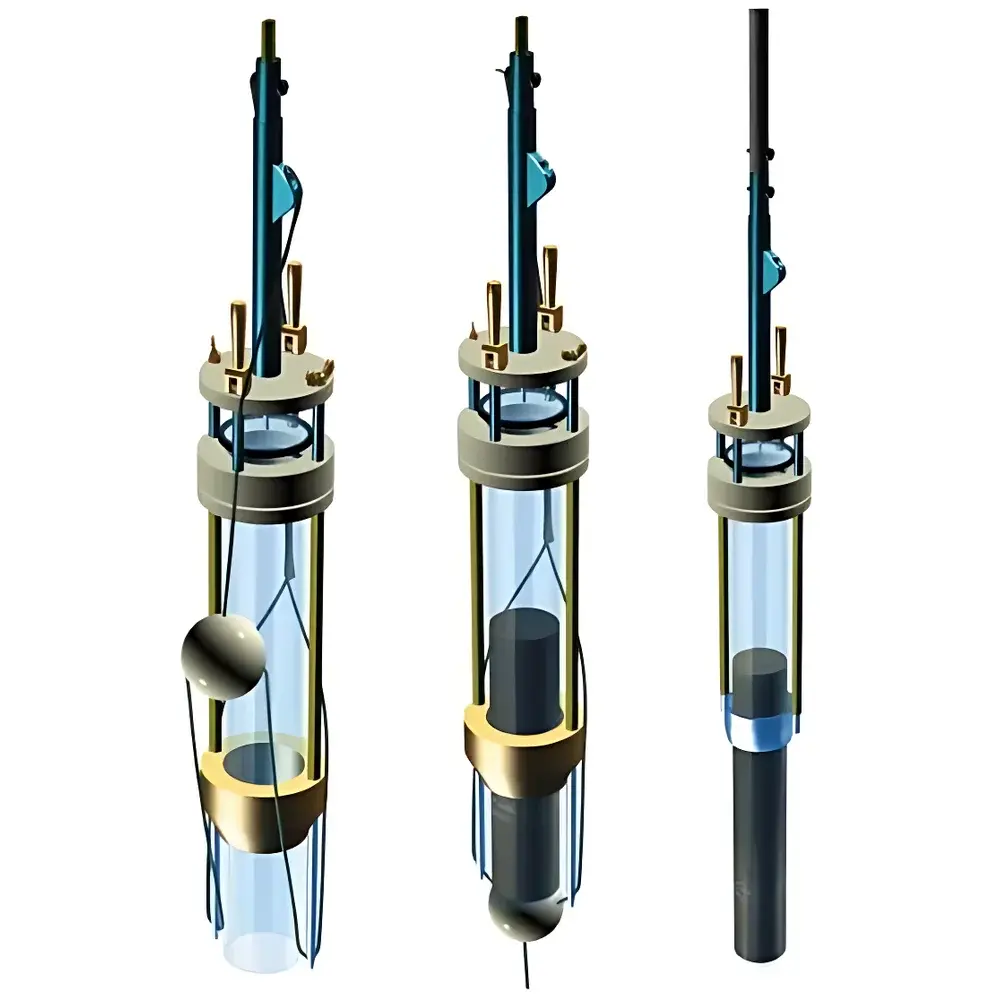
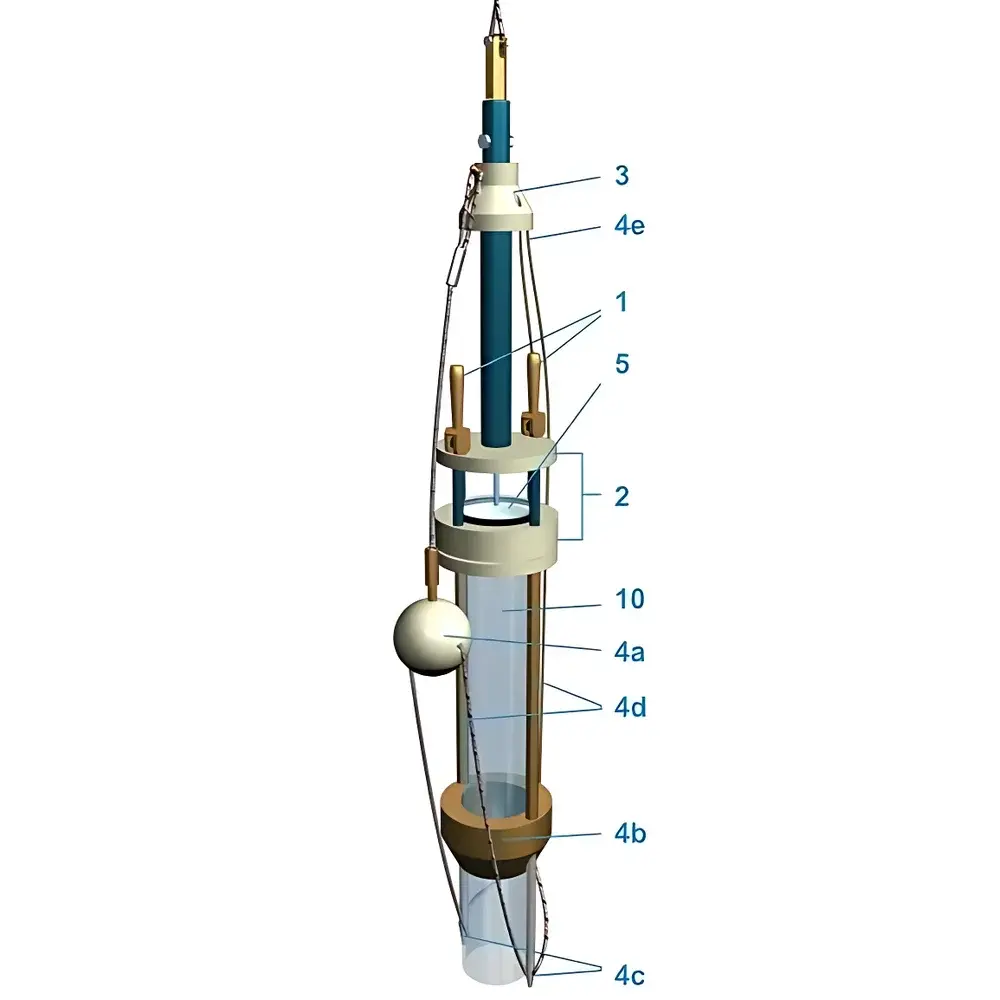
Corer 60 Cylindrical Sediment Corer (Austrian Import)
Overview
The Corer 60 is a high-precision, gravity-driven cylindrical sediment corer engineered for quantitative, stratigraphically intact sampling of unconsolidated aquatic sediments across marine, lacustrine, estuarine, and riverine environments. Designed in accordance with ISO 14687:2022 (Water quality — Sampling — Guidance on sampling of sediments) and compatible with ASTM D3690 / D6988 protocols for sediment core recovery, the system operates on hydrostatic pressure differential principles to achieve minimal disturbance during penetration and reliable core retention upon retrieval. Its dual-mode actuation—leveraging either hydraulic piston closure or mechanical clamp-based capture—ensures consistent recovery efficiency (>95% core retention rate under controlled field validation per DIN 19666 Annex B) regardless of sediment rheology, from fluid muds (yield stress <10 Pa) to cohesive clays (shear strength up to 5 kPa). The device is rated for unlimited water depth deployment via cable-suspended operation, with optional hammer-assisted penetration for high-density substrates.
Key Features
- Modular stainless-steel and marine-grade anodized aluminum architecture enables rapid field disassembly, cleaning, and transport without tool dependency.
- Hydraulic piston closure mechanism: Upon rope tension release at target depth, a spring-loaded ball latch disengages, allowing upward motion to expel interstitial water through calibrated vent channels into an elastomeric sleeve—sealing the PVC liner instantly and preventing core extrusion or layer mixing.
- Interchangeable coring modules: Standard 59.5 mm and 86 mm internal diameter transparent PVC liners (60 cm or 120 cm length) support visual stratigraphy logging and non-destructive XRF/XRD scanning; optional 3 m extendable liners available with segmented coupling.
- Adjustable penetration force: Dual-rope hammer drop system allows precise kinetic energy delivery (up to 30 kg total mass, configurable in 4 kg increments); distance-controlled impact depth via removable 5 mm spacing plates ensures reproducible insertion velocity profiles.
- Integrated stratigraphic sectioning guide: Precision-machined cutting board (0.5 mm tolerance) and sample segmentation jig enable sub-centimeter subsampling aligned with sediment horizon boundaries.
Sample Compatibility & Compliance
The Corer 60 accommodates heterogeneous sediment matrices including silty clays, organic-rich gyttjas, volcanic ash layers, carbonate oozes, and anthropogenically contaminated deposits. Its full-open cross-sectional geometry eliminates wall friction artifacts common in piston-cored systems, preserving natural grain orientation and porewater gradients. All wetted components comply with EU Directive 2002/95/EC (RoHS) and FDA 21 CFR 177.1520 for food-contact polymer safety. Liners meet ISO 8518:2017 requirements for dimensional stability under hydrostatic loading. Calibration traceability is maintained per ISO/IEC 17025:2017 through documented field verification using reference sediment columns with known density stratification.
Software & Data Management
While the Corer 60 is a hardware-only sampling platform, its design integrates seamlessly with laboratory data workflows. Each liner is marked with laser-etched depth graduations (1 cm intervals), enabling direct correlation with digital core logging software (e.g., Corelyzer v3.2+, ITRAX GeoTrak). Optional RFID-tagged tube racks (Accessory #20) synchronize physical inventory with LIMS databases supporting 21 CFR Part 11 audit trails. Sample metadata—including deployment timestamp, GPS coordinates, water depth, and operator ID—is captured via standardized CSV templates compliant with INSPIRE Directive Annex III (Environmental Monitoring Facilities).
Applications
- Baseline environmental monitoring under EU Water Framework Directive (WFD) Article 8 reporting requirements.
- Paleolimnological reconstruction using varved sediments, supported by high-fidelity lamina preservation.
- Contaminant fate studies (e.g., PCBs, heavy metals, microplastics) requiring undisturbed vertical concentration profiling.
- Benthic habitat assessment for EIA projects involving dredging or offshore wind farm foundations.
- Validation of in situ sensor arrays (e.g., porewater peepers, O2 optodes) through co-located core extraction.
FAQ
What sediment types are compatible with the hydraulic capture system?
The hydraulic piston seal is optimized for low-to-medium cohesion sediments (liquid limit <60%, plasticity index <25%). For highly consolidated or gravelly strata, the optional clamp-type capture head (Accessory #27 array configuration) provides mechanical retention without reliance on hydrostatic pressure.
Can the Corer 60 be deployed from small vessels or shore-based platforms?
Yes—its modular weight distribution (5–8 kg base unit) and tripod-mount compatibility (Accessory #26) allow stable operation from inflatable boats, jetties, or ice-covered surfaces. The 5 m manual push rod (Item #7) supports shallow-water hand deployment without winch infrastructure.
How is core integrity verified post-retrieval?
Each liner includes embedded fluorescent tracer bands visible under UV illumination, enabling immediate visual confirmation of compression or slumping. Recovery ratio is calculated as (core length / liner length) × 100%; values ≥90% indicate acceptable fidelity per GLP-compliant sediment protocols.
Are replacement liners and seals supplied with certified calibration documentation?
All consumables—including PVC liners, Viton® piston seals, and silicone rubber sleeves—are shipped with CoC (Certificate of Conformance) referencing EN ISO 10477:2021 dimensional tolerances and ASTM D573 aging test reports.







