WinDENDRO Tree-Ring Analysis System
| Origin | Canada |
|---|---|
| Manufacturer Type | Authorized Distributor |
| Origin Category | Imported |
| Model | WinDENDRO |
| Pricing | Available Upon Request |
Overview
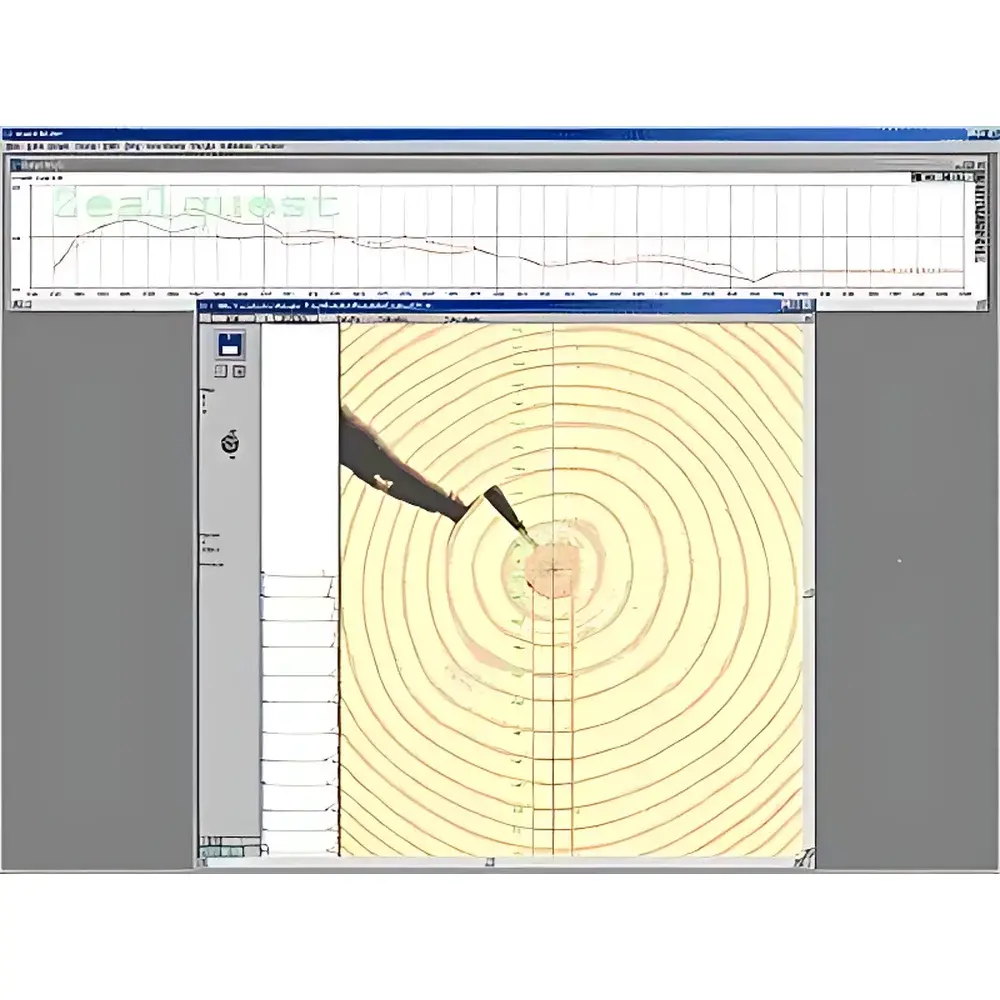
The WinDENDRO Tree-Ring Analysis System is a precision digital dendrochronological workstation engineered for high-resolution, non-destructive analysis of tree-ring structures in wood samples. Built upon a calibrated flatbed scanning architecture—replacing legacy video-based acquisition—the system captures true-color and grayscale TIFF images at optical resolutions up to 4800 dpi, ensuring sub-micron spatial fidelity across full cross-sections. Its proprietary illumination module eliminates vignetting, shadow artifacts, and intensity gradients, delivering uniform radiometric response essential for quantitative densitometric and geometric measurements. The platform operates on the fundamental principle that annual growth increments manifest as periodic variations in cell wall density and lumen geometry, which are resolved via pixel-intensity profiling along user-defined transects or fully automated radial trajectories. Designed for long-term archival compliance and reproducible inter-laboratory comparisons, WinDENDRO supports traceable measurement workflows aligned with ISO 13370 (thermal performance of building materials) and ASTM D143–22 (standard test methods for small clear specimens of timber), where ring-width chronologies serve as proxy indicators of environmental stress, climate variability, and silvicultural history.
Key Features
- Optical flatbed scanning with adjustable white LED illumination and automatic glare compensation
- Native support for lossless TIFF image import—including legacy camera-captured scans—enabling retrospective analysis of historical datasets
- Three-tiered software licensing: Basic, Standard, and Professional editions—each expanding algorithmic depth and analytical scope
- Automated ring detection based on intensity gradient thresholding, edge continuity, and local contrast normalization
- Pixel-level reflectance quantification per annual ring: min/max/mean intensity values, directional asymmetry metrics, and standard deviation profiles
- Robust gap-handling logic for defective samples—including interpolation of missing rings using adjacent sector correlation and spline-fitting heuristics
- Multi-angle radial measurement capability for eccentric or reaction-wood specimens with irregular pith displacement
- Integrated XLSTEM stem-analysis add-in for Microsoft Excel, enabling direct export of ring-width series, autocorrelation matrices, and pointer-year event tables
- Configurable data storage orientation: “pith-to-bark” or “bark-to-pith”, preserving anatomical context for ontogenetic modeling
- Annotation layer support for field notes, sampling metadata, and dendroclimatic interpretations directly embedded within image headers
Sample Compatibility & Compliance
WinDENDRO accommodates solid wood cores (5–20 mm diameter), cross-sections up to A3 format (297 × 420 mm), and thin sections mounted on glass slides. It accepts samples prepared via standard increment borer extraction, microtome sectioning, or polished resin-embedded blocks. All measurement outputs comply with FAO Forest Resource Assessment reporting templates and adhere to ITRDB (International Tree-Ring Data Bank) submission standards. Software audit trails meet GLP documentation requirements, including timestamped operator IDs, parameter version logs, and revision-controlled calibration records. Optional 21 CFR Part 11-compliant electronic signature modules are available for regulated environmental monitoring programs.
Software & Data Management
The WinDENDRO software suite runs natively on Windows OS platforms (Windows 98 through Windows 11, 64-bit compatible). Data files are stored in open-format HDF5 containers, ensuring long-term readability and interoperability with R (dplR package), Python (NumPy/Pandas), and MATLAB environments. Batch processing pipelines support parallel analysis of multi-core datasets with configurable quality-control flags (e.g., signal-to-noise ratio thresholds, ring continuity scores). Export options include CSV (ring-width series), PNG/JPEG (annotated visuals), and XML (metadata-rich structural descriptors). All versions maintain backward compatibility with prior release archives; no data migration is required during upgrades.
Applications
- Dendroclimatology: Reconstruction of past temperature/precipitation regimes using standardized ring-width indices
- Forest ecology: Age structure mapping, disturbance chronosequences (fire, insect outbreaks, windthrow)
- Timber provenancing and authentication: Species-level discrimination via intra-annual density patterns
- Archeological wood dating: Cross-dating of structural timbers from historic buildings and shipwrecks
- Urban forestry monitoring: Growth response assessment to air pollution, soil compaction, and irrigation regimes
- Carbon sequestration modeling: Integration of ring-width-derived biomass accumulation rates into IPCC Tier 2 inventories
FAQ
Does WinDENDRO require proprietary hardware?
No—while Regent-certified professional-grade scanners are recommended for optimal resolution and illumination consistency, the software fully supports third-party TWAIN-compatible scanners meeting minimum 2400 dpi optical resolution and 16-bit grayscale depth specifications.
Can WinDENDRO analyze images acquired with microscope-mounted cameras?
Yes—TIFF, BMP, and PNG files captured via digital microscopy systems may be imported and analyzed, provided spatial calibration (µm/pixel) is manually entered or derived from embedded scale bars.
Is batch processing supported across multiple sample sets?
Yes—Professional Edition includes scriptable batch mode with customizable preprocessing rules (e.g., auto-contrast adjustment, pith localization, sector masking) and error-reporting logs for QA/QC review.
How does WinDENDRO handle reaction wood or compression wood distortions?
Through adaptive radial profiling: the software detects abnormal cell-wall thickening gradients and applies localized curvature correction before width calculation, preserving chronological integrity without manual intervention.
Are raw pixel-intensity datasets exportable for external statistical modeling?
Yes—Professional Edition exports per-ring intensity vectors (min/max/mean/std dev) alongside geometric coordinates in tab-delimited ASCII format, suitable for PCA, wavelet analysis, or machine learning feature engineering.