
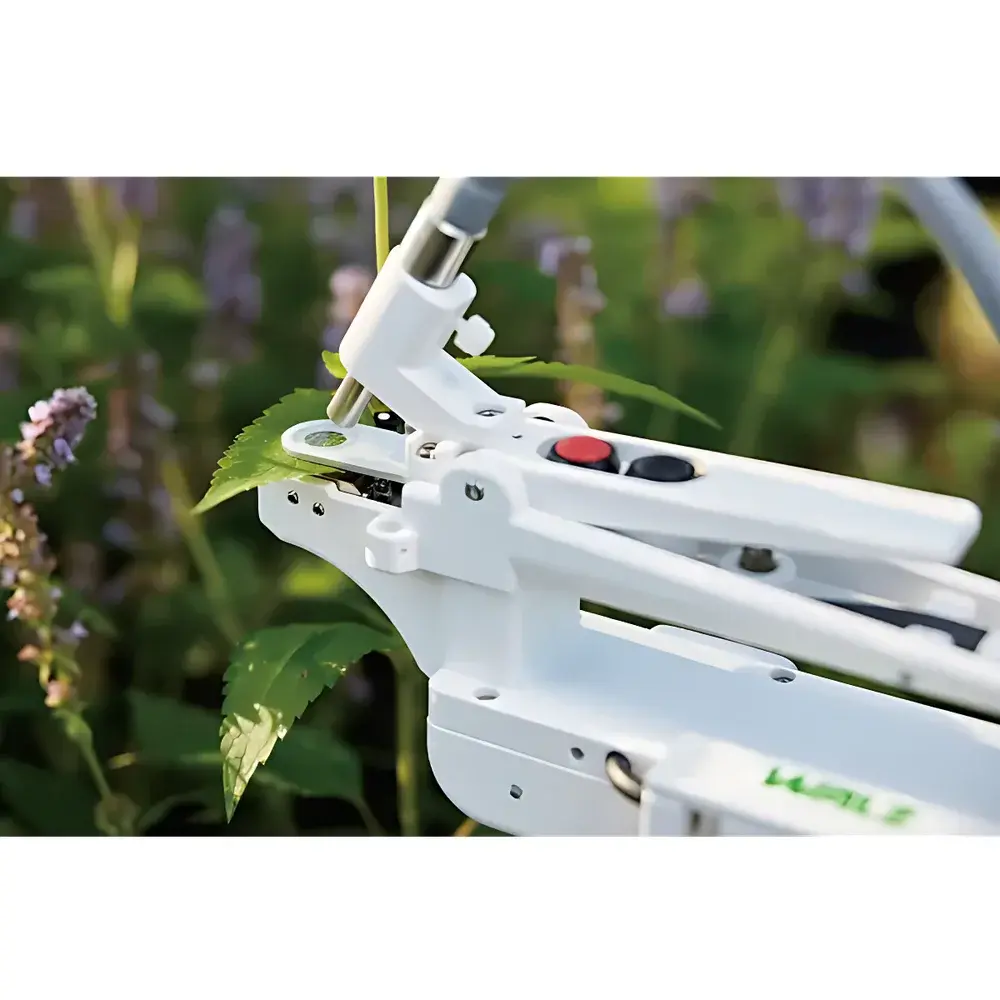
WALZ MINI-PAM-II/Porometer Portable Gas Exchange & Chlorophyll Fluorescence Coupling Module
| Brand | WALZ |
|---|---|
| Origin | Germany |
| Model | MINI-PAM-II/Porometer |
| Sample Area | 1 cm diameter circular chamber |
| Flow Rate | 40–200 µmol s⁻¹ (9-step adjustable) |
| Humidity Sensor Accuracy | ±1.0–1.5 %RH, ΔT = ±0.1 ℃ |
| Pressure Sensor Accuracy | ±0.1 kPa |
| Leaf Temperature Sensor Accuracy | ±0.3 ℃ (emissivity adjustable 0.1–1.0) |
| Ambient CO₂ Sensor Accuracy | ±30 ppm + 3% of reading |
| Flowmeter Accuracy | ±1.5% RD + 0.15% F.S. |
| GPS Receiver Accuracy | 2.0 m CEP |
| PAR Sensor Range | 0–7000 µmol m⁻² s⁻¹ (cosine-corrected for ±30° incidence) |
| Operating Temperature | −5 to 45 ℃ |
| Relative Humidity Range | 0–90% RH (non-condensing) |
| Atmospheric Pressure Range | 30–110 kPa |
| Measured Parameters | gₛ, gₜ, g_b (mmol m⁻² s⁻¹), H₂Oᵢₙ / H₂Oₒᵤₜ / ΔH₂O (mmol mol⁻¹), leaf chamber pressure (kPa), Tₗₑₐf (℃), inlet/outlet flow rate (µmol s⁻¹), VPD (Pa/kPa), E (mmol m⁻² s⁻¹), PAR (µmol m⁻² s⁻¹), GPS coordinates, solar zenith angle |
Overview
The WALZ MINI-PAM-II/Porometer is a purpose-engineered, field-deployable coupling module designed to integrate real-time stomatal conductance (gs) measurements with high-resolution modulated chlorophyll a fluorescence kinetics in a single, synchronized acquisition workflow. Built as a dedicated accessory for the MINI-PAM-II portable fluorometer, it operates on the principle of open-path, steady-state gas exchange combined with pulse-amplitude modulation (PAM) fluorometry. This dual-signal architecture enables concurrent quantification of photosynthetic electron transport rate (ETR) — derived from quantum yield of PSII (ΦPSII) and incident photosynthetically active radiation (PAR) — and stomatal conductance — calculated from water vapor concentration gradients, leaf temperature, chamber pressure, and precisely regulated sample airflow. The system’s physical design adheres to ISO 17025-aligned metrological traceability principles, with all embedded sensors calibrated against NIST-traceable references where applicable. Its compact form factor (≤1.2 kg total mass) and battery-operated architecture support uninterrupted operation across heterogeneous field sites, growth chambers, and controlled-environment laboratories — fulfilling requirements for longitudinal physiological phenotyping under dynamic environmental regimes.
Key Features
- Integrated dual-modality measurement: Simultaneous acquisition of gs, transpiration rate (E), intercellular CO2 (Ci), ΦPSII, NPQ, qP, and Rfd within a single 1 cm² leaf area
- High-fidelity environmental sensing suite: Onboard RH sensor (±1.5% RH), leaf thermistor (±0.3 ℃), differential pressure transducer (±0.1 kPa), non-dispersive infrared (NDIR) CO2 analyzer (±30 ppm), and cosine-corrected PAR quantum sensor (0–7000 µmol m⁻² s⁻¹)
- Stable microclimate control: Precision mass-flow controller (40–200 µmol s⁻¹, 9-step resolution) coupled with low-noise diaphragm pump and regulated chamber pressure management
- Georeferenced data capture: Integrated GPS receiver (2.0 m CEP) logs positional metadata and computes solar zenith/azimuth angles for irradiance normalization
- Dark-adaptation compatibility: Includes light-tight leaf clip with adjustable shutter mechanism for Fo/Fm, OJIP, and dark-relaxation kinetics
- Modular expansion interface: Standardized digital I/O and analog inputs support optional peripherals including external LED actinic sources (2054-L), fiber-optic oxygen probes (FSO2-1), and barcode scanners for high-throughput sample tracking
Sample Compatibility & Compliance
The MINI-PAM-II/Porometer accommodates intact, attached leaves from herbaceous and woody species with minimal mechanical disturbance. Its 1 cm² circular chamber permits standardized measurement across broadleaf monocots (e.g., maize, rice), dicots (e.g., Arabidopsis, tomato), and conifer needles (with custom adapters). All optical and thermal interfaces comply with ASTM E2915-21 (Standard Practice for Evaluating Instrumental Measurement Uncertainty) and ISO 14155:2020 (Clinical investigation of medical devices). Data acquisition protocols align with FAO Plant Stress Physiology Guidelines and are compatible with GLP-compliant workflows when paired with WALZ’s GLP-validated firmware (v3.8+). Sensor calibrations are documented per ISO/IEC 17025:2017 Annex A.2, and firmware supports audit trails meeting FDA 21 CFR Part 11 requirements for electronic records.
Software & Data Management
Acquisition and analysis are managed via WALZ’s PAMWin Pro v4.5 software, which provides synchronized time-series visualization of fluorescence and gas exchange parameters. Raw data export follows HDF5 format (HDF Group specification 1.12+) with embedded metadata (sensor IDs, calibration dates, GPS coordinates, ambient conditions). Batch processing supports automated induction curve fitting (Stern-Volmer, exponential decay models), rapid light curve (RLC) derivation of α, ETRmax, and Ik, and VPD-normalized stomatal response modeling. Export modules generate CSV, MATLAB .mat, and NetCDF4 files compliant with MIAPPE (Minimum Information About a Plant Phenotyping Experiment) v1.1 standards. Remote firmware updates and configuration backups are secured via TLS 1.3 encrypted USB-C or Bluetooth 5.0 link.
Applications
- High-throughput screening of stomatal mutants (e.g., slac1, ost1) under controlled drought or ABA treatment
- Quantifying dynamic stomatal responses to diurnal PAR fluctuations and VPD gradients in field-grown crops
- Assessing photoprotective capacity via simultaneous NPQ kinetics and gs feedback during heat stress trials
- Validating stomatal conductance models (e.g., Ball-Berry, Medlyn) using empirically derived gs-An-Ci relationships
- Multi-stress interaction studies (e.g., combined ozone + high light exposure) with temporal resolution down to 100 ms per fluorescence saturation pulse
- Calibration of hyperspectral reflectance indices (e.g., PRI, NDVI) against ground-truthed ΦPSII and gs datasets
FAQ
Can the MINI-PAM-II/Porometer operate independently without the MINI-PAM-II host unit?
No. It functions exclusively as an add-on module requiring the MINI-PAM-II base unit for power, signal processing, and display.
Is the CO₂ sensor suitable for long-term greenhouse monitoring?
Yes — its NDIR architecture and factory-calibrated zero/span stability (drift <0.5% per month) meet ISO 12039:2000 requirements for ambient CO₂ monitoring in controlled environments.
What is the minimum leaf thickness supported by the chamber seal?
Leaves ≥0.1 mm thick achieve reliable sealing; thinner tissues (e.g., moss gametophytes) require supplemental silicone grease or custom gaskets.
Does the GPS module support differential correction (e.g., SBAS/WAAS)?
Yes — firmware v4.2+ enables SBAS augmentation for sub-meter horizontal accuracy under open-sky conditions.
How is PAR sensor cosine response validated?
Each LS-C sensor undergoes angular responsivity testing per ISO 9060:2018 Class A specifications, with published correction coefficients supplied in calibration certificates.



