
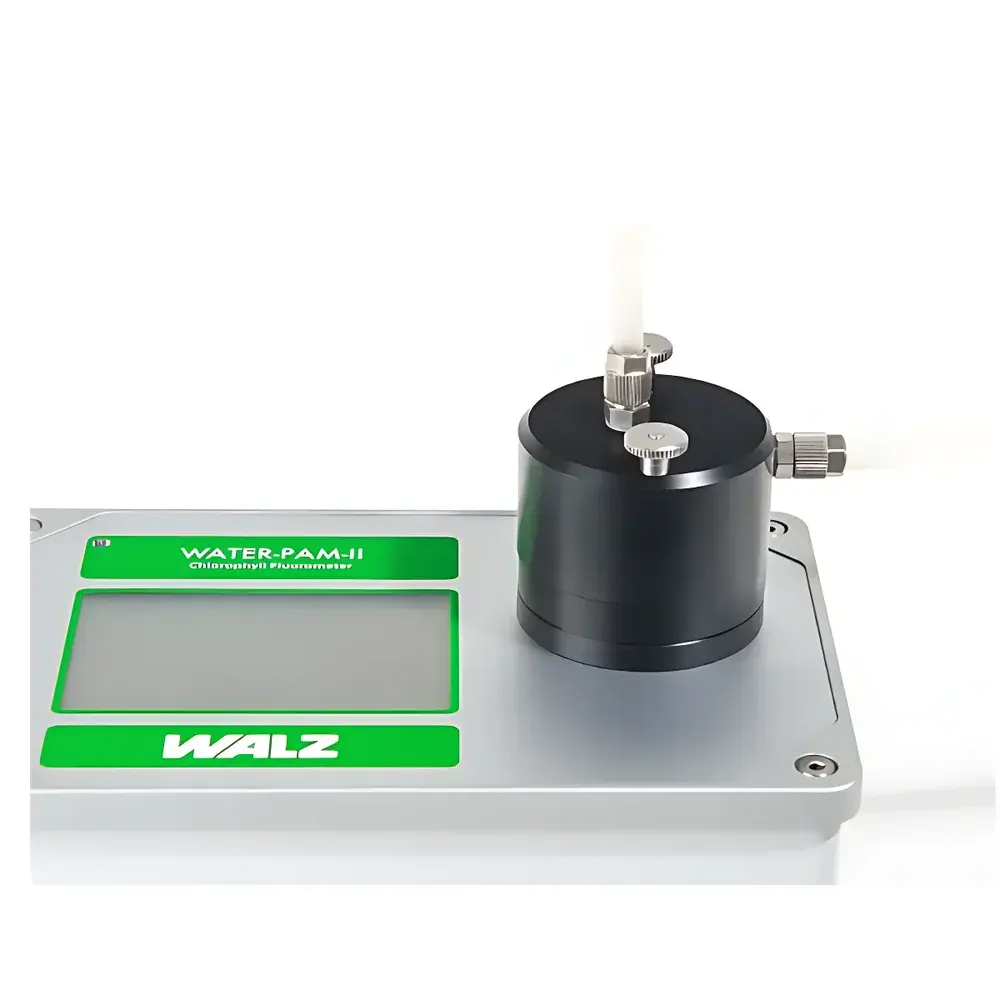
WALZ WATER-PAM-II Portable Aquatic Pulse-Amplitude Modulated Chlorophyll Fluorometer
| Brand | WALZ |
|---|---|
| Origin | Germany |
| Model | WATER-PAM-II |
| Excitation Wavelengths | 450 nm (blue), 520 nm (green), 630 nm (red), 660 nm (deep red), 730 nm (far-red) |
| Measurement Parameters | Fo, Fm, Fv/Fm, F, Fm’, Fo’, Y(II), qP, qN, NPQ, Y(NPQ), Y(NO), ETR, α, Ik, ETRmax, Chl a concentration (cyanobacteria, green algae, diatoms/dinoflagellates), Total Chl a |
| Detection Limit | 0.1 µg Chl a/L |
| Data Storage | 27,000 saturation pulse datasets |
| Power Supply | 8× rechargeable AA batteries (up to 30 h operation |
| Compliance | Designed for field-deployable GLP-aligned aquatic photobiology workflows |
Overview
The WALZ WATER-PAM-II is a portable, high-sensitivity pulse-amplitude modulated (PAM) chlorophyll fluorometer engineered specifically for quantitative photosynthetic assessment of phytoplankton in natural and experimental aquatic systems. Operating on the principle of dual-wavelength excitation and saturating pulse analysis, it non-invasively probes Photosystem II (PSII) photochemical efficiency by measuring variable chlorophyll a fluorescence kinetics under controlled actinic and saturating light regimes. Unlike general-purpose fluorometers, the WATER-PAM-II integrates multi-spectral excitation (450, 520, 630, 660, and 730 nm LEDs) to resolve taxon-specific fluorescence signatures—enabling discrimination and quantification of cyanobacteria, green algae, and diatoms/dinoflagellates based on their distinct absorption and emission profiles. This capability supports both functional photophysiology (e.g., quantum yield, electron transport rate, non-photochemical quenching) and compositional analysis (Chl a partitioning) within mixed algal assemblages—a critical requirement for limnological monitoring, HABs early-warning systems, and climate-responsive aquatic ecology research.
Key Features
- Multi-spectral excitation architecture with five precisely calibrated LED sources (450 nm blue, 520 nm green, 630 nm red, 660 nm deep red, and 730 nm far-red) optimized for differential algal pigment activation and PSII relaxation kinetics.
- Simultaneous acquisition of induction curves (IC), light response curves (LC), and rapid light curves (RLC) with automated protocol sequencing and real-time curve visualization via intuitive top-level menu navigation.
- Detection limit of 0.1 µg Chl a/L—validated across freshwater, brackish, and marine matrices—ensuring reliable quantification in oligotrophic and eutrophic conditions.
- Integrated battery-powered design: 8× rechargeable AA cells deliver up to 30 hours of continuous field operation or ≥70,000 Y(II) measurements per charge cycle, supporting extended deployments without external power.
- Onboard storage for 27,000 saturation pulse datasets with timestamped metadata, enabling traceable, offline data collection compliant with GLP documentation standards.
- Modular expandability: Standard configuration supports discrete water sample analysis; optional flow-through cuvette chamber and peristaltic pump kit enable unattended, long-term in situ monitoring of dynamic water columns.
Sample Compatibility & Compliance
The WATER-PAM-II accommodates both laboratory-cultured microalgae suspensions and unfiltered natural water samples—including lake, river, estuarine, and coastal seawater—with minimal sample preparation. Its optical path design minimizes scattering artifacts from suspended solids, while spectral deconvolution algorithms correct for overlapping fluorescence contributions across taxonomic groups. The instrument conforms to internationally recognized photobiological measurement practices defined in ASTM D8019–16 (Standard Guide for In Vivo Chlorophyll Fluorescence Measurements) and ISO 10260:2021 (Water quality — Guidance on phytoplankton photosynthetic activity assessment). Data integrity is maintained through internal calibration verification routines, and all fluorescence parameters (Fo, Fm, Y(II), NPQ, ETR, etc.) are reported in SI-aligned units consistent with peer-reviewed aquatic plant physiology literature.
Software & Data Management
Data acquisition and post-processing are performed using WALZ’s proprietary ImagingWin software (Windows-based), which supports direct USB connection, batch parameter export (CSV, Excel), and spectral unmixing modeling for Chl a fractionation. Raw fluorescence traces retain full temporal resolution (ms-scale sampling), permitting re-analysis of kinetic components such as OJIP transients when required. Audit trails—including operator ID, measurement time/date, instrument firmware version, and LED intensity calibration logs—are embedded in each dataset. While the WATER-PAM-II itself does not implement FDA 21 CFR Part 11 electronic signature controls, its structured output format and metadata schema are compatible with validated LIMS and ELN platforms used in regulated environmental testing laboratories operating under ISO/IEC 17025 or EPA Method 445.1 frameworks.
Applications
- Early detection and risk stratification of harmful algal blooms (HABs) via real-time tracking of Fv/Fm depression, NPQ dynamics, and taxon-specific Chl a shifts in reservoirs and coastal zones.
- Field-based assessment of phytoplankton photoinhibition and photoacclimation responses to UV exposure, nutrient limitation, or trace metal stress.
- Calibration and validation of remote sensing algorithms (e.g., satellite-derived Chl a products) through concurrent in situ spectral fluorescence profiling.
- Ecotoxicological screening of herbicide mode-of-action (e.g., PSII inhibitors like atrazine) using standardized RLC protocols aligned with OECD Test No. 201 and ISO 8692.
- Long-term ecological monitoring programs in lakes, rivers, and aquaculture facilities where portability, low maintenance, and reproducible inter-laboratory comparability are essential.
FAQ
What distinguishes the WATER-PAM-II from the PHYTO-PAM-II?
The WATER-PAM-II shares the same multi-spectral excitation engine and spectral deconvolution algorithm as the PHYTO-PAM-II but is optimized for liquid-phase measurements: it features a dedicated water-immersion probe geometry, enhanced sensitivity at low Chl a concentrations (<0.1 µg/L), and a streamlined firmware interface prioritizing field-deployable protocols over imaging functionality.
Can the WATER-PAM-II quantify absolute Chl a without lab-based extraction?
Yes—it provides calibrated, taxon-resolved Chl a estimates (µg/L) directly from in vivo fluorescence, validated against acetone-extraction HPLC methods across >120 natural water samples per WALZ technical report TR-WPAM-2022-03.
Is the device suitable for saline or turbid waters?
It has been tested in salinities up to 35 PSU and turbidity levels ≤50 NTU; signal correction routines compensate for scattering-induced attenuation, though extreme particulate loads (>100 NTU) may require pre-filtration or dilution.
Does the system support automated data upload to cloud platforms?
Not natively—the device stores data locally and requires manual transfer via USB; however, exported CSV files are structured for seamless ingestion into third-party environmental data management systems (e.g., EnviroDIY, HydroShare, or custom Python/Pandas pipelines).
How often does the instrument require recalibration?
LED output stability is verified during factory calibration (certified annually); users perform routine dark-adaptation checks and reference standard (quenching solution) validation before critical field campaigns—no field recalibration hardware is required.




