
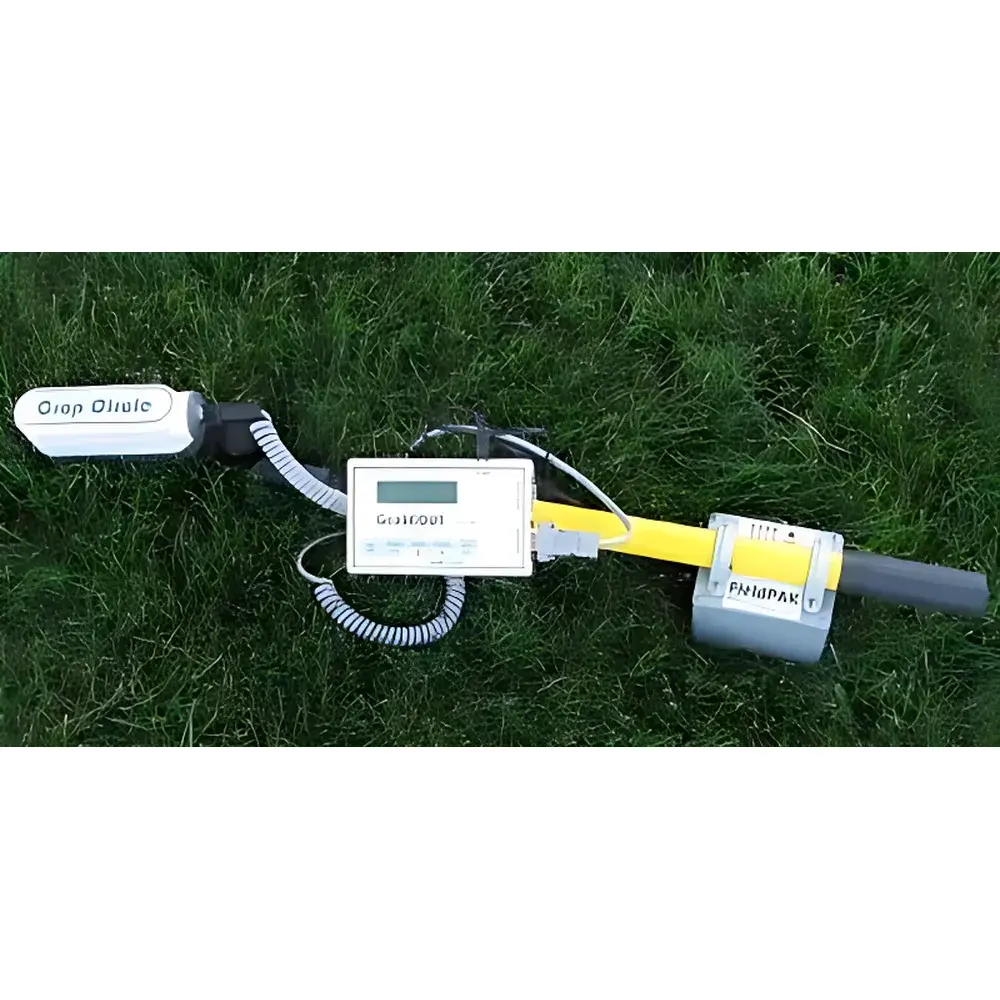
Holland Scientific Crop Circle ACS-470 Handheld Canopy Spectroradiometer
| Origin | USA |
|---|---|
| Manufacturer Type | Authorized Distributor |
| Origin Category | Imported |
| Model | ACS-470 |
| Price | Upon Request |
Overview
The Holland Scientific Crop Circle ACS-470 Handheld Canopy Spectroradiometer is a field-deployable, actively illuminated optical sensing system engineered for quantitative, height-invariant measurement of spectral reflectance across plant canopies and soil surfaces. Unlike passive radiometers that rely on ambient solar irradiance—and thus suffer from diurnal variability, cloud interference, and directional lighting artifacts—the ACS-470 integrates a modulated multi-color LED light source and a synchronized three-channel silicon photodiode array to deliver calibrated pseudo-solar reflectance (PSR) values. This proprietary PSR methodology enables absolute reflectance (%) measurements independent of sensor-to-target distance—eliminating the need for precise height control during surveying and ensuring reproducible data acquisition across heterogeneous terrain. Operating across the photosynthetically active radiation (PAR) and near-infrared (NIR) spectrum (320–1100 nm), the ACS-470 supports targeted spectral analysis via user-swappable 12.5 mm interference filters, making it suitable for high-resolution phenotyping, precision agronomy, and ecological monitoring in both daylight and nocturnal conditions.
Key Features
- Three independently configurable optical channels with swappable 12.5 mm interference filters (standard options: 450 nm, 550 nm, 650 nm, 670 nm, 730 nm, 760 nm)
- Active illumination using a modulated multi-wavelength LED array—enables consistent measurements day or night, unaffected by ambient light, fluorescence, or AC-powered artificial sources
- Height-invariant pseudo-solar reflectance (PSR) output—provides absolute % reflectance values across a 0.25–2.0 m measurement range without recalibration
- Rugged IP68-rated probe housing—dust-tight and submersible to 1.5 m for extended field durability
- High-speed sampling: programmable from 1 to 20 Hz (factory default: 10 Hz)
- Integrated GeoSCOUT GLS-400 data logger with SD card storage (text-based CSV export) and optional GPS geotagging for GIS integration
- Lightweight modular system: total weight < 3.6 kg; probe mass = 755 g; dimensions = 20.1 × 8.9 × 4.8 cm
- FieldPAK PS-12 rechargeable power pack delivers up to 5 hours of continuous operation
Sample Compatibility & Compliance
The ACS-470 is validated for non-destructive, in situ measurement of vegetative canopies—including row crops (maize, soybean, wheat), pasture grasses, turfgrass, orchard understories, and natural herbaceous communities—as well as bare and residue-covered soils. Its optical design accommodates variable canopy architecture, density, and surface roughness within its 30° horizontal × 14° vertical field of view. The system complies with ISO 11737-1 for environmental robustness testing and meets IEC 60529 IP68 ingress protection standards. Data acquisition protocols support GLP-aligned field documentation when paired with timestamped, georeferenced logging—facilitating traceability in regulatory or academic research contexts. While not FDA-cleared, raw spectral outputs are compatible with analytical workflows compliant with ASTM E2593 (Standard Guide for Use of Spectral Reflectance Measurements in Agriculture) and ISO 19952 (Plant phenotyping—Optical sensing methods).
Software & Data Management
Data are recorded directly to removable SD cards in plain-text CSV format, enabling immediate post-processing in MATLAB, Python (NumPy/Pandas), R, or commercial platforms such as ENVI, ArcGIS, or QGIS. The GeoSCOUT GLS-400 interface supports real-time display of normalized ratio indices (e.g., NDVI, PRI, NDRE) and raw channel intensities. Optional firmware updates enable custom index calculation onboard. All logged files include UTC timestamps, GPS coordinates (when GNSS module is attached), and probe metadata (filter IDs, sampling rate, battery status). Audit trails—including operator ID, session start/stop times, and configuration changes—are retained in header records to satisfy internal QA/QC and external audit requirements under ISO/IEC 17025 or GxP-aligned field study protocols.
Applications
- Quantitative crop nitrogen status assessment and variable-rate fertilization modeling
- Evaluation of herbicide mode-of-action and phytotoxicity response kinetics
- Non-destructive estimation of aboveground biomass and LAI (Leaf Area Index) across spatial gradients
- Early detection of biotic stress (e.g., fungal infection, viral symptoms) prior to visible symptom expression
- Monitoring senescence dynamics in cereals and legumes using red-edge (730 nm) and NIR (760 nm) band ratios
- High-resolution turfgrass health mapping for golf course and municipal landscape management
- Supporting hybrid performance trials through spectral trait correlation with yield and quality metrics
- Development of localized nutrient recommendation algorithms grounded in proximal spectral reference libraries
- Forage biomass forecasting in rangeland and silage production systems
FAQ
Does the ACS-470 require calibration against reference panels before each use?
No—its active illumination and PSR algorithm eliminate dependence on external white reference panels. Factory calibration is stable over time; annual verification against NIST-traceable standards is recommended for ISO 17025 compliance.
Can the ACS-470 be mounted on UAVs or ground vehicles?
Yes—the probe’s low mass, IP68 rating, and analog/digital output options support integration into mobile platforms. Contact Holland Scientific for mounting brackets and synchronization interfaces.
Is spectral data export compatible with USDA’s ARS CropScan or NASA’s AVIRIS-NG processing pipelines?
Raw CSV outputs contain wavelength-aligned intensity values and metadata sufficient for ingestion into standard hyperspectral preprocessing workflows; spectral resampling may be required for direct compatibility.
What is the minimum detectable change in reflectance (%ΔR) under field conditions?
System noise-equivalent reflectance (NER) is ≤0.3% across all configured bands at 10 Hz sampling, enabling detection of subtle physiological shifts associated with early water deficit or micronutrient deficiency.
Are firmware updates and technical support available internationally?
Yes—Holland Scientific provides remote firmware upgrades, application engineering consultation, and multilingual documentation through authorized regional distributors.



