
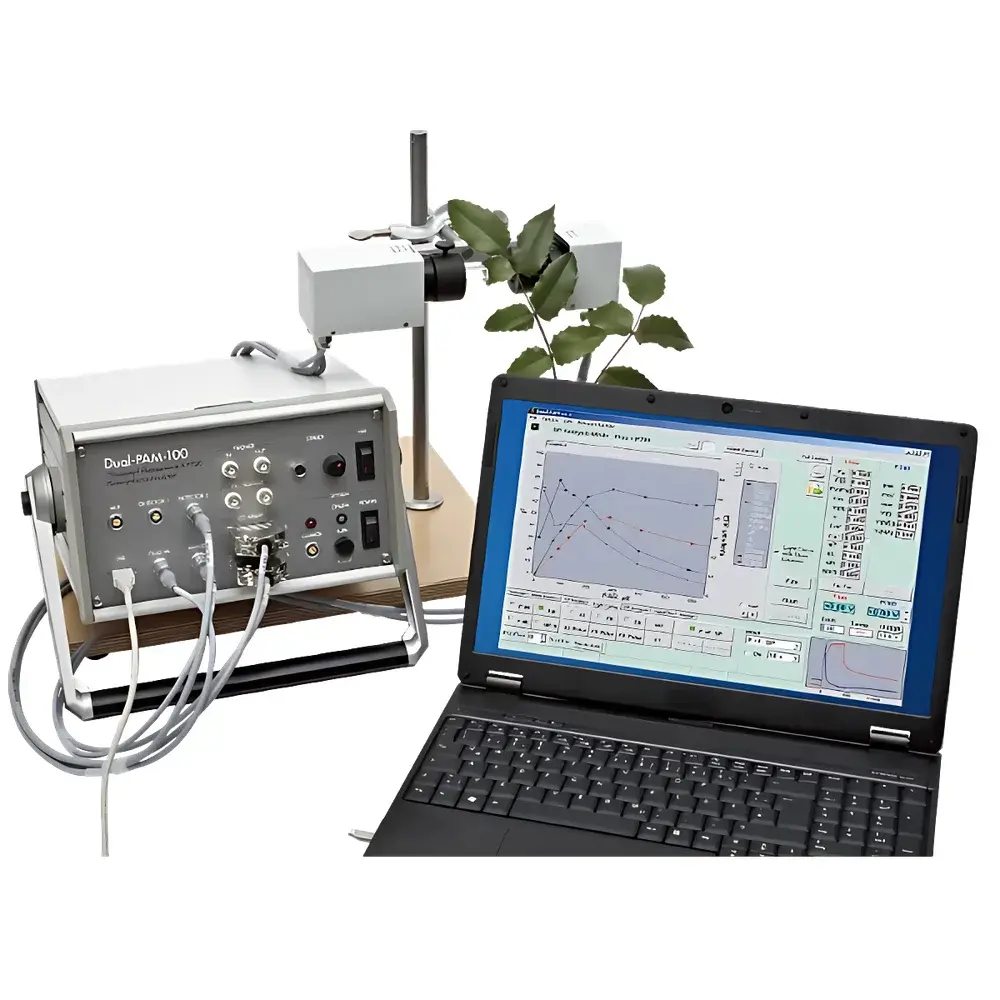
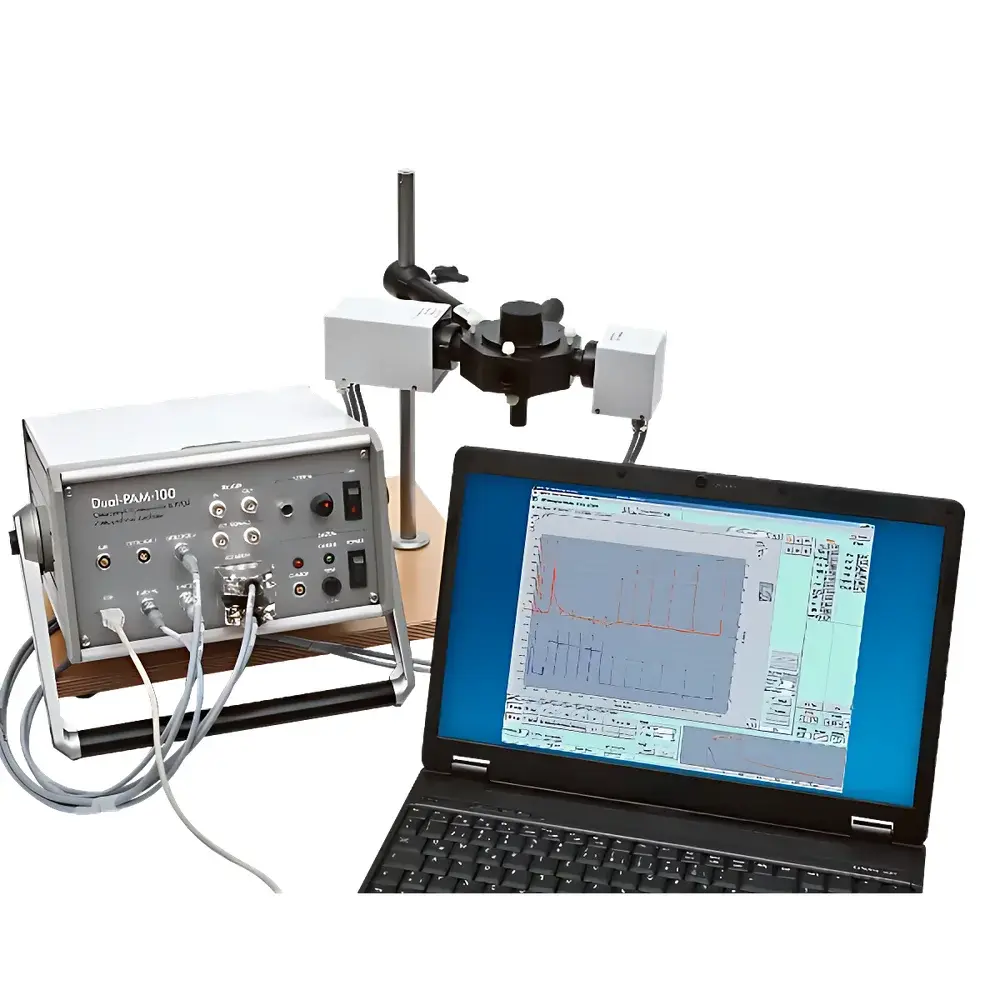
WALZ DUAL-PAM-100 Dual-Channel Modulated Chlorophyll Fluorescence and P700 Absorbance Imaging System
| Brand | WALZ |
|---|---|
| Origin | Germany |
| Model | DUAL-PAM-100 |
| Sample Types | Intact leaves, isolated chloroplasts/thylakoids, algal suspensions |
| Optional Modules | P515/535 (pmf, ΔpH, ΔΨ), NADPH/9-AA (NADP⁺ reduction, ΔpH), 3010-DUAL coupling chamber for GFS-3000 gas exchange integration |
| Compliance | Designed for GLP-aligned plant physiology research |
Overview
The WALZ DUAL-PAM-100 is a dual-channel, modulated optical measurement platform engineered for simultaneous, high-temporal-resolution quantification of photosystem II (PSII) chlorophyll fluorescence and photosystem I (PSI) redox kinetics via P700⁺/P700 differential absorbance at 820 nm. Its core principle relies on saturation pulse-modulated fluorometry coupled with dual-wavelength (820/870 nm) absorbance detection, enabling precise kinetic resolution of electron transport dynamics across both photosystems in real time. Unlike single-channel systems, the DUAL-PAM-100 eliminates temporal misalignment between PSII and PSI signals—critical for modeling intersystem electron pool size, cyclic electron flow (CEF), and regulatory cross-talk between light-harvesting complexes. The system operates under controlled actinic illumination, employs lock-in amplification to suppress ambient noise, and delivers sub-millisecond time resolution for induction kinetics, rapid light curves (RLCs), and post-illumination relaxation analysis. It is purpose-built for non-invasive, in vivo measurements on intact leaves using standardized leaf clips, as well as suspension-based assays in quartz cuvettes (1.4 mL volume), supporting reproducible physiological interrogation across angiosperms, bryophytes, algae, and cyanobacteria.
Key Features
- Dual independent excitation/detection pathways: One optimized for chlorophyll fluorescence (450–470 nm LED excitation; 680–740 nm emission detection), the other for P700 redox kinetics (820 nm measuring beam; 870 nm reference beam)
- Integrated saturation pulse generator delivering adjustable intensity (0–100% relative output) and duration (0.1–10 s) for accurate Fm, Pm, and quenching parameter derivation
- Modulated measuring light (0.1–10 kHz) with automatic gain control to maintain signal linearity across wide dynamic ranges (Fo to Fm, P700 to Pm)
- Standardized leaf clip design enabling rapid, pressure-controlled mounting without tissue compression artifacts or stomatal interference
- Cuvette holder compatible with magnetic stirring for homogeneous suspension measurements (e.g., Chlamydomonas, Synechocystis, isolated thylakoids)
- Micro-injection port on cuvette lid for real-time pharmacological intervention (e.g., DCMU, methyl viologen, nigericin) during kinetic assays
- Firmware-upgradable architecture supporting custom protocol scripting via PAMWin software environment
Sample Compatibility & Compliance
The DUAL-PAM-100 accommodates diverse biological matrices without modification: intact leaves (dicots, monocots, conifers), excised leaf discs, detached moss gametophytes, algal pellets resuspended in buffer, and purified thylakoid membranes. All measurements adhere to established photobiological conventions defined in ASTM E2933-14 (Standard Guide for Photosynthetic Efficiency Measurements) and align with ISO 10211:2021 (Plant Physiology — Determination of Photosynthetic Parameters). Data acquisition logs include timestamped metadata (ambient temperature, humidity, actinic irradiance), fulfilling audit requirements for GLP-compliant studies. When integrated with the optional 3010-DUAL chamber and GFS-3000 portable photosynthesis system, the platform satisfies USP analytical instrument qualification criteria for combined gas exchange and optical redox profiling.
Software & Data Management
PAMWin 3.x provides a validated, scriptable interface compliant with FDA 21 CFR Part 11 for electronic records and signatures. It enables automated execution of multi-step protocols—including dark adaptation sequences, multipoint RLCs, NPQ relaxation series, and synchronized P700/P515 induction experiments. All raw and processed parameters (e.g., Y(II), Y(I), ETR(II), ETR(I), qP, qL, NPQ, Y(ND), Y(NA), pmf, ΔpH, vH⁺) are stored in structured .pam files with embedded calibration coefficients. Export functions support direct conversion to .xlsx (Microsoft Excel) and .csv formats, preserving full kinetic trace fidelity for third-party modeling (e.g., MATLAB, R, Python-based photosynthetic models such as Farquhar-von Caemmerer-Berry or Pettersson–Ribas). Audit trails record user actions, parameter changes, and firmware versions—essential for regulatory submissions and method validation documentation.
Applications
The DUAL-PAM-100 serves as a foundational tool in mechanistic plant physiology, enabling quantitative dissection of: (1) Linear vs. cyclic electron transport partitioning under abiotic stress (drought, salinity, high light); (2) Redox regulation of state transitions and LHCII phosphorylation; (3) Proton motive force (pmf) composition under varying CO₂ availability; (4) NADP⁺/NADPH pool dynamics during diurnal cycles or metabolic perturbations; (5) PSI photoinhibition kinetics and repair capacity; (6) Cross-species comparisons of photosynthetic efficiency in crop breeding programs; (7) Functional characterization of photosynthetic mutants (e.g., Arabidopsis pgr5, crr2, stn7); (8) Biohybrid solar energy conversion systems where electron transfer kinetics inform device design. Its data underpin over 1,680 peer-reviewed publications indexed in the Photosynthesis Research database, including studies in Nature Plants, Molecular Plant, The Plant Cell, and PNAS.
FAQ
Can the DUAL-PAM-100 measure both PSII and PSI simultaneously on the same sample without signal crosstalk?
Yes. Independent optical paths, phase-sensitive detection, and spectral separation ensure zero interference between chlorophyll fluorescence and P700 absorbance signals.
Is calibration required before each experiment?
No routine recalibration is needed; factory-applied optical gain factors remain stable for >12 months. A quick Fo/Fm verification test is recommended before critical experiments.
What is the minimum sample thickness for reliable leaf measurements?
Leaves ≥0.1 mm thick yield robust signals; thinner tissues (e.g., epidermal peels) require cuvette-based suspension protocols.
Does the system support long-term time-series measurements (e.g., diurnal courses)?
Yes—via scheduled scripts and external environmental controllers (e.g., growth chamber integration), with continuous logging enabled for up to 72 h.
Are raw kinetic traces exportable for custom modeling?
Yes. Full-resolution time-series data (including all measuring light, saturation pulses, and actinic steps) are exportable in ASCII format with microsecond timestamps.




