
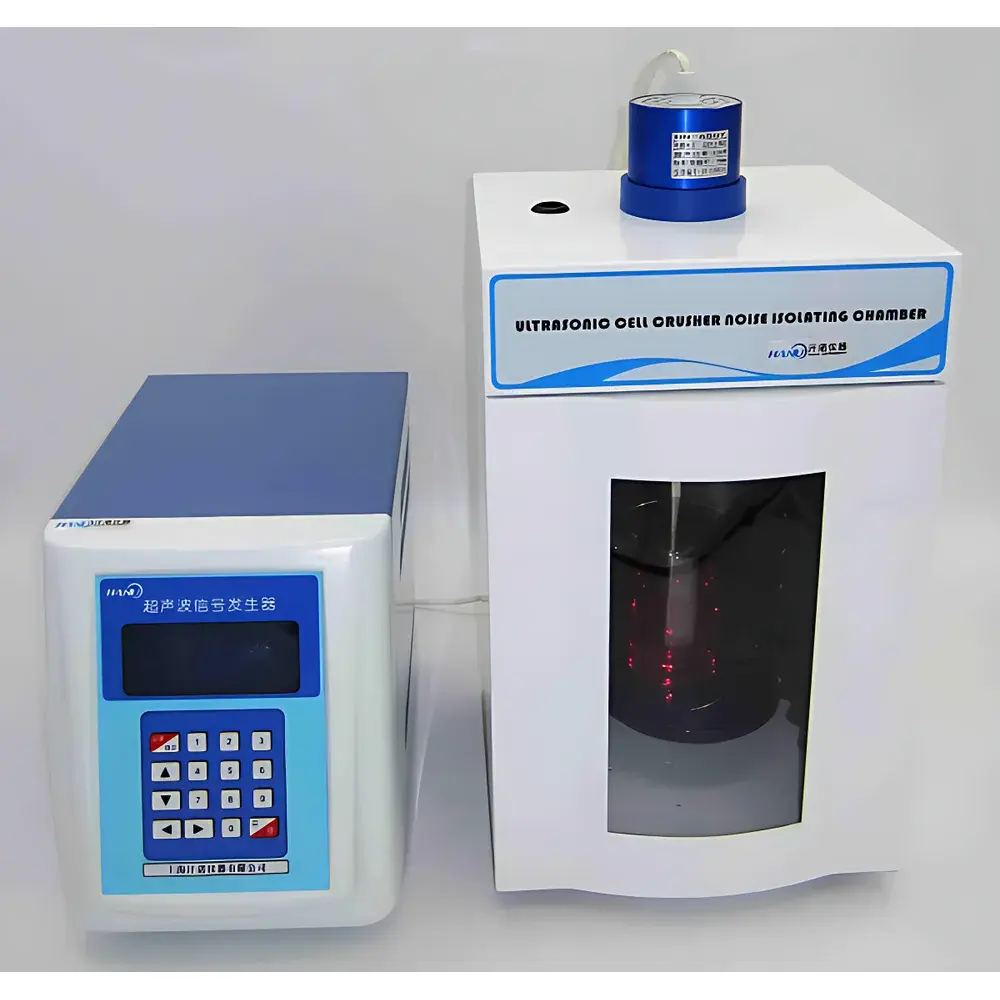
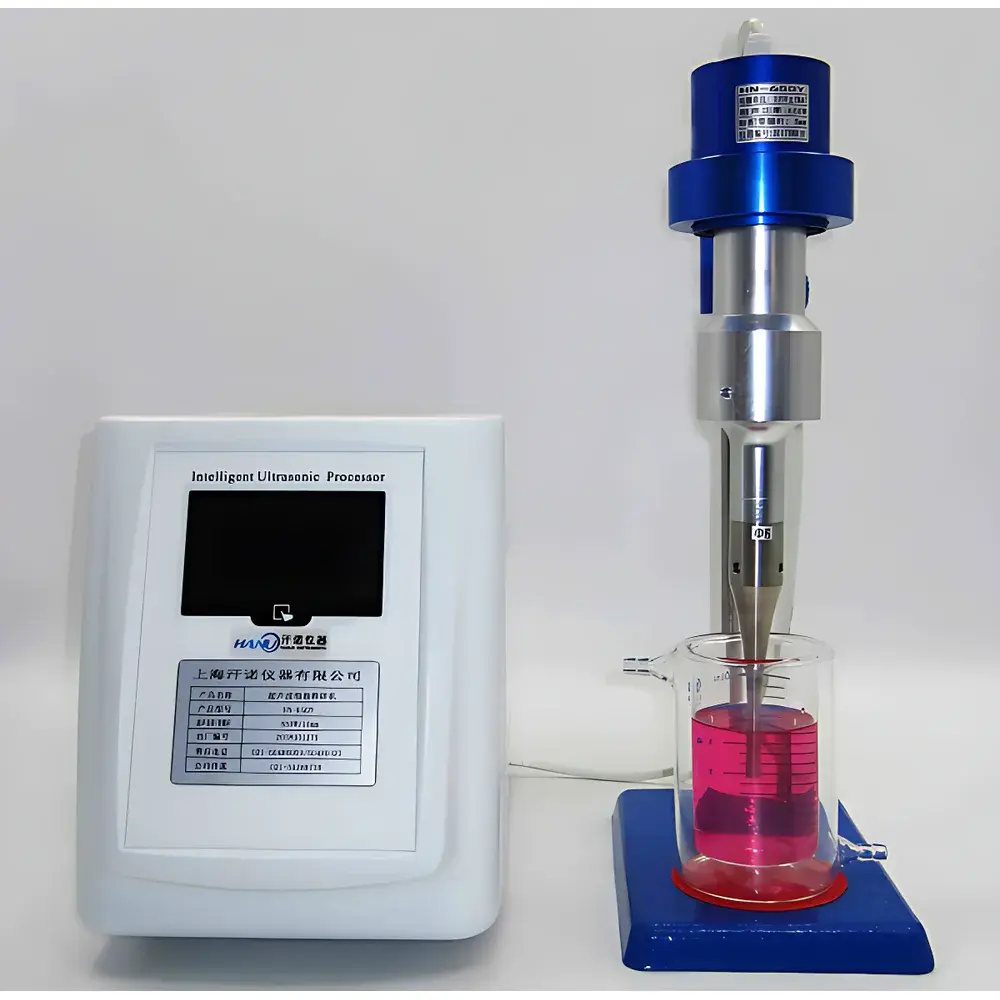
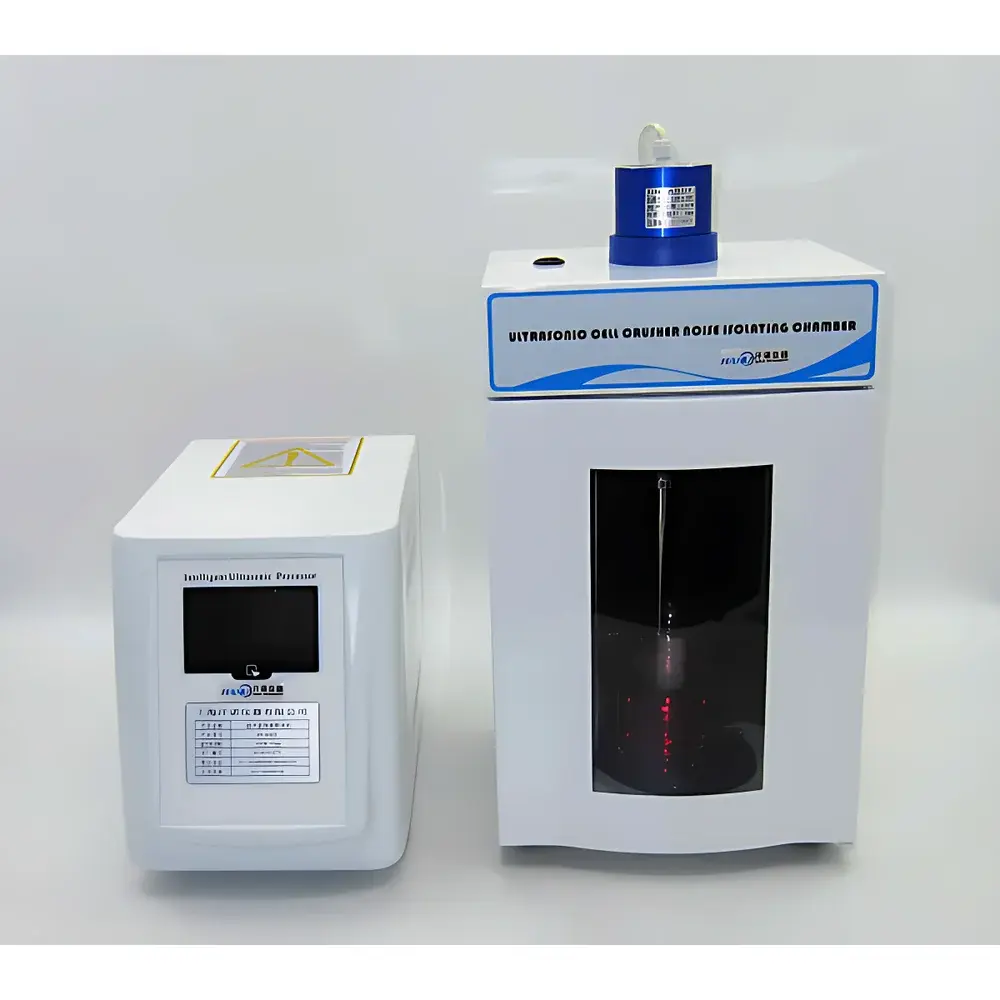
Hanuo HN92-II Ultrasonic Cell Disruptor
| Brand | Hanuo |
|---|---|
| Origin | Shanghai, China |
| Model | HN92-II |
| Instrument Type | Ultrasonic Cell Disruptor |
| Ultrasonic Power | 650 W |
| Operating Frequency | 20–25 kHz |
| Temperature Range | −5 to 100 °C |
| Maximum Sample Volume | 650 mL |
| Number of Samples per Run | 1 |
| Probe Material | Titanium Alloy |
| Duty Cycle Adjustment | 1–99.9% |
| Automatic Frequency Tracking | Yes |
| Amplitude Stability Control | Yes |
| Integrated Temperature Monitoring & Protection | Yes |
Overview
The Hanuo HN92-II Ultrasonic Cell Disruptor is a benchtop ultrasonic processor engineered for reliable, reproducible cell lysis, emulsification, dispersion, and homogenization in life science and bioprocessing laboratories. It operates on the principle of high-intensity focused ultrasound (HIU) at frequencies between 20 and 25 kHz, generating acoustic cavitation in liquid media. This cavitation produces transient microbubbles that collapse violently, resulting in localized shockwaves, shear forces, and extreme transient conditions (up to ~5,000 K and ~1,000 atm), which mechanically disrupt cellular membranes and subcellular structures without significant thermal denaturation when properly controlled. Designed for routine and scalable sample preparation, the HN92-II delivers consistent energy delivery across variable sample volumes (0.2–650 mL), making it suitable for applications ranging from small-volume nucleic acid extraction to bulk protein solubilization.
Key Features
- High-efficiency titanium alloy probe (standard Φ6 mm or optional Φ10 mm) with corrosion resistance and mechanical durability under prolonged sonication cycles.
- Digitally controlled ultrasonic power output (20–650 W), continuously adjustable in 1-W increments for precise energy modulation.
- Programmable duty cycle (1–99.9%) enabling pulsed-mode operation to minimize thermal accumulation during sensitive sample processing.
- Integrated temperature monitoring with real-time display and automatic shutdown if preset limits (−5 to 100 °C) are exceeded—critical for preserving labile biomolecules such as enzymes or RNA.
- Microprocessor-based control system with memory for up to 10 user-defined protocols, including time, power, duty cycle, and temperature thresholds.
- Automatic frequency tracking circuitry maintains resonance stability despite load variation or probe wear, ensuring consistent cavitation efficiency over time.
- Acoustically damped enclosure constructed with multi-layer composite sound-absorbing materials, reducing ambient noise to ≤65 dB(A) at 1 m distance.
- Amplitude stabilization algorithm compensates for impedance changes during sonication, maintaining constant displacement amplitude regardless of sample viscosity or volume.
Sample Compatibility & Compliance
The HN92-II accommodates a broad range of biological and chemical samples—including bacterial, yeast, mammalian, and plant cells; tissue suspensions; nanoparticle dispersions; and viscous polymer solutions. Its modular probe design supports interchangeable tips (Φ2, Φ3, Φ8, Φ10, Φ12, and Φ15 mm) for optimized energy coupling across diverse viscosities and vessel geometries. The instrument complies with IEC 61000-6-3 (EMC emission standards) and IEC 61000-6-2 (immunity). While not certified for GMP manufacturing environments, its programmable parameters, audit-ready protocol logging, and temperature interlock support GLP-aligned workflows. When used with validated methods, it meets common requirements for sample prep prior to downstream analysis per ISO 13485, USP , and ASTM E2927-14 (standard guide for ultrasonic processing).
Software & Data Management
The HN92-II features an embedded LCD interface with tactile keypad navigation—no external PC required for standard operation. All executed runs are timestamped and logged internally, recording start/stop time, total sonication duration, average power, peak temperature, and active protocol ID. Optional RS-232 or USB-to-serial connectivity enables integration with laboratory information management systems (LIMS) for automated data export. Though no proprietary software suite is bundled, ASCII-formatted logs can be parsed by third-party tools compliant with FDA 21 CFR Part 11 for electronic records—provided users implement appropriate access controls, audit trails, and electronic signatures externally.
Applications
- Cell lysis for genomic DNA, plasmid DNA, and total RNA isolation from Gram-negative/positive bacteria, yeast, and cultured mammalian cells.
- Chromatin shearing in ChIP-seq sample preparation (with optimized low-power, high-duty-cycle settings).
- Nanomaterial dispersion and deagglomeration in drug delivery formulation development.
- Protein extraction and solubilization from inclusion bodies or membrane fractions.
- Emulsification of oil-in-water or water-in-oil systems for food science and cosmetic R&D.
- Accelerated solvent extraction of natural products from botanical matrices.
- Wastewater microbiome disruption for metagenomic library construction.
FAQ
What is the maximum recommended continuous operating time per cycle?
For optimal probe longevity and thermal management, continuous operation should not exceed 5 minutes without a 2-minute cooling interval. Pulsed mode (e.g., 5 s ON / 3 s OFF) allows extended total processing times while maintaining sample integrity.
Can the HN92-II be used for sterilization or microbial inactivation?
No. While intense cavitation causes physical damage to microorganisms, the HN92-II is not designed or validated as a sterilization device. It lacks the process controls, validation documentation, and regulatory clearance required for sterility assurance.
Is calibration traceable to national standards?
Power output calibration is factory-performed using NIST-traceable acoustic power meters. Users may verify performance annually using a calibrated hydrophone and oscilloscope setup per ASTM E1002-19.
Does the unit support remote start/stop via TTL or analog signal?
No. The HN92-II does not feature external trigger inputs. Automation requires serial command integration via RS-232/USB.
What maintenance is required for long-term reliability?
Monthly inspection of probe threads and horn tip for pitting or cracking; annual replacement of ultrasonic transducer damping gaskets; cleaning of air vents and heat sinks to prevent thermal throttling.





