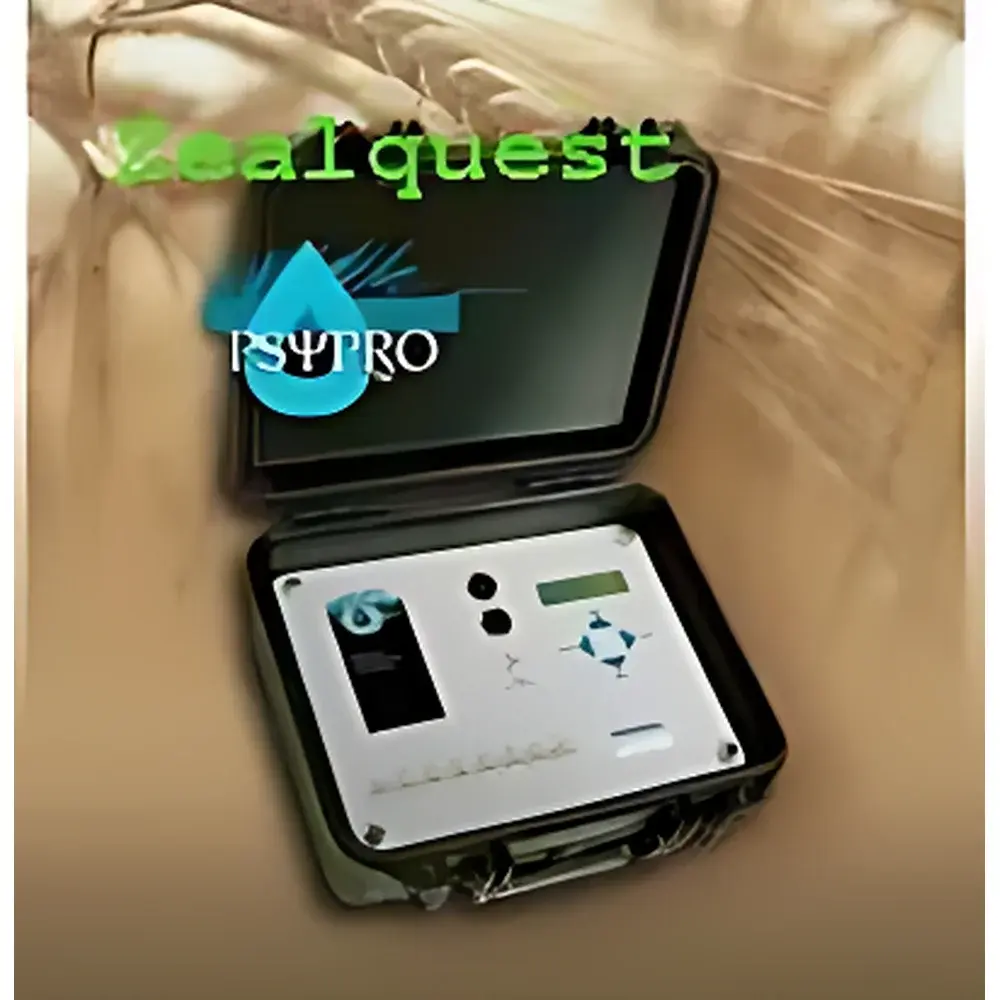
Wescor Psypro Dew Point Water Potential System
| Origin | USA |
|---|---|
| Manufacturer Type | Authorized Distributor |
| Import Status | Imported |
| Model | Psypro |
| Pricing | Upon Request |
Overview
The Wescor Psypro Dew Point Water Potential System is a precision-engineered instrument designed for direct, high-resolution measurement of water potential (Ψ) in plant tissues, soils, and other hygroscopic biological or geological samples. Operating on the fundamental thermodynamic principle of dew point depression, the system quantifies the vapor pressure deficit between a sample and a saturated reference surface by detecting the temperature at which condensation forms on a chilled thermocouple junction—i.e., the dew point temperature. This physical relationship is directly convertible to water potential via the Clausius–Clapeyron equation and calibrated vapor pressure–temperature functions. Unlike pressure chamber-based methods, the Psypro enables non-destructive, rapid (<60 s per sample), and repeatable measurements across a broad dynamic range—from near-zero (e.g., turgid leaves) to highly negative values (down to –300 MPa under optimized conditions with C-52 sample chambers). Its dual-mode operation supports both dew point and wet-bulb psychrometric protocols, allowing methodological flexibility depending on sample type, hydration state, and required accuracy. The system is widely deployed in plant ecophysiology, irrigation scheduling research, drought stress phenotyping, and soil–plant–atmosphere continuum (SPAC) modeling.
Key Features
- Eight-channel simultaneous input architecture supporting up to eight independent sensors—including C-52 sample chambers, L-51/L-51A leaf probes, and PST-55 soil water potential probes
- High-sensitivity analog front-end with ±300 mV input range, 20 nV resolution, and ±60 nV baseline noise floor for stable microvolt-level thermocouple signal detection
- Integrated thermoelectric cooling circuit with programmable cooling duration (5–60 s) and post-cooling wet-bulb equilibration window (2–10 s)
- Backlit 4-line × 20-character LCD display with intuitive menu-driven interface; no external computer required for field operation
- Onboard data logging capacity for 10,000 timestamped measurements with automatic channel identification and user-defined sampling intervals
- Rechargeable 12 V sealed lead-acid battery enabling >8 hours of continuous operation in remote or off-grid environments
- NEMA 4X-rated enclosure for dust-tight, water-resistant performance in greenhouse, field, and laboratory settings
Sample Compatibility & Compliance
The Psypro system accommodates diverse sample geometries and matrices through interchangeable sensor modules. The C-52 sample chamber accepts soil cores (9.5 mm × 4.5 mm cavity), intact leaves (7 mm × 2.5 mm), or standard filter paper discs (9.5 mm × 1.25 mm). The L-51A probe is optimized for narrow, flexible grass blades without tissue compression, while the PST-55 probe enables in situ soil monitoring with 1.5 m or 3 m cable options. All sensors comply with ASTM D4213-22 (Standard Test Method for Water Potential of Soils Using a Thermocouple Psychrometer) and align with ISO 11274:2021 (Soil quality — Determination of water retention characteristic curves). Data integrity meets GLP and GMP documentation requirements when used with time-stamped audit logs and RS232 export functionality compatible with FDA 21 CFR Part 11–compliant data management systems.
Software & Data Management
The included Windows-compatible software provides bidirectional communication via standard RS232 serial interface. Users can download logged datasets, configure measurement parameters (e.g., cooling duration, dwell time, averaging cycles), perform batch calibration corrections, and export tab-delimited ASCII files for integration into R, Python, or MATLAB workflows. Raw voltage readings (mV), calculated water potential (MPa), ambient temperature (°C), and timestamp metadata are stored with full traceability. The software supports automated report generation compliant with institutional data archiving policies and facilitates export to LIMS platforms via CSV schema mapping.
Applications
- Quantifying stomatal conductance limitations via leaf water potential gradients under controlled drought trials
- Validating soil hydraulic property models (e.g., van Genuchten parameters) using direct Ψ measurements at multiple matric potentials
- Screening crop genotypes for osmotic adjustment capacity in high-throughput phenotyping platforms
- Monitoring root-zone water status in precision agriculture deployments with PST-55 probe networks
- Calibrating capacitance and TDR-based soil moisture sensors against thermodynamically grounded water potential references
- Studying xylem embolism vulnerability curves via sequential dehydration experiments
FAQ
What is the lowest measurable water potential with the C-52 chamber?
Under standard laboratory conditions, the C-52 chamber reliably measures from –0.05 MPa to –8 MPa. With vacuum desiccation pretreatment and extended cooling cycles, validated measurements down to –300 MPa are achievable per Wescor technical note TN-017.
Can the Psypro operate unattended in the field for extended periods?
Yes—the internal battery supports >8 hours of continuous logging, and the NEMA 4X housing ensures operational integrity in rain, dust, and temperature fluctuations between 0°C and 60°C.
Is the system compatible with third-party data loggers or SCADA systems?
While designed for standalone use, the RS232 output provides ASCII-formatted real-time streaming (baud rate configurable up to 115,200), enabling integration with Campbell Scientific CR-series loggers or Modbus RTU gateways via serial-to-RTU converters.
How often does the thermocouple require recalibration?
Wescor recommends annual verification against certified saturated salt solutions (e.g., LiCl, MgCl₂) per ISO 9001 calibration procedures; drift is typically <±0.03 MPa over 12 months under routine use.
Does the software support multi-user access control or electronic signatures?
The base software does not include role-based authentication; however, exported datasets retain full metadata (operator ID, timestamp, instrument serial number), enabling downstream implementation in validated 21 CFR Part 11 environments via validated LIMS or ELN platforms.
Related Products