
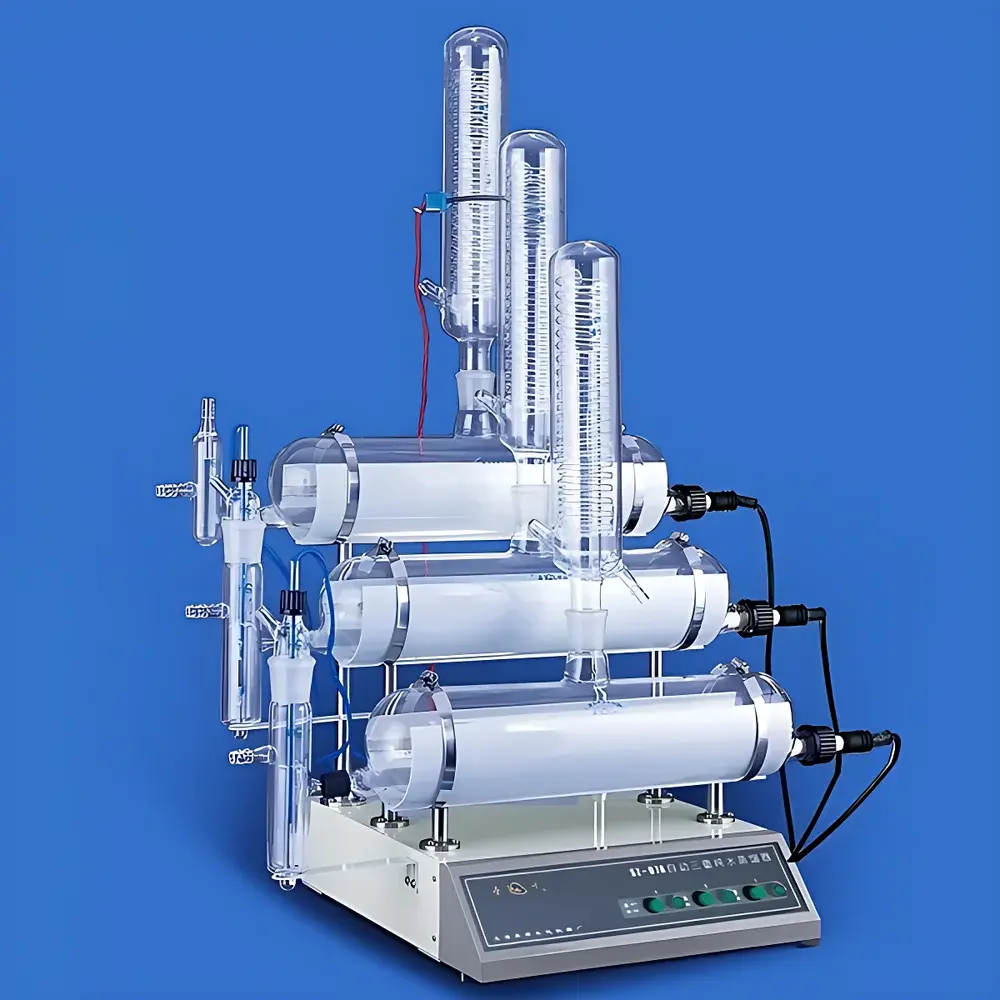
Jinye SZ-97A Automatic Triple-Stage Water Distillation System
| Brand | Jinye |
|---|---|
| Origin | Shanghai, China |
| Manufacturer Type | Direct Manufacturer |
| Country of Origin | China |
| Model | SZ-97A |
| Pricing | Available Upon Request |
Overview
The Jinye SZ-97A Automatic Triple-Stage Water Distillation System is a robust, benchtop laboratory purification apparatus engineered for the continuous production of high-purity distilled water via sequential vaporization and condensation. Unlike single-stage distillers, the SZ-97A implements three thermally isolated distillation stages in series—each stage re-distilling the condensate from the prior stage—to effectively remove non-volatile contaminants (e.g., heavy metals, silica, nitrates), semi-volatile organics, and ionic species that may carry over during primary evaporation. The system operates on the principle of fractional phase separation under controlled thermal gradients, leveraging gravity-fed feedwater circulation and passive reflux management to ensure consistent vapor purity across all stages. Designed for unattended operation, it integrates temperature-sensing thermostats, automatic water-level monitoring, and fail-safe dry-run protection to maintain operational integrity during extended runs—critical for labs requiring ISO/IEC 17025-compliant water for trace metal analysis, buffer preparation, or calibration standard dilution.
Key Features
- Triple-stage vertical distillation architecture with independent heating chambers and cooled condensation zones—minimizes cross-contamination and maximizes removal efficiency for total dissolved solids (TDS) and conductivity-limiting ions.
- Energy-efficient insulated housing with low-thermal-loss jacketing, reducing power consumption by up to 30% compared to conventional open-coil distillers without compromising output rate (typical yield: 4–6 L/h at 20°C ambient).
- Automated safety interlocks: real-time water level detection in each boiling chamber, overtemperature cutoff (<105°C), and automatic power disengagement upon reservoir depletion or condenser flow interruption.
- Stainless steel 316 construction for all wetted parts—including evaporator vessels, condenser coils, and collection tubing—to resist corrosion from chloride-rich feedwater and ensure long-term compliance with CLSI EP23 and ASTM D1193 Type II water specifications.
- Modular design supports field serviceability; heating elements, level sensors, and fuses are user-replaceable without specialized tools or factory recalibration.
Sample Compatibility & Compliance
The SZ-97A accepts municipal tap water, deionized (DI) water, or softened feedstock as input—provided feed conductivity remains below 500 µS/cm to prevent scaling and thermal stress on heating surfaces. Output water consistently meets or exceeds ASTM D1193 Type II (conductivity ≤ 1.0 µS/cm at 25°C; TOC < 50 ppb; bacteria < 10 CFU/mL) and ISO 3696 Grade 2 specifications. The system’s mechanical design conforms to IEC 61010-1:2010 for laboratory electrical equipment safety, and its documentation structure supports GLP audit readiness—including logbook templates for maintenance history, calibration records, and daily output verification per ISO/IEC 17025 Clause 7.7.
Software & Data Management
As a standalone analog-electromechanical system, the SZ-97A does not incorporate digital controllers or embedded firmware. All operational parameters—including heating status, chamber fill level, and fault indicators—are communicated via front-panel LED status lights and tactile push-button controls. For laboratories requiring traceability, optional external data loggers (e.g., Omega OM-DAQPRO-5300) can be interfaced via 4–20 mA analog outputs from integrated temperature transmitters (available as factory-installed accessory). This configuration satisfies basic FDA 21 CFR Part 11 requirements for attributable, legible, and contemporaneous records when paired with validated electronic lab notebook (ELN) systems.
Applications
- Preparation of rinse water for ICP-MS sample introduction systems and quartz atomization chambers.
- Formulation of HPLC mobile phases where residual sodium or chloride ions could suppress ionization or foul C18 columns.
- Manufacturing of cell culture media and electrophoresis buffers requiring low endotoxin and metal content.
- Calibration of conductivity meters, pH electrodes, and TOC analyzers in metrology laboratories.
- Supporting ISO 15195-accredited reference material dilution protocols where water purity directly impacts uncertainty budgets.
FAQ
What feedwater quality is recommended for optimal performance and longevity?
Tap water with hardness < 150 ppm CaCO₃ and chlorine residual < 2 mg/L is acceptable; however, pretreatment via activated carbon filtration and softening is strongly advised to extend heating element life and reduce descaling frequency.
Can the SZ-97A produce Type I ultrapure water?
No—the SZ-97A delivers Type II water per ASTM D1193. For Type I (≤ 0.1 µS/cm, < 5 ppb TOC), downstream polishing with a mixed-bed ion exchange cartridge or UV oxidation module is required.
Is validation documentation available for GMP environments?
Yes—Jinye provides a Factory Acceptance Test (FAT) report, IQ/OQ protocol templates, and a materials-of-construction certificate (316SS mill test reports) upon request for regulated facility integration.
How often does the system require descaling?
Under typical Shanghai municipal feedwater conditions (TDS ≈ 300–400 ppm), descaling every 200–250 operating hours using 5% citric acid solution is sufficient; frequency scales inversely with feedwater pretreatment efficacy.
Does the unit comply with CE or UKCA marking requirements?
The SZ-97A is supplied with IEC 61010-1 certification and RoHS 2011/65/EU compliance documentation; CE marking is applied for EU-distributed units meeting EN 61326-1 for EMC and EN 61000-6-3 for emissions.
Related Products



