
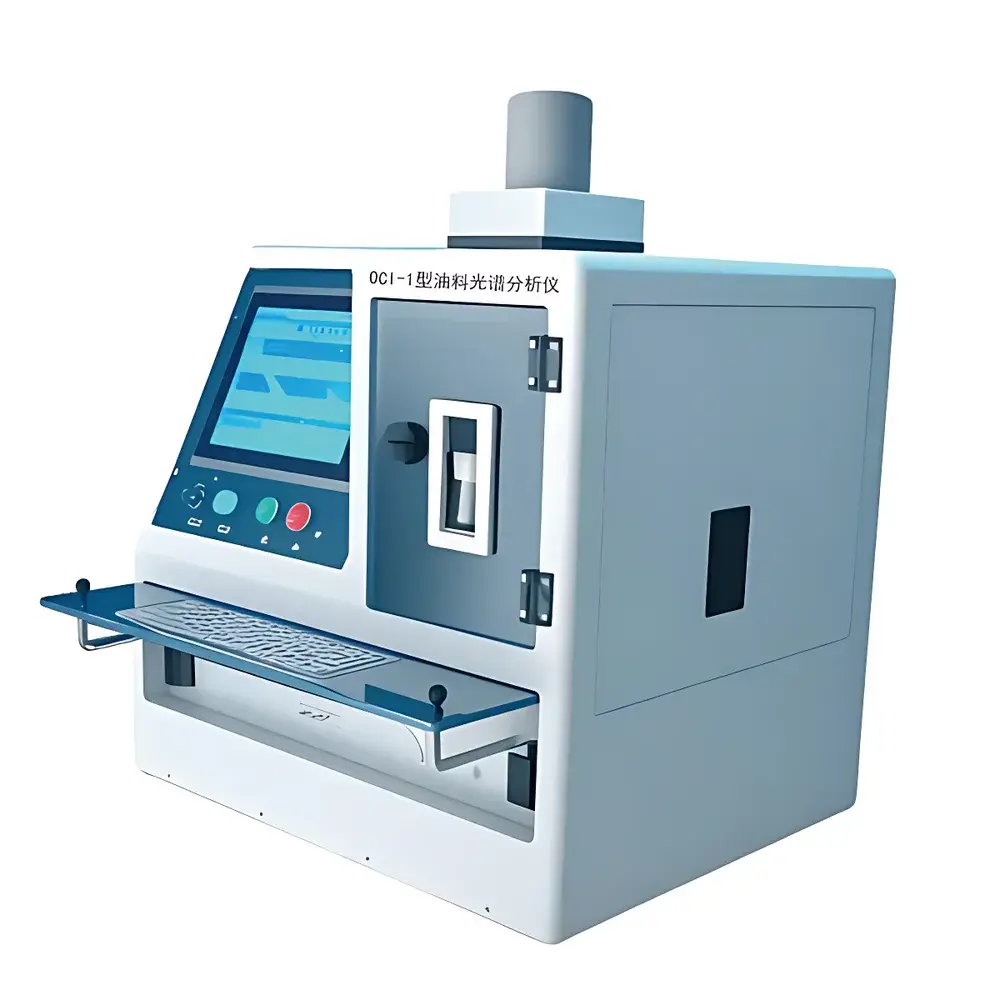
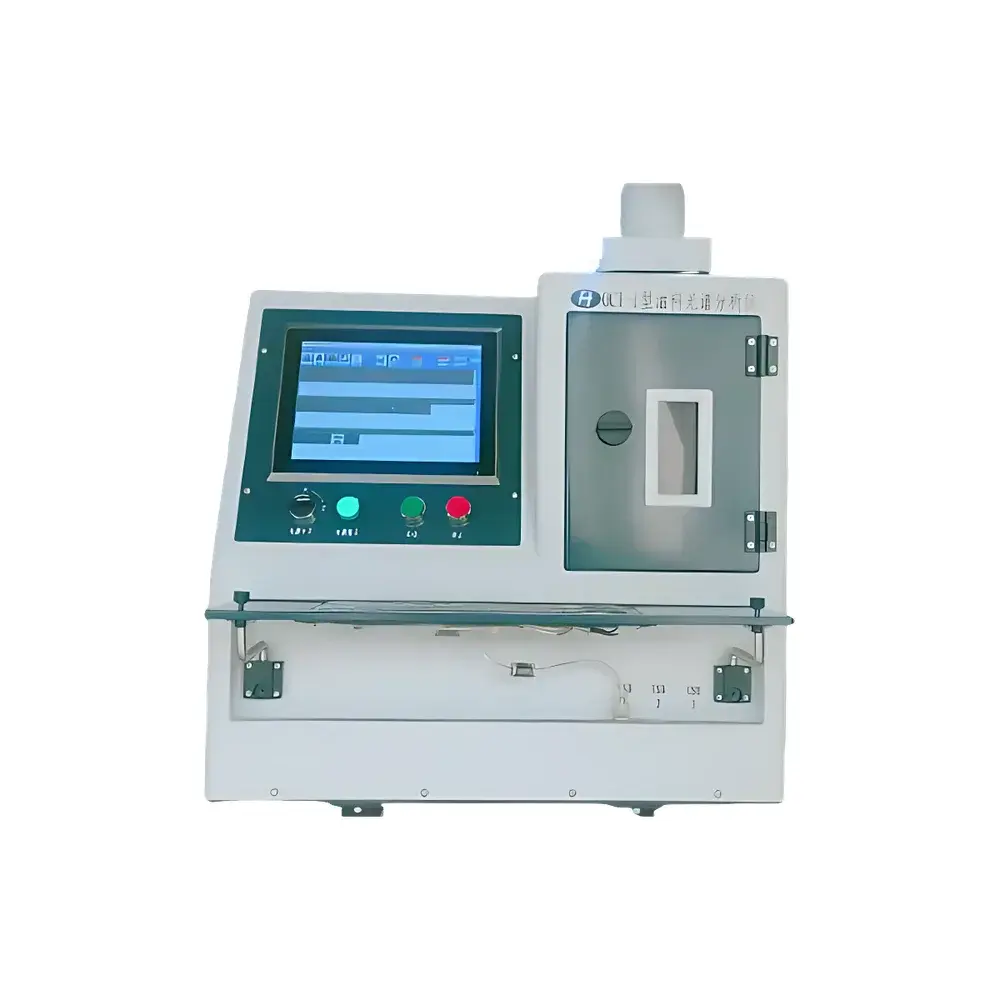
Beijing Hangfeng OCI-1 Rotating Disk Electrode Optical Emission Spectrometer
| Brand | Beijing Hangfeng |
|---|---|
| Origin | Beijing, China |
| Model | OCI-1 |
| Spectral Range | 203–800 nm |
| Sample Volume | ~2 mL |
| Detection Limit | 1 ppm (for key wear metals) |
| Operating Temperature | 0–50 °C |
| Relative Humidity | 0–90% RH (non-condensing) |
| Power Consumption | 10 W (standby), 500 W (during spark excitation) |
| Voltage | 220 V / 50 Hz |
| Dimensions (L×W×H) | 737 × 686 × 830 mm |
| Weight | <68 kg |
| Data Interface | USB + Ethernet |
| Compliant Standards | ASTM D6595, ASTM D6596 (lubricants), ASTM D6728 (fuels) |
| Analyte Elements | Fe, Al, Cu, Cr, Ni, Ca, Mn, Mo, Ti, Cd, Pb, Sn, Na, Ag (expandable per customer requirement) |
| Detector | CCD array |
| Excitation Method | Rotating disk electrode (RDE) with controlled spark discharge |
| Sample Prep | Minimal — no acid digestion or dilution required |
| Analysis Time | ≤30 seconds per sample |
| Integrated Components | Industrial-grade embedded PC, thermal printer, intelligent temperature stabilization system |
| Optional | Vibration-damping transport case, Expert Diagnostic Module (EDM), electrode maintenance kit (grinding blade, cleaning wipes, calibration oils, sample cups, RDE rods & disks) |
Overview
The Beijing Hangfeng OCI-1 Rotating Disk Electrode Optical Emission Spectrometer is a benchtop analytical instrument engineered for rapid, quantitative elemental analysis of used lubricants, hydraulic fluids, and fuels. It operates on the principle of arc/spark-induced atomic emission spectroscopy (AES), where a high-energy electrical discharge between a rotating disk electrode and a counter electrode atomizes and excites metal particles suspended in the oil matrix. The emitted light is dispersed across a 203–800 nm spectral range and resolved by a high-resolution CCD array detector, enabling simultaneous multi-element detection without mechanical wavelength scanning. Designed to meet ASTM D6595 performance criteria for wear debris analysis in condition monitoring programs, the OCI-1 delivers laboratory-grade precision in both fixed-lab and mobile field environments—supporting predictive maintenance strategies across aviation, power generation, marine propulsion, and heavy-duty industrial fleets.
Key Features
- Rotating disk electrode (RDE) excitation system ensures stable plasma generation and reproducible signal intensity across varying oil viscosities and particulate loadings.
- Full-spectrum CCD detection enables flexible channel selection and post-acquisition reprocessing—no hardware reconfiguration needed to add or modify analyte elements.
- Intelligent temperature stabilization system maintains optical path and detector thermal equilibrium within ±0.5 °C, minimizing spectral drift during extended operation.
- Minimal sample preparation: direct analysis of 2 mL untreated oil—no acid digestion, filtration, or dilution required—reducing contamination risk and operator exposure.
- Integrated industrial PC and thermal printer provide standalone operation; results are generated, stored, and printed within ≤30 seconds per sample.
- Robust mechanical architecture with reinforced chassis and optional vibration-damping transport case supports deployment in non-laboratory settings including hangars, engine test cells, and offshore platforms.
Sample Compatibility & Compliance
The OCI-1 accepts a broad range of hydrocarbon-based fluids—including mineral and synthetic engine oils, turbine oils, gear oils, hydraulic fluids, diesel fuel, and jet fuel (Jet A/Jet A-1). Its RDE configuration accommodates viscosity ranges from ISO VG 10 to VG 680 without modification. All measurement protocols align with ASTM D6595 (Standard Test Method for Determination of Wear Metals and Contaminants in Used Lubricating Oils or Fuel Oils by Rotating Disc Electrode Atomic Emission Spectrometry), ASTM D6596 (for lubricant elemental analysis), and ASTM D6728 (for distillate fuel analysis). Instrument validation documentation supports GLP-compliant reporting and satisfies data integrity requirements under FDA 21 CFR Part 11 when paired with audit-trail-enabled software configurations.
Software & Data Management
The OCI-1 runs on a Windows-based analytical platform featuring real-time spectrum visualization, automated peak identification, and multi-point calibration curve fitting using NIST-traceable reference oils. Data export conforms to ASTM E1382-compliant formats (CSV, XML, PDF) and integrates with CMMS and SAP PM modules via OPC UA or SQL database connectors. The optional Expert Diagnostic Module (EDM) functions as an embedded decision-support layer: it cross-references elemental concentration trends against OEM wear thresholds, historical baselines, and failure mode libraries to generate actionable maintenance advisories—not generic alerts. All software updates, method templates, and calibration logs are version-controlled with timestamped user authentication.
Applications
- Condition-based monitoring of rotating machinery (turbines, compressors, gearboxes) through trending of Fe, Cr, Ni, and Al concentrations.
- Detection of coolant ingress (Na, K, Si) and fuel dilution (Ca, Zn, P depletion patterns) in diesel and gas engine oils.
- Verification of additive package integrity (Zn, P, Ca, Mg, Ba) in new and in-service lubricants per OEM specifications.
- Field-deployable forensic analysis following catastrophic failures—enabling rapid root-cause attribution to bearing fatigue, abrasive wear, or corrosion mechanisms.
- Quality assurance screening of bulk oil deliveries and reconditioned fluids prior to commissioning.
FAQ
What sample volume is required for analysis?
Approximately 2 mL of unfiltered, homogenized oil is sufficient. No centrifugation or settling is necessary.
Does the instrument require external argon or other purge gases?
No. The RDE excitation operates reliably in ambient air; no gas supply infrastructure is needed.
How frequently must the electrodes be reconditioned?
Electrode lifetime exceeds 500 analyses under typical use; grinding and cleaning are recommended every 100–200 tests using the supplied maintenance kit.
Can the OCI-1 quantify non-metallic elements such as boron or sulfur?
Not natively—the current optical design and RDE plasma conditions are optimized for metallic wear elements and common additives; non-metals fall below reliable detection limits.
Is remote diagnostics and software support available?
Yes. The embedded PC supports secure remote desktop access (with customer authorization) for troubleshooting, method validation, and firmware updates.




