
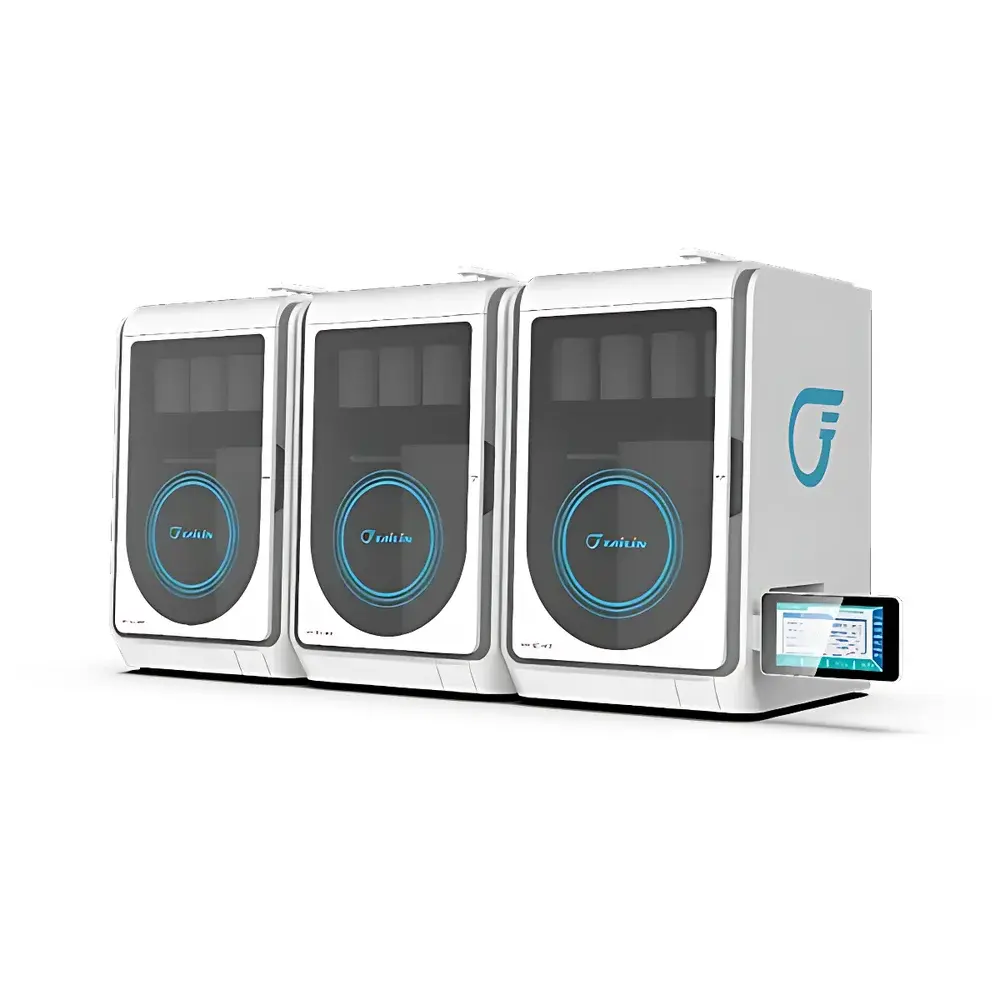
Tailin Biotech HTY-GCC-S100 Fully Automated *Cryptosporidium* and *Giardia* (Two-Protozoan) Sedimentation and Concentration System
| Brand | Tailin Biotech |
|---|---|
| Origin | Zhejiang, China |
| Manufacturer Type | Direct Manufacturer |
| Country of Origin | China |
| Model | HTY-GCC-S100 |
| Price | Upon Request |
| Water Processing Capacity | 10 L per cycle |
| Pretreatment Time | ≤15 min |
| Touchscreen Interface | 7-inch foldable color LCD |
| Sample Loading | Motorized or manual |
| Power Consumption | ≤300 W |
| Unit Weight | 18 kg |
| Settling Timer Range | 0–99 h |
| Turbidity Sensor Range | 0–200 NTU |
| Pressure Sensor Range | 0–2.0 MPa |
| Stirring Speed Range | 0–1500 rpm |
| Disinfection Method | Integrated UV-C lamp (254 nm) |
| pH Sensor Range | 0–14 |
| Parallel Operation | Up to 8 units via master-slave configuration |
| Average Protozoan Recovery Efficiency | >35% (per ASTM D5421 / ISO 15553 validated methodology) |
| Workflow Customization | User-defined SOPs with real-time status alerts and auto-halt on anomaly detection |
Overview
The Tailin Biotech HTY-GCC-S100 is a fully automated sedimentation-based concentration system engineered for the reliable recovery and enrichment of Cryptosporidium parvum and Giardia lamblia cysts and oocysts from large-volume environmental water samples. Designed in accordance with the foundational principles of gravitational settling under controlled hydrodynamic conditions, the HTY-GCC-S100 eliminates manual centrifugation and filtration bottlenecks by integrating programmable agitation, timed quiescent settling, and integrated sensor-monitored stabilization. Its core architecture supports methodologically consistent implementation of EPA Method 1623.1 and ISO 15553:2012 — both of which specify sedimentation as a primary concentration step prior to immunomagnetic separation (IMS) and microscopic or molecular detection. The system operates without requiring hazardous chemical flocculants or high-pressure membrane filtration, making it suitable for field-deployable labs, municipal water quality control centers, and contract testing laboratories conducting routine regulatory compliance monitoring.
Key Features
- Automated dual-mode sample loading: motor-driven peristaltic aspiration or manual gravity-fed input, configurable per sample matrix viscosity and turbidity
- Real-time multi-parameter monitoring: integrated turbidity (0–200 NTU), pressure (0–2.0 MPa), pH (0–14), and rotational speed (0–1500 rpm) sensors feed closed-loop control logic during agitation and settling phases
- Programmable settling protocol: user-definable quiescent duration (0–99 hours) with temperature-stabilized chamber design to minimize thermal convection currents
- Onboard UV-C disinfection (254 nm, ≥40 mJ/cm² dose) for post-cycle decontamination of fluidic pathways and sample contact surfaces, reducing cross-contamination risk between runs
- 7-inch foldable industrial-grade touchscreen with glove-compatible interface, supporting multilingual UI (English, Spanish, French) and embedded SOP-guided workflow navigation
- Scalable modular architecture: up to eight HTY-GCC-S100 units can be synchronized via RS485/Modbus RTU to a central controller, enabling parallel processing of heterogeneous sample sets while maintaining individual audit trails
Sample Compatibility & Compliance
The HTY-GCC-S100 accommodates raw surface water, finished drinking water, wastewater effluent, and reclaimed water matrices — including those with suspended solids up to 100 mg/L and turbidity ≤150 NTU. All wetted components comply with USP Class VI biocompatibility standards and FDA 21 CFR 177.2600 for food-contact polymers. System validation documentation includes traceable recovery data generated using certified C. parvum oocyst and G. lamblia cyst reference materials (Waterborne Inc., lot-matched to NIST SRM 2971). Instrument operation adheres to GLP-compliant data integrity requirements: all parameter changes, run logs, sensor calibrations, and maintenance events are time-stamped and stored locally with optional encrypted export to LIMS via CSV or ASTM E1384-compliant XML.
Software & Data Management
Firmware v3.2.1 embeds a deterministic real-time operating system (RTOS) with non-volatile memory retention for ≥10,000 run records. Each record contains full metadata: operator ID, sample ID, start/stop timestamps, sensor trend snapshots (every 30 s), alarm flags (e.g., overpressure, motor stall, UV lamp failure), and final recovery efficiency estimates derived from internal calibration curves. Audit trail functionality satisfies FDA 21 CFR Part 11 requirements, including electronic signatures, role-based access control (admin/operator/viewer), and immutable log archiving. Optional cloud sync (TLS 1.3 encrypted) enables remote diagnostics and fleet-wide performance benchmarking across distributed laboratory networks.
Applications
- Regulatory compliance testing for drinking water utilities under the U.S. Long Term 2 Enhanced Surface Water Treatment Rule (LT2ESWTR) and EU Drinking Water Directive (2020/2184)
- Environmental surveillance of watersheds impacted by agricultural runoff or wildlife encroachment
- Validation studies supporting IMS and qPCR assay development for protozoan pathogen quantification
- Emergency response screening during suspected waterborne outbreaks (e.g., community-level giardiasis investigations)
- Research applications in parasitology, environmental virology, and source tracking of zoonotic enteric pathogens
FAQ
What volume range does the HTY-GCC-S100 support per run?
The system is calibrated for single-run processing of 1–10 L of water, with precision volumetric dosing accuracy ±2% at 10 L.
Is method validation data available for regulatory submission?
Yes — a complete IQ/OQ/PQ protocol package, including inter-laboratory recovery studies aligned with ASTM D5421 Annex A1, is supplied with each unit.
Can the system interface with third-party LIMS platforms?
It supports ASTM E1384, HL7 v2.5.1, and generic RESTful API endpoints for structured data export; custom integration support is available under NDA.
How often must the UV lamp be replaced?
Lamp lifetime is rated at ≥8,000 hours; firmware tracks cumulative irradiation dose and triggers preventive maintenance alerts at 90% end-of-life threshold.
Does the system require external compressed air or vacuum sources?
No — all fluid handling is driven by integrated peristaltic pumps and gravity-assisted settling; only standard 100–240 VAC power input is required.







