
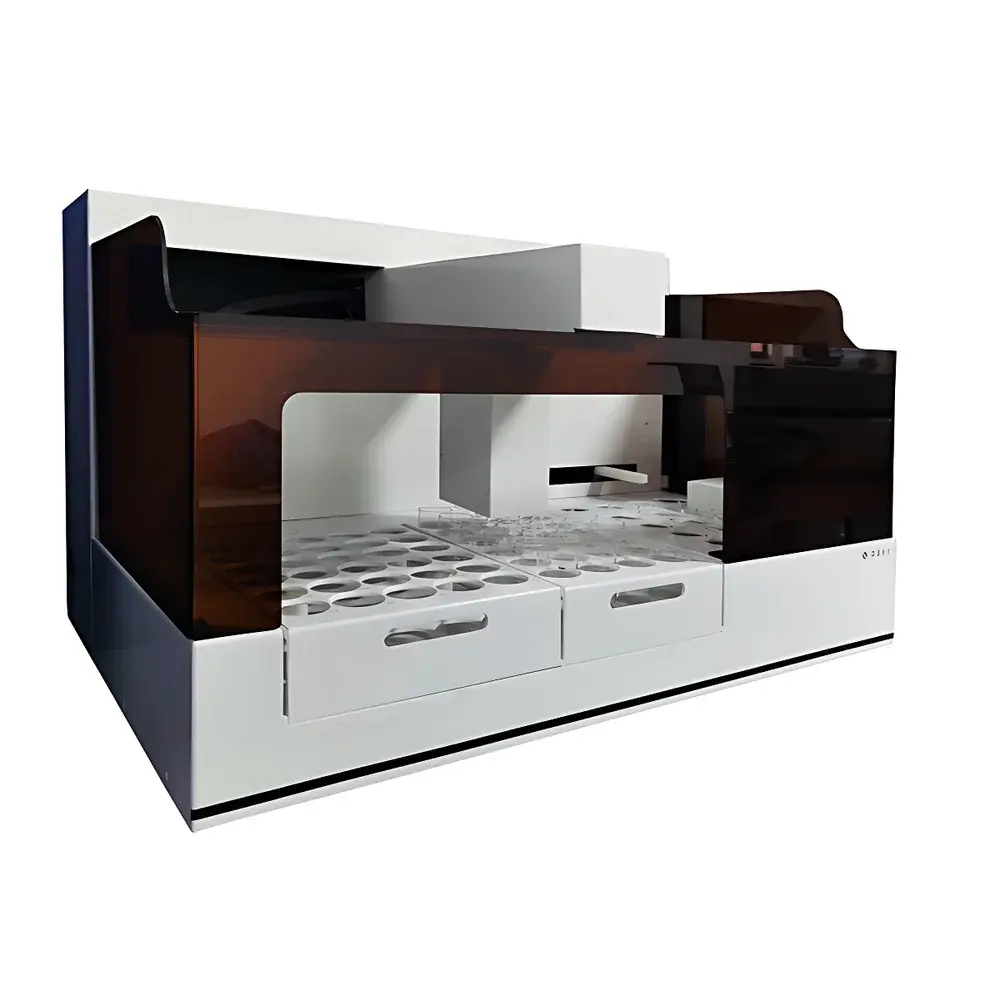
Synpec SP7210 Permanganate Index Analyzer
| Brand | Synpec |
|---|---|
| Model | SP7210 |
| Origin | Shanghai, China |
| Manufacturer Type | Direct Manufacturer |
| Measurement Principle | Potassium Permanganate Titrimetric Oxidation (COD<sub>Mn</sub>) |
| Measurement Range | 0–6 mg/L as O<sub>2</sub> |
| Repeatability | RSD ≤ 2.5% |
| Sample Capacity | 54 positions |
| Digestion Time | 30 min at boiling temperature (100 °C) |
| Digestion Mode | Automated water bath with constant temperature and liquid level control |
| Titration Delivery Precision | Adjustable single-dose volume from 0.01 to 0.07 mL |
| Titration Endpoint Detection | Colorimetric endpoint recognition |
| Sample Throughput | One sample per 5 minutes |
| Sample Introduction | Three-axis robotic arm (X/Y/Z) with basket-style tray loading |
| Reagent Delivery | High-accuracy peristaltic pump for KMnO<sub>4</sub>, H<sub>2</sub>SO<sub>4</sub>, and Na<sub>2</sub>OX solutions |
| Compliance | GB 11892–1989 |
Overview
The Synpec SP7210 Permanganate Index Analyzer is a fully automated benchtop instrument engineered for the precise, reproducible determination of the permanganate index (CODMn) in natural and treated waters. CODMn quantifies the oxygen demand exerted by oxidizable substances—including reduced inorganic species (e.g., Fe2+, NO2−, S2−) and readily oxidized organic compounds—when reacted with potassium permanganate under standardized acidic, boiling conditions. As defined in GB 11892–1989, this method serves as a key surrogate parameter for assessing low-to-moderate organic pollution in surface water, groundwater, reservoirs, drinking water sources, and environmental monitoring stations. Unlike dichromate-based COD (CODCr), CODMn reflects a milder oxidation strength, making it especially relevant for clean or slightly polluted freshwater systems where regulatory frameworks emphasize ecological integrity and potability.
Key Features
- Fully automated workflow—from sample aspiration and reagent dosing to boiling digestion, back-titration, and result calculation—eliminates manual intervention and operator bias.
- 54-position sample carousel with basket-style tray design enables rapid batch loading and unloading while maintaining thermal and positional stability during analysis.
- Three-axis robotic arm (X/Y/Z) ensures repeatable, vibration-free movement across the workspace; precision-guided motion supports consistent pipetting, vial positioning, and titration nozzle alignment.
- Integrated boiling water bath with active temperature and liquid-level regulation guarantees uniform 30-minute digestion at 100 °C ± 0.5 °C, meeting the strict thermal requirements of GB 11892–1989.
- High-resolution peristaltic pumping system delivers KMnO4, H2SO4, and sodium oxalate solutions with volumetric accuracy better than ±0.5% CV, enabling reliable stoichiometric control throughout the redox reaction sequence.
- Colorimetric endpoint detection uses dual-wavelength photometry (525 nm/620 nm) to identify the persistent pink hue of excess permanganate, minimizing subjectivity and enhancing inter-laboratory comparability.
- Modular mechanical architecture maximizes internal accessibility—no tools required for routine maintenance of pumps, valves, tubing, or digestion bath components.
Sample Compatibility & Compliance
The SP7210 accepts standard 25-mL borosilicate glass digestion vials and accommodates turbid, colored, or suspended-solid-containing samples typical of riverine, lacustrine, and shallow aquifer matrices. It complies fully with the procedural specifications outlined in GB 11892–1989, including prescribed reagent concentrations, digestion duration, cooling intervals, and titration protocol. While not intended for wastewater or highly saline effluents (where CODCr per ISO 6060 or ASTM D1252 is recommended), the analyzer supports GLP-aligned operation through audit-trail-enabled software logging, user access levels, and electronic signature capability—facilitating readiness for regulatory inspections under China’s Ministry of Ecology and Environment (MEE) guidelines and municipal water quality surveillance programs.
Software & Data Management
Control and data acquisition are managed via Synpec’s proprietary Windows-based analytical software, which provides real-time monitoring of all hardware states (temperature, pump cycles, arm position, photometric signal). Each analysis generates a timestamped report containing raw absorbance curves, titration volume logs, calculated CODMn values (mg/L O2), RSD statistics per batch, and deviation flags for out-of-spec digestion or endpoint detection. Data export conforms to CSV and PDF formats; optional LIMS integration supports HL7 or ASTM E1384-compliant transmission. All method parameters—including acid concentration, KMnO4 titer, and blank correction routines—are user-configurable and stored with version-controlled method files to ensure traceability and method validation compliance.
Applications
- Regulatory monitoring of source water quality for municipal drinking water treatment plants.
- Routine assessment of lake and reservoir trophic status in environmental protection agencies.
- Long-term trend analysis of organic load in headwater streams and protected watersheds.
- Verification of pretreatment efficiency in groundwater remediation projects.
- Quality assurance testing for bottled water and spring water producers under GB 8537–2018.
- Academic research on biogeochemical cycling of reducible species in freshwater ecosystems.
FAQ
What standards does the SP7210 validate against?
The instrument implements the complete methodology specified in GB 11892–1989, including reagent preparation, digestion conditions, titration procedure, and calculation formula. It does not claim equivalence to ISO 8467 or APHA 5210 B, as those methods differ in oxidation strength and applicability scope.
Can the SP7210 analyze seawater or brackish samples?
No. Chloride interference above 300 mg/L compromises permanganate stability and endpoint clarity. For saline matrices, alternative indices such as iodometric or spectrophotometric chloride-corrected methods should be applied separately.
Is calibration verification required before each batch?
Yes. A system suitability test using certified potassium hydrogen phthalate (KHP) or standardized oxalic acid solution must be performed daily or per batch, per GB 11892–1989 Section 7.2.
How is carryover prevented between samples?
The system employs air-gap aspiration, triple-rinse cycles with deionized water, and dedicated waste lines for acidic and permanganate residuals—validated to achieve <0.1% cross-contamination per ICH Q2(R2) guidance.
Related Products





