
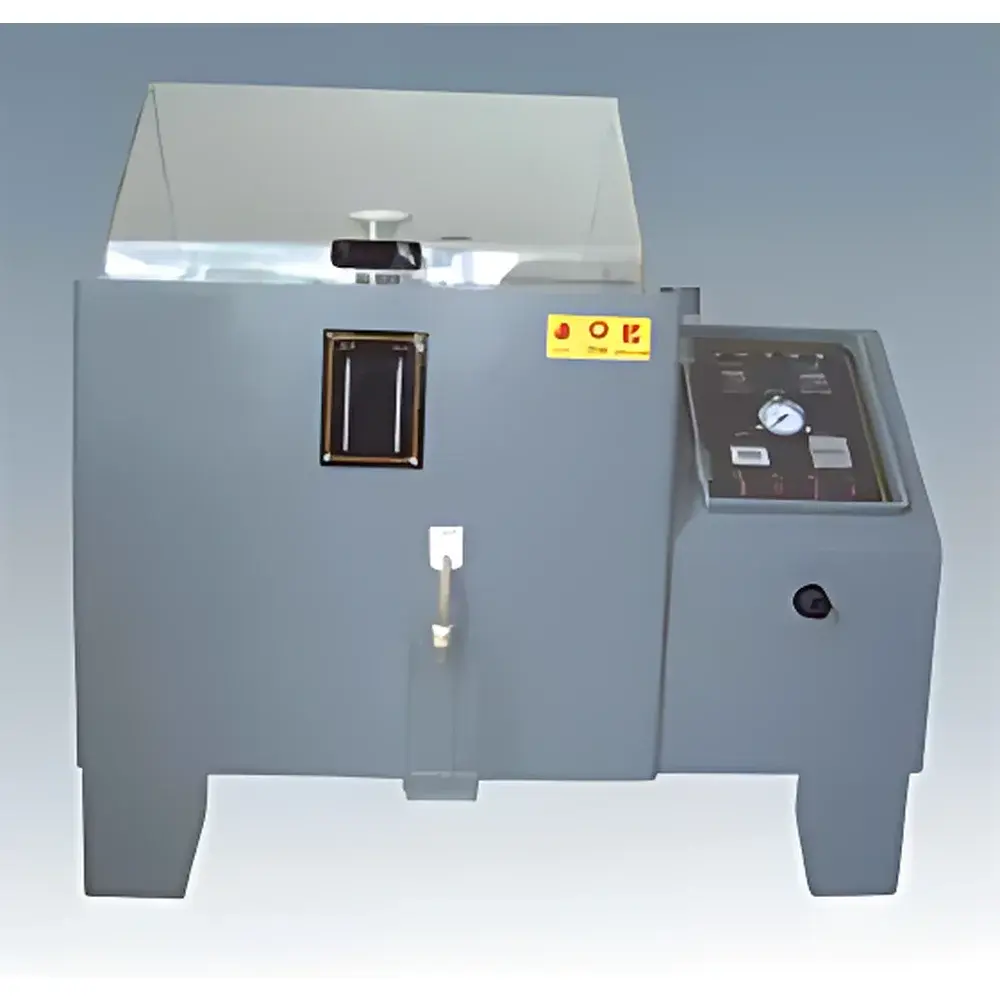
LabCompanion SH-110 Salt Spray Test Chamber
| Brand | LabCompanion |
|---|---|
| Origin | Guangdong, China |
| Manufacturer Type | Direct Manufacturer |
| Model | SH-110 |
| Construction Material | Imported corrosion-resistant, high-strength PVC/PP inner chamber |
| Sealing Method | Water-seal design (zero salt fog leakage) |
| Standard Accessories | One round-bar & one V-shaped sample rack, two nozzles, two funnels + calibrated collection cylinders |
| Safety Protections | Leakage current, short-circuit, over-temperature, low-water, end-of-test, and over-current protection |
| Power Supply | AC220V±10% 50Hz or AC380V±10% 50Hz |
| Operating Ambient | 5°C–30°C, ≤85% RH |
| Temperature Range | +5°C to 55°C |
| Temperature Uniformity | ≤±2°C |
| Temperature Fluctuation | ≤±0.5°C |
| Salt Fog Deposition Rate | 1–2 mL / 80 cm²·h |
| Spray Mode | Continuous or programmable cyclic spray |
| Timer Range | 1–999 hours (adjustable in seconds/minutes/hours) |
| Humidity Range (optional wet-salt mode) | 85–95% RH |
| Compliance | GB/T 2423.17, GB/T 10125–1997, GB/T 10587, ASTM B117, ISO 3768/3769/3770, DIN 50021, JIS Z 2371, MIL-STD-810, IEC 60068-2-11 |
Overview
The LabCompanion SH-110 Salt Spray Test Chamber is an engineered environmental test system designed for accelerated corrosion evaluation of metallic substrates, coated components, electroplated parts, and finished assemblies under controlled saline aerosol exposure. It operates on the principle of continuous or cyclic nebulization of a standardized sodium chloride (NaCl) solution—typically 5% w/w—into a temperature-regulated test chamber, generating a stable, reproducible salt fog atmosphere that simulates aggressive coastal or industrial marine environments. Unlike ambient exposure testing requiring months or years, this chamber enables quantifiable corrosion assessment within days or weeks, supporting comparative material qualification, process validation, and quality assurance workflows across automotive, aerospace, electronics, and defense supply chains. Its dual-capability architecture supports both neutral salt spray (NSS) per ASTM B117 and acetic acid salt spray (AASS) per ISO 9227, with optional integration into combined humidity-salt cycling protocols aligned with ISO 16701 and GMW 14872.
Key Features
- Robust chamber construction using imported high-grade PVC and PP for inner walls and base—resistant to HCl, NaCl, and organic solvents, ensuring long-term structural integrity and minimal maintenance.
- Transparent polycarbonate (PC) or high-impact PVC lid enabling real-time visual monitoring of specimen condition and spray distribution without opening the chamber.
- Tower-type spray system with non-crystallizing nozzles and integrated water filtration at the suction line—prevents nozzle clogging and ensures uniform fog generation across the entire test volume (1–2 mL/80 cm²·h, ASTM-compliant deposition).
- Water-seal chamber interface eliminates salt fog leakage, maintaining operator safety and preventing laboratory contamination—critical for ISO/IEC 17025-accredited labs.
- Dual-mode temperature control via PID-regulated nickel-chromium heating elements and platinum RTD (PT100) sensing, delivering ±0.5°C stability and ≤±2°C uniformity across the 750 × 1100 × 500 mm working volume.
- Modular electrical layout with front-access service panels, circuit breakers on all branches, and redundant thermal cutoffs—supporting GLP-compliant preventive maintenance and audit readiness.
- Configurable timer (1–999 h) and spray cycle logic (on/off duration independently adjustable), facilitating multi-stage corrosion protocols including dry, humid, and salt phases.
Sample Compatibility & Compliance
The SH-110 accommodates flat, cylindrical, or irregularly shaped specimens up to 1100 mm wide, with standardized V- and round-bar racks ensuring optimal orientation per ASTM B117 angular requirements (15°–30° from vertical). All internal fixtures—including racks, funnels, and calibrated collection cylinders—meet dimensional tolerances specified in ISO 9227 Annex A. The chamber satisfies mandatory regulatory alignment for product certification and supplier qualification programs: it is fully compliant with GB/T 2423.17 (China), ASTM B117 (U.S.), ISO 9227 (International), DIN 50021 (Germany), JIS Z 2371 (Japan), and MIL-STD-810H Method 509. For regulated industries, its hardware architecture supports traceable calibration (per GB/T 5170.8), and when paired with optional data-logging controllers, it meets FDA 21 CFR Part 11 requirements for electronic records and signatures.
Software & Data Management
While the base SH-110 features a microprocessor-based LED PID controller with manual setpoint input, optional digital controllers (Fuji, RKC, or Honeywell) provide RS-485/Modbus RTU output for integration into centralized lab management systems (LIMS) or MES platforms. These units support time-stamped temperature and spray status logging, configurable alarm thresholds, and print output of test parameters (start/end time, average chamber temp, cumulative spray duration). All firmware adheres to IEC 61508 SIL-2 functional safety principles. Audit trails—including user logins, parameter changes, and fault events—are retained locally for ≥30 days, satisfying GLP documentation mandates and internal QA review cycles.
Applications
This chamber is routinely deployed in R&D laboratories and QC departments for evaluating: corrosion resistance of zinc-nickel, chromate, and epoxy-coated fasteners; adhesion durability of automotive body panel primers; passivation efficacy of stainless steel surgical instruments; galvanic compatibility in multi-metal assemblies; and long-term reliability of printed circuit board conformal coatings. In manufacturing, it supports first-article inspection (FAI), incoming raw material screening (e.g., sheet metal batches), and process capability studies (Cp/Cpk) for electroplating lines. Its extended humidity range (85–95% RH) also permits standalone damp heat testing per IEC 60068-2-3, enabling cross-functional use without dedicated equipment duplication.
FAQ
What standards does the SH-110 explicitly comply with?
It meets the full technical requirements of ASTM B117, ISO 9227, GB/T 2423.17, GB/T 10125–1997, DIN 50021, and JIS Z 2371—including chamber geometry, temperature control accuracy, fog deposition rate, and specimen placement rules.
Can the SH-110 perform cyclic corrosion testing (CCT)?
Yes—when equipped with optional humidity control and programmable relay modules, it executes multi-phase tests per ISO 16701, SAE J2334, or GMW 14872, combining salt spray, drying, and high-humidity intervals.
Is calibration documentation included?
Factory calibration certificates for temperature sensors and fog deposition verification are provided; users must perform periodic in-house verification per GB/T 5170.8 using NIST-traceable reference standards.
What maintenance is required for sustained compliance?
Daily: rinse nozzles and drain sump; weekly: inspect water seals and filter elements; quarterly: verify PT100 sensor drift and heater continuity; annually: full performance validation against ASTM B117 Annex A acceptance criteria.
Does the chamber support remote monitoring?
Via optional Ethernet-enabled controllers, real-time chamber status, alarms, and historical logs can be accessed through secure web interfaces compatible with modern IT infrastructure and cybersecurity policies (TLS 1.2+, role-based access control).



