
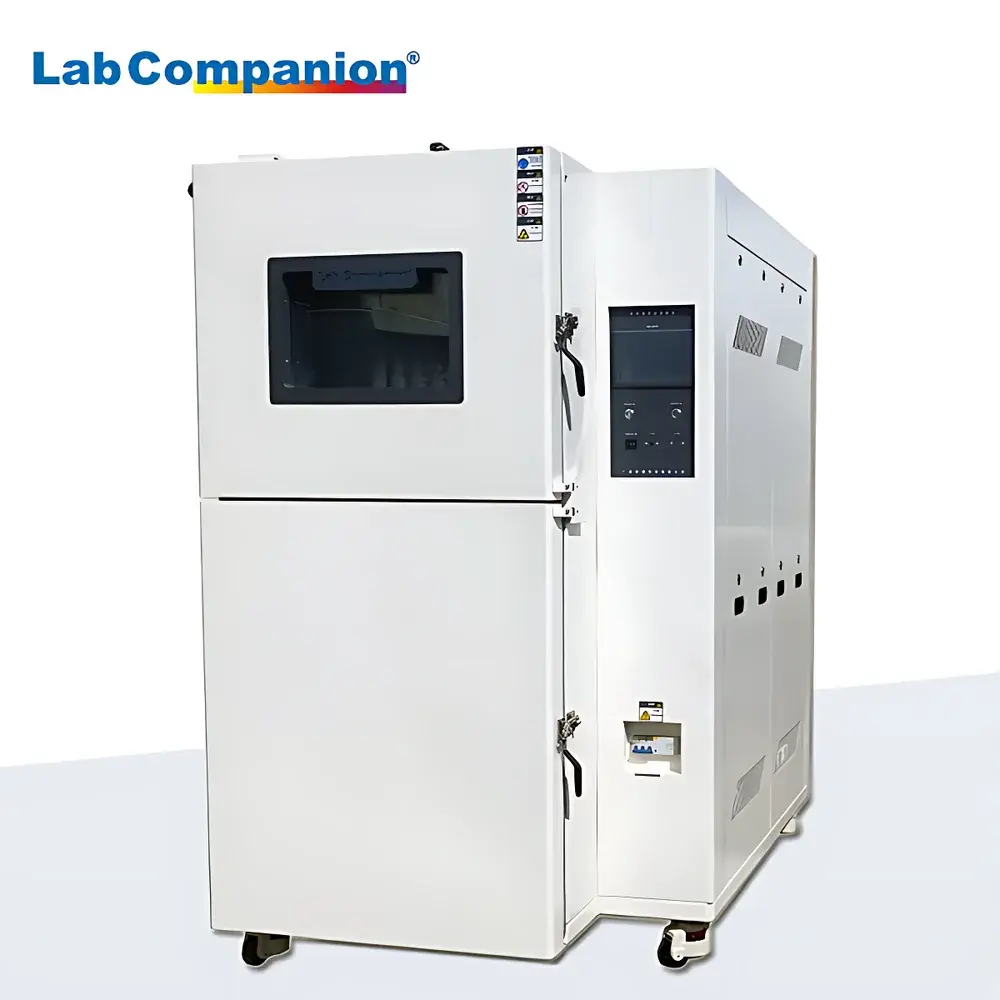
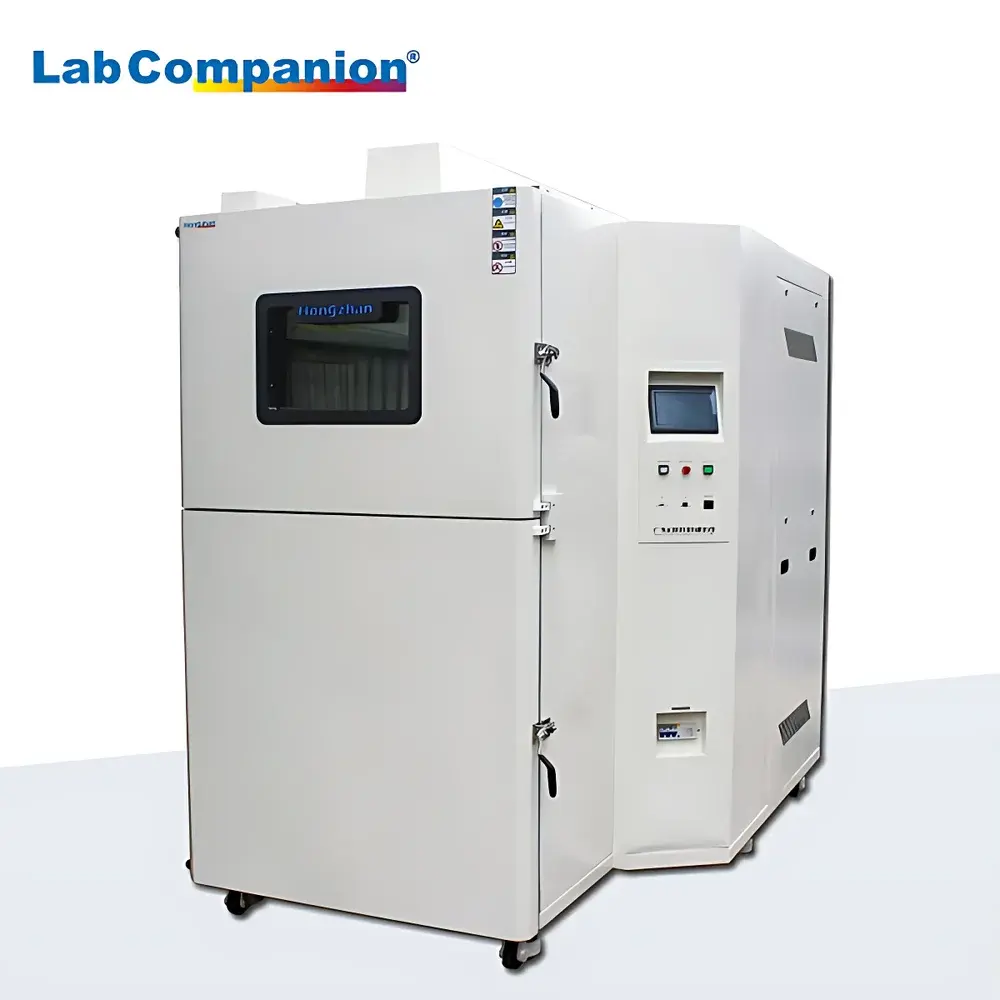
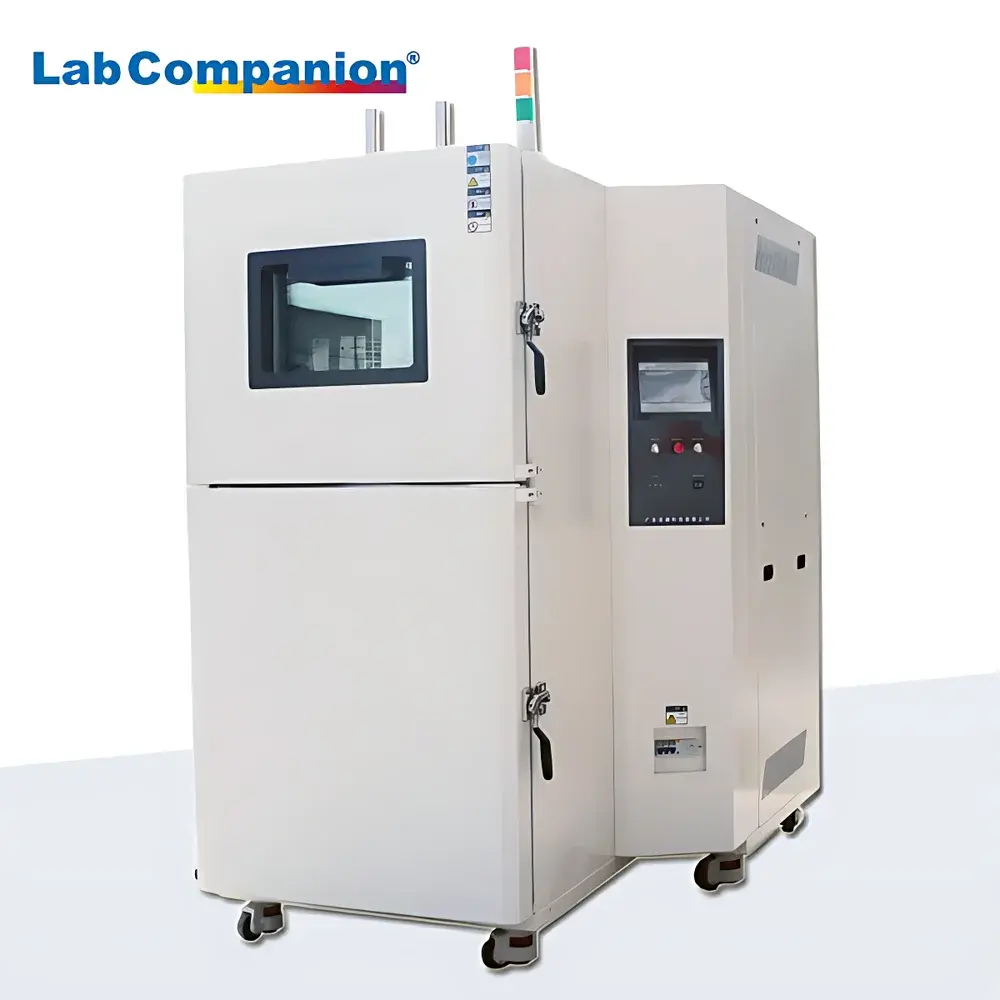
LabCompanion CTS-120 Thermal Shock Test Chamber
| Brand | LabCompanion |
|---|---|
| Origin | Guangdong, China |
| Manufacturer Type | Direct Manufacturer |
| Model | CTS-120 |
| High-Temperature Range | +60 °C to +200 °C |
| Low-Temperature Range | 0 °C to −70 °C |
| Thermal Shock Range | −65 °C to +150 °C |
| Temperature Stability | ±2 °C |
| Heating Rate | R.T. → +200 °C in ~40 min |
| Cooling Rate | R.T. → −70 °C in ~60 min |
| Transfer Time | ≤5 s |
| Temperature Recovery Time | ≤5 min |
| Internal Dimensions (W×H×D) | 500×610×400 mm |
| External Dimensions (W×H×D) | 2720×1050×1950 mm |
| Construction | Cold-Rolled Steel Outer Shell (Ivory White Powder Coating) / #304 Mirror-Finish Stainless Steel Inner Chamber (1.2 mm) |
| Insulation | Eco-Friendly Glass Fiber (Non-Hazardous Waste Class) |
| Refrigeration | Air-Cooled or Water-Cooled Option |
| Compressor | Imported Hermetic Scroll Compressor |
| Temperature Sensor | Armored Pt100 RTD |
| Controller | Siemens PLC Module + 7″ Color TFT Touchscreen (LabCompanion PlatinumV1.0 Embedded Control Software) |
| Data Interface | USB 2.0 (CSV Log Export, Non-Hot-Swappable) / RJ45 Ethernet (TCP/IP, Supports Up to 5 Concurrent Clients per Unit |
| Power Supply | AC 380 V, 50 Hz, 3-Phase + PE |
| Total Installed Capacity | 32 kVA |
| Compliance | GJB 150.3–150.5, GB/T 2423.1–2423.2 |
Overview
The LabCompanion CTS-120 Thermal Shock Test Chamber is an engineered environmental stress screening system designed for rapid, repeatable thermal cycling between extreme high- and low-temperature zones. Based on the two-chamber (hot/cold) horizontal transfer principle, it subjects test specimens to abrupt temperature transitions—enabling accelerated evaluation of material integrity, solder joint reliability, coating adhesion, and packaging performance under severe thermal gradients. Unlike single-chamber ramp-based systems, the CTS-120 utilizes physically isolated hot and cold chambers with a motorized lift-and-transfer basket mechanism, ensuring minimal thermal cross-contamination and precise control over exposure duration, dwell time, and transition dynamics. Its operational envelope spans −65 °C to +150 °C, with a maximum hot chamber setpoint of +200 °C and cold chamber limit of −70 °C—making it suitable for qualification testing across aerospace, automotive electronics, semiconductor packaging, and military-grade component development.
Key Features
- Two-zone independent thermal architecture: Separate hot chamber (+60 °C to +200 °C) and cold chamber (0 °C to −70 °C), each with dedicated refrigeration and heating circuits.
- High-speed pneumatic transfer mechanism: Basket movement completed in ≤5 seconds, minimizing transitional thermal lag and meeting stringent MIL-STD-810G and GJB 150.5A timing requirements.
- Temperature recovery stability: ≤±2 °C deviation across full shock range (−65 °C to +150 °C); ≤±0.5 °C fluctuation during dwell phases per GB/T 5170.2–2017 verification protocol.
- Robust chamber construction: 1.2 mm thick #304 mirror-finish stainless steel inner lining; outer shell of cold-rolled steel with electrostatic powder coating (ivory white, corrosion-resistant).
- Energy-efficient insulation: Non-hazardous, low-conductivity glass fiber blanket (density ≥48 kg/m³), compliant with RoHS and REACH Annex XIV restrictions on hazardous substances.
- Redundant safety architecture: Dual independent over-temperature and over-pressure cut-offs, door interlock switch, refrigerant leak detection, and real-time compressor discharge temperature monitoring.
Sample Compatibility & Compliance
The CTS-120 accommodates samples up to 500 × 610 × 400 mm (W×H×D) internal volume, supporting PCB assemblies, molded plastic housings, MEMS devices, battery modules, and sealed optical enclosures. Its mechanical design conforms to GJB 150.3A (high-temperature exposure), GJB 150.4A (low-temperature exposure), and GJB 150.5A (temperature shock), as well as civilian standards GB/T 2423.1 (cold test) and GB/T 2423.2 (dry heat). All thermal profiles—including dwell times, transition rates, and cycle counts—are programmable and auditable. The system supports GLP/GMP-aligned validation: IQ/OQ documentation templates are available upon request, and controller firmware maintains timestamped event logs with user-accessible audit trails—facilitating FDA 21 CFR Part 11 compliance when integrated with LabCompanion’s PlatinumV1.0 supervisory software suite.
Software & Data Management
Control and data acquisition are managed via an embedded Siemens S7-1200 PLC platform running LabCompanion’s proprietary PlatinumV1.0 firmware. A 7-inch capacitive touchscreen provides intuitive profile editing, real-time graphing of chamber temperatures, and alarm history review. Operational data—including target setpoints, actual chamber readings, elapsed time, and fault codes—is logged at user-defined intervals (1–60 sec) to internal flash memory and exported via USB 2.0 in standard CSV format. The exported files retain ISO 8601 timestamps and are directly importable into MATLAB, Python pandas, or JMP for statistical process analysis. Optional Ethernet connectivity enables remote monitoring through PlatinumV1.0 Supervisory Software, which supports multi-unit fleet management (up to 32 chambers), centralized report generation, and role-based access control (administrator/operator/viewer). All data transfers comply with TLS 1.2 encryption when deployed in networked laboratory environments.
Applications
- Electronics reliability assessment: Identification of intermetallic growth, die attach delamination, and CTE mismatch failure modes in IC packages and multilayer ceramic capacitors.
- Aerospace component qualification: Validation of avionics housing seals, sensor calibration drift, and composite panel fastener integrity per DO-160 Section 4.9.
- Automotive ECU stress screening: Pre-screening of engine control units prior to HALT/HASS, per ISO 16750-4 and LV-124 specifications.
- Battery module thermal robustness: Evaluation of lithium-ion cell swelling, electrolyte leakage, and separator shrinkage after repeated −40 °C/+85 °C cycling.
- Medical device packaging validation: Verification of sterile barrier integrity for Class II/III devices subjected to simulated distribution temperature excursions.
FAQ
What is the minimum dwell time per zone?
The controller supports configurable dwell times from 1 minute to 999 hours per temperature zone, with default factory settings optimized for GJB 150.5A (30 min minimum dwell recommended).
Can the system operate continuously for extended qualification cycles?
Yes—the CTS-120 is rated for unattended 24/7 operation with scheduled maintenance intervals aligned to ISO 13374-1 condition monitoring guidelines.
Is third-party calibration support available?
LabCompanion provides NIST-traceable calibration certificates (per ISO/IEC 17025) and collaborates with accredited metrology labs for on-site verification of chamber uniformity and sensor accuracy.
Does the unit meet CE or UKCA marking requirements?
While primarily certified to Chinese national and military standards, optional EU-compliant variants (with CE-marked components, EN 61000-6-2/6-4 EMC, and EN 61010-1 safety certification) are available upon formal request and additional configuration.
How is refrigerant charge monitored and maintained?
The system integrates electronic pressure transducers and evaporator superheat feedback loops; refrigerant level diagnostics are accessible via service mode, and all compressors use R404A/R507A blends compatible with current EPA SNAP-approved alternatives.



