
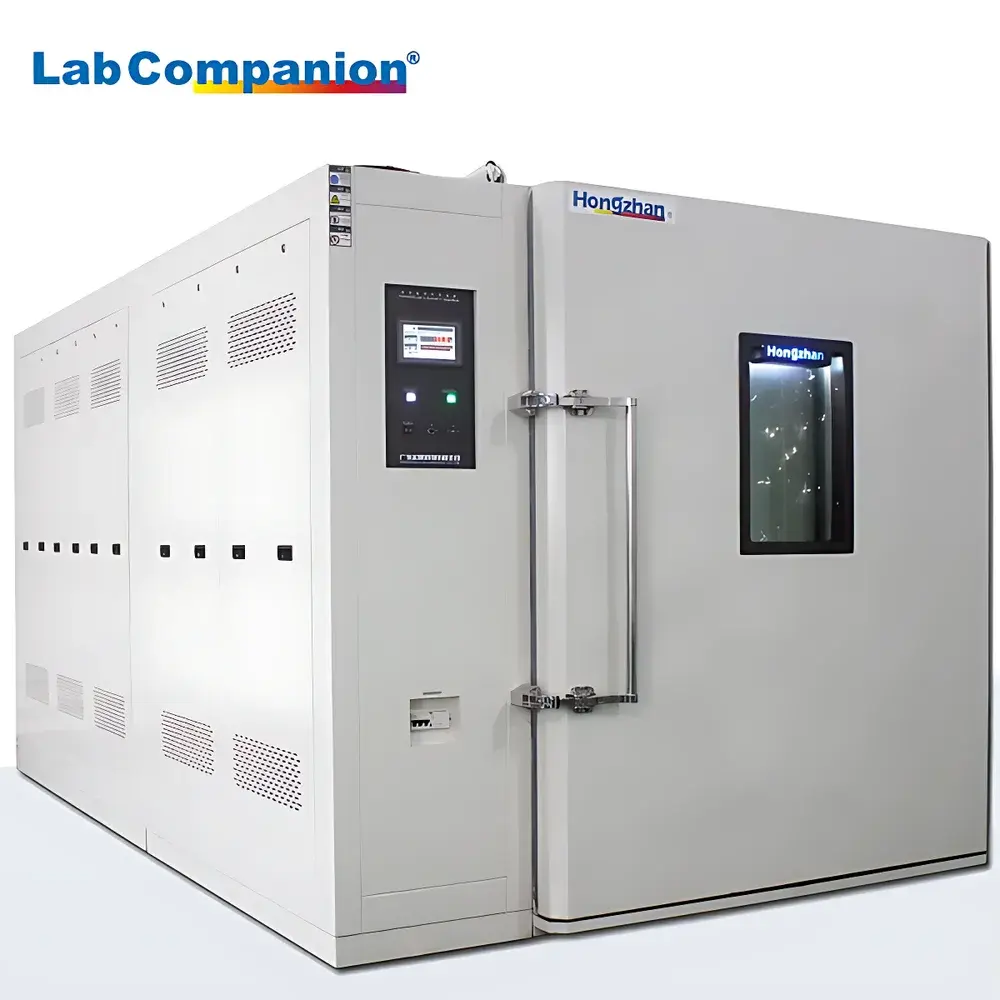
LabCompanion PSL-800 Large-Scale Temperature & Humidity Environmental Test Chamber
| Brand | LabCompanion |
|---|---|
| Origin | Guangdong, China |
| Manufacturer Type | Direct Manufacturer |
| Country of Origin | China |
| Model | PSL-800 |
| Price | USD 1,400 (approx.) |
| Temperature Range | −70 °C to +150 °C |
| Humidity Range | 20–98% RH |
| Temperature Uniformity | ≤2.0 °C |
| Temperature Fluctuation | ±0.5 °C |
| Temperature Deviation | ±2 °C |
| Heating Rate (20 °C to +150 °C, non-linear, no-load) | ~3.5 °C/min |
| Internal Dimensions (W×H×D) | 1000×1000×800 mm |
| External Dimensions (W×H×D) | 1480×2050×1240 mm |
| Net Weight | 650 kg |
| Power Supply | AC 380 V / 31.0 A |
Overview
The LabCompanion PSL-800 is a large-volume, precision-engineered environmental test chamber designed for accelerated aging, reliability validation, and long-term stability assessment of materials, components, and finished products under controlled temperature and humidity conditions. It operates on a dual-refrigeration cascade system with electric heating and steam-based humidification, enabling stable operation across an extended climatic envelope—from deep-freeze at −70 °C to high-temperature stress at +150 °C, combined with programmable relative humidity from 20% to 98% RH. The chamber’s structural integrity, thermal mass optimization, and multi-point PID-controlled air distribution ensure high reproducibility in thermal cycling and steady-state exposure—critical for compliance-driven testing protocols in automotive electronics, aerospace composites, medical device packaging, and polymer formulation development.
Key Features
- Robust stainless-steel inner chamber (SUS304) with seamless welding and electrostatically applied epoxy-coated outer housing for corrosion resistance and long-term dimensional stability.
- High-efficiency cascade refrigeration system using environmentally compliant R404A/R23 mixed refrigerants, certified to ISO 5170-2 and IEC 60068-3-5 for low-temperature performance verification.
- Dual-sensor humidity control with capacitive RH transducers traceable to NIST standards; integrated dew-point monitoring prevents condensation during rapid transitions.
- Programmable 10-segment, 99-cycle profile capability with ramp/soak logic and user-defined dwell times—fully compliant with MIL-STD-810H Method 502.7 (Temperature Shock) and Method 507.6 (Humidity).
- Real-time data logging via embedded RS485 interface supporting Modbus RTU protocol; optional Ethernet/IP or Profibus-DP modules available for factory automation integration.
- Over-temperature, over-humidity, compressor high-pressure, and door-open safety interlocks conforming to EN 61000-6-2 (EMC) and EN 61000-6-4 (Emission) requirements.
Sample Compatibility & Compliance
The PSL-800 accommodates full-size automotive ECUs, PCB assemblies up to 950 mm tall, lithium-ion battery modules, and packaged pharmaceutical blister cards without spatial compromise. Its 0.8 m³ internal volume supports ASTM D4332 (Standard Practice for Conditioning Containers, Packages, or Packaging Components for Testing), ISO 11607-1 (Packaging for terminally sterilized medical devices), and IEC 60068-2-1 (Cold), -2 (Dry Heat), -14 (Change of Temperature), and -30 (Humidity Cycling) test methods. All control firmware and calibration records are structured to support GLP/GMP audit readiness—including electronic signature capability, audit trail logging, and 21 CFR Part 11-compliant user access levels when paired with LabCompanion’s optional TraceLock software suite.
Software & Data Management
The chamber integrates with LabCompanion’s TC-Studio v4.2 control and analysis platform—a Windows-based application offering real-time multi-channel trending, deviation alarm escalation (email/SMS via SMTP gateway), and automated report generation in PDF/CSV formats. Raw sensor data (temperature, humidity, setpoint, power consumption) is timestamped at 1-second intervals and stored locally on an industrial-grade SSD with 32 GB capacity—retaining ≥12 months of continuous operation logs. Exported datasets comply with ASTM E2918 (Standard Guide for Data Acquisition in Environmental Chambers) and include metadata fields for operator ID, test standard reference, chamber serial number, and calibration certificate expiry dates.
Applications
- Accelerated life testing of elastomers, adhesives, and thermoplastic housings per ISO 11358 (Thermogravimetric analysis correlation).
- Pre-conditioning of sensors and MEMS devices prior to functional electrical testing (FET) in automotive Tier-1 supply chains.
- Stability studies of active pharmaceutical ingredients (APIs) and excipients under ICH Q1A(R2) long-term and accelerated storage conditions.
- Validation of hermetic seal integrity in microelectronics packaging using humidity-induced failure acceleration (HAST-equivalent stress profiles).
- Environmental stress screening (ESS) of avionics subsystems per DO-160G Section 4 (Operating Temperature) and Section 5 (Humidity).
FAQ
What is the maximum allowable sample load for thermal stability testing in the PSL-800?
For guaranteed uniformity (≤2.0 °C) and fluctuation (±0.5 °C), total non-volatile sample mass should not exceed 45 kg. Higher loads require extended stabilization time and may necessitate custom airflow calibration.
Does the PSL-800 support remote monitoring and control via LAN or cloud?
Yes—via optional TC-Studio Remote Server license, enabling secure HTTPS-based access, multi-user role management, and live dashboard visualization through any modern browser.
Is third-party calibration certification included with delivery?
A factory-issued NIST-traceable calibration certificate (covering temperature and humidity sensors at three points across range) is provided standard. ISO/IEC 17025-accredited field calibration is available as a service add-on.
Can the chamber be configured for non-standard humidity ranges below 20% RH?
Not natively—the minimum specified RH is 20%. For sub-20% applications (e.g., dry storage validation), LabCompanion offers the PDR-series desiccant-assisted chambers with nitrogen purge capability.
What maintenance intervals are recommended for sustained performance?
Refrigerant oil change every 24 months; condenser coil cleaning every 3 months in dusty environments; humidity sensor recalibration annually or after 2,000 operational hours—whichever occurs first.



