
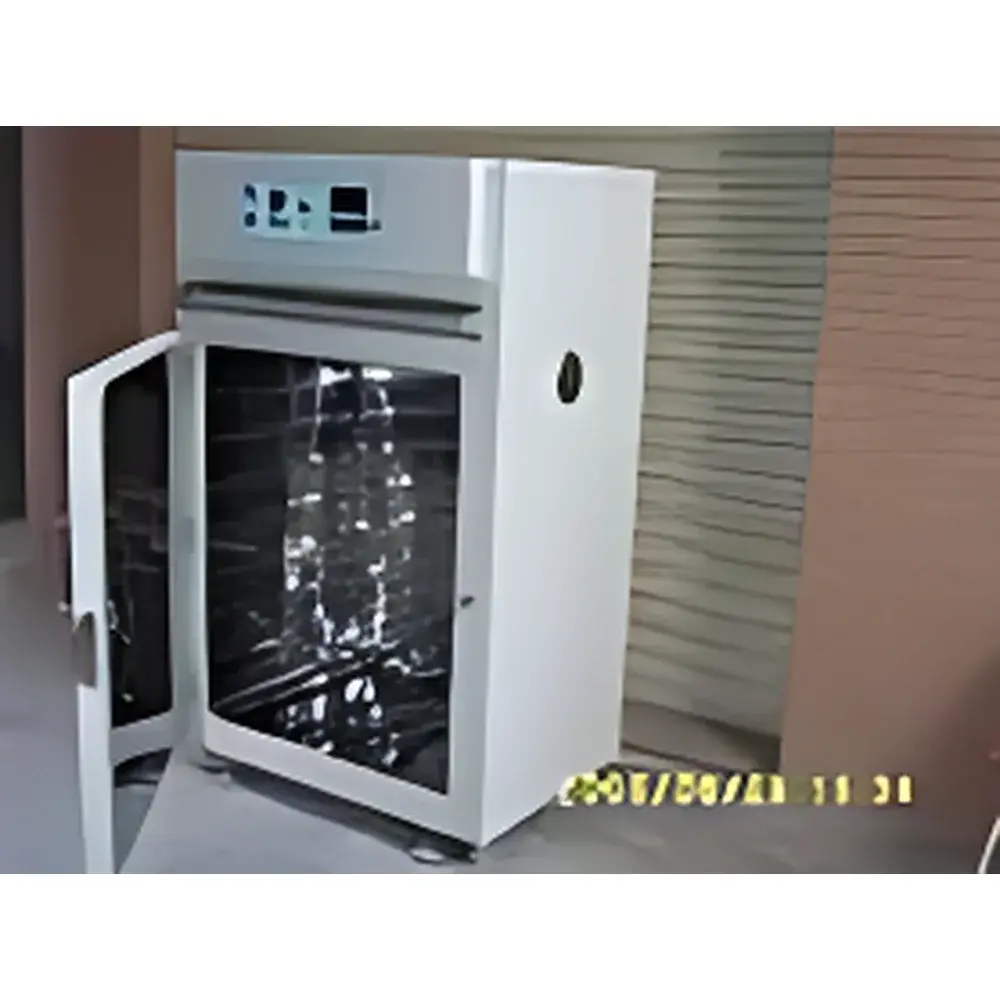
LabCompanion HH6 Vertical Forced-Air Drying Oven
| Brand | LabCompanion |
|---|---|
| Origin | Guangdong, China |
| Manufacturer Type | Direct Manufacturer |
| Product Category | Domestic |
| Model | HH6 |
| Pricing | Upon Request |
| Temperature Range | RT+10°C to 200°C / RT+10°C to 300°C (selectable) |
| Control Accuracy | ±1% of full scale |
| Temperature Uniformity | ±1°C (at setpoint, empty chamber, 25°C ambient) |
| Temperature Resolution | 0.1°C |
| Timer Range | 1–9999 minutes |
| Heating System | Independent Ni-Cr alloy sheathed heaters |
| Air Circulation | Vertical forced convection via high-temp low-noise motor + multi-blade centrifugal impeller |
| Safety Protections | Over-temperature cut-off, leakage current protection, short-circuit protection, motor overheat protection, over-current protection |
| Power Supply | AC 220V 50Hz or AC 380V 50Hz |
| Standard Shelving | 2 stainless steel shelves |
| Chamber Liner | Mirror-finish or brushed stainless steel (argon arc welded) |
| Exterior Finish | Powder-coated steel |
| Compliance | JB/T 5520–1991 |
Overview
The LabCompanion HH6 Vertical Forced-Air Drying Oven is an engineered solution for precise, repeatable thermal processing in laboratory and industrial quality control environments. Designed around a vertical airflow architecture with German-sourced circulation fans, it delivers uniform temperature distribution across the entire working chamber—critical for applications demanding spatial consistency in drying, baking, conditioning, or low-temperature sterilization. Its core operating principle relies on controlled convective heat transfer: heated air is drawn vertically through a high-efficiency multi-blade centrifugal impeller, directed upward along the chamber walls, and recirculated across sample surfaces via optimized inlet/outlet duct geometry. This configuration minimizes thermal stratification and reduces dwell-time variability—particularly beneficial when processing multiple samples on stacked shelves. The oven operates within two selectable temperature ranges: RT+10°C to 200°C for general-purpose drying and RT+10°C to 300°C for accelerated curing or moisture removal from refractory materials. All performance specifications—including ±1°C temperature uniformity and 0.1°C resolution—are validated under no-load, 25°C ambient conditions per JB/T 5520–1991, ensuring traceability to established Chinese national standards for drying equipment.
Key Features
- Vertical forced-air convection system with imported German fan assembly for enhanced thermal homogeneity and reduced cross-contamination risk between shelf levels
- Microprocessor-based PID temperature controller with large LED display, real-time deviation monitoring, and auto-tuning capability
- Dual-stage safety architecture: independent mechanical over-temperature limiter (hardwired cutoff) plus electronic thermal runaway protection
- Robust chamber construction—fully welded mirror-finish or brushed stainless steel interior (304 grade), powder-coated carbon steel exterior
- Modular heating design: fully isolated Ni-Cr alloy heating elements with individual circuit breakers for maintenance redundancy
- Manually adjustable air inlet/outlet dampers to fine-tune airflow velocity and humidity evacuation rate
- Programmable timer (1–9999 min) with audible end-of-cycle alert and auto-shutdown function
Sample Compatibility & Compliance
The HH6 accommodates non-volatile, thermally stable specimens including ceramic green bodies, polymer pellets, pharmaceutical excipients, metal oxide powders, filter membranes, and glassware prior to autoclaving. It is not rated for flammable solvents, organic vapors, or biological aerosols. Chamber dimensions range from 300×300×350 mm to 800×600×1300 mm (D×W×H), supporting up to six optional stainless steel shelves (standard: two). All models comply with JB/T 5520–1991 for industrial drying ovens and meet basic electrical safety requirements per GB 4793.1 (equivalent to IEC 61010-1). While not intrinsically compliant with FDA 21 CFR Part 11 or EU Annex 11 out-of-the-box, the optional programmable controller supports audit-trail-enabled operation when integrated into validated laboratory information management systems (LIMS).
Software & Data Management
The standard HH6 integrates a stand-alone microcontroller with non-volatile memory storing up to 10 user-defined temperature profiles. Optional intelligent controllers provide RS485 Modbus RTU interface for integration with SCADA platforms or centralized environmental monitoring systems. Data logging (timestamped temperature, setpoint, alarm status) is supported via external USB data loggers or third-party DAQ hardware. For GLP/GMP-aligned workflows, users may configure the optional controller to generate CSV-formatted reports with operator ID, cycle parameters, and deviation flags—facilitating retrospective review during internal audits or regulatory inspections.
Applications
- Moisture content determination per ASTM D2298 and ISO 787-2 for inorganic pigments and fillers
- Pre-conditioning of tensile test specimens (ASTM D618, ISO 291) prior to mechanical evaluation
- Baking of printed circuit board (PCB) solder masks and conformal coatings
- Drying of gravimetric filters in environmental water analysis (EPA Method 160.1)
- Thermal stabilization of reference standards before calibration (e.g., NIST SRMs)
- Low-temperature depyrogenation of glass vials and stoppers in pharmaceutical packaging R&D
FAQ
What is the maximum allowable load mass for thermal stability verification?
The specified uniformity (±1°C) is guaranteed only under no-load conditions. For loaded chambers, users must perform in-situ mapping per ISO/IEC 17025 Clause 5.10.3 using calibrated PT100 probes at nine locations.
Can the HH6 be used for sterilization of medical devices?
No. It lacks steam generation, pressure control, and biological indicator validation pathways required for sterilization per ISO 17665. It is suitable only for dry-heat depyrogenation of heat-stable components.
Is calibration documentation included with shipment?
A factory calibration certificate (traceable to CNAS-accredited labs) is provided. Full IQ/OQ documentation packages are available upon request for regulated environments.
How often should the air filter be cleaned or replaced?
The intake filter requires inspection every 200 operational hours; cleaning frequency depends on ambient particulate load. In cleanroom-adjacent labs, quarterly replacement is recommended.
Does the oven support ramp-hold programming?
Yes—when equipped with the optional intelligent controller, multi-step ramp-soak cycles with up to 32 segments can be defined and stored.
Related Products



