
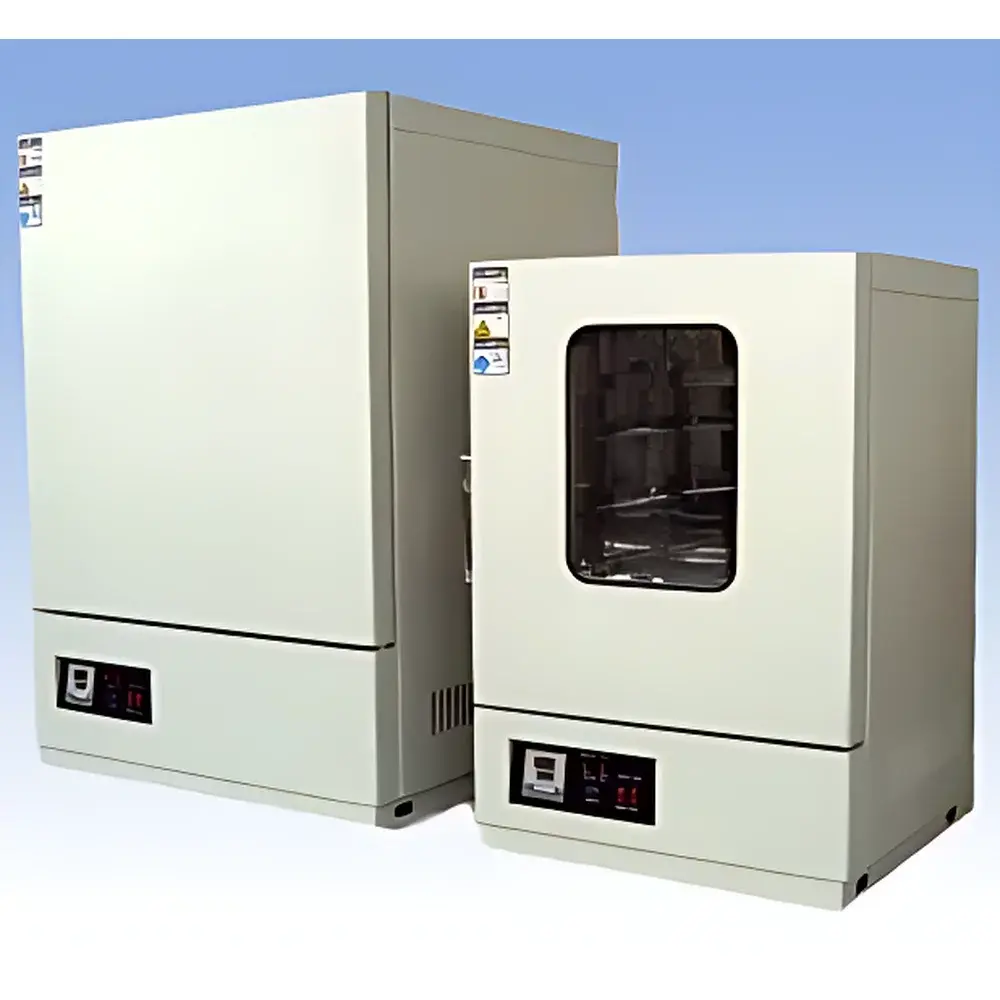
LabCompanion CS101-E Forced-Air Constant-Temperature Drying Oven
| Brand | LabCompanion |
|---|---|
| Origin | Guangdong, China |
| Manufacturer Type | Direct Manufacturer |
| Model | CS101-E |
| Temperature Range | R.T.+10°C to 300°C |
| Temperature Uniformity | ±2.5% |
| Temperature Fluctuation | ±0.5°C |
| Heating Method | Nickel-Chromium Alloy Heaters |
| Control System | PID Digital Controller with PT100 Sensor |
| Air Circulation | Forced Convection (Centrifugal Blower) |
| Interior Material | SUS304 Mirror-Finish Stainless Steel (BN variant) or Pre-treated Cold-Rolled Steel (EN variant) |
| Insulation | High-Density Fiberglass |
| Safety Features | Over-Temperature Protection, Over-Current Circuit Breaker |
| Power Supply | AC 220 V, 50 Hz |
| Rated Power | 1.5 kW |
| Internal Volume | 72 L |
| Interior Dimensions (W×D×H) | 450 × 400 × 400 mm |
| Exterior Dimensions (W×D×H) | 610 × 575 × 905 mm |
| Standard Accessories | 2 Stainless Steel Shelves, 4 Shelf Supports, User Manual |
Overview
The LabCompanion CS101-E is a precision-engineered forced-air constant-temperature drying oven designed for laboratory and industrial applications requiring stable thermal environments for drying, baking, sterilization, aging, and heat treatment of non-flammable and non-explosive materials. Operating on the principle of forced convection—where a centrifugal blower circulates heated air uniformly across the chamber—the CS101-E ensures consistent thermal distribution critical for process repeatability in quality control, R&D, and production validation. Its temperature control architecture integrates a platinum resistance thermometer (PT100) sensor with a digital PID controller, enabling accurate setpoint regulation within ±0.5°C fluctuation under no-load conditions (per JB/T 5520–1991). The oven complies with fundamental design and safety requirements for Class II laboratory ovens per IEC 61010-1 and supports traceable thermal validation when used in GLP-compliant workflows.
Key Features
- Forced-air convection system: High-efficiency centrifugal blower ensures rapid air exchange and minimizes thermal stratification—critical for uniform sample exposure during aging tests of electronic components such as LED modules, LCD panels, quartz crystals, and passive devices.
- PID digital temperature control: Real-time feedback loop using PT100 sensing delivers high reproducibility and eliminates overshoot during ramp-and-soak cycles; temperature is displayed simultaneously for both setpoint and actual chamber reading via dual LED indicators.
- Robust thermal construction: Interior chamber fabricated from SUS304 mirror-finish stainless steel (BN version) resists oxidation and facilitates cleaning—ideal for pharmaceutical and semiconductor cleanroom-adjacent use; alternatively, pre-treated cold-rolled steel (EN version) offers cost-effective durability for general-purpose labs.
- Multi-layer thermal insulation: High-density fiberglass insulation surrounding the chamber reduces external surface temperature rise and improves energy efficiency while maintaining internal stability at elevated setpoints up to 300°C.
- Integrated safety safeguards: Independent over-temperature cut-off circuit and thermal-magnetic circuit breaker provide redundant protection against heater failure or controller malfunction—meeting essential risk mitigation criteria outlined in ISO/IEC 17025 Annex A.3 for equipment qualification.
- Modular expandability: Optional RS485 serial interface enables integration into centralized lab monitoring systems; cable ports and programmable controllers are available as factory-installed accessories for automated validation protocols.
Sample Compatibility & Compliance
The CS101-E is validated for use with solid, non-volatile, non-corrosive, and non-hygroscopic samples including polymer films, ceramic substrates, metallized components, glass wafers, and dried biological matrices. It is not intended for solvent-based or volatile organic compound (VOC) processing. Chamber geometry (72 L volume, 450 × 400 × 400 mm usable space) accommodates standard ISO/IEC 17025-compliant calibration loads and ASTM E2251-22 thermal mapping configurations. All materials conform to RoHS Directive 2011/65/EU restrictions on hazardous substances. Electrical safety certification aligns with GB 4793.1–2019 (equivalent to IEC 61010-1:2010).
Software & Data Management
While the base CS101-E operates via standalone hardware controls, optional programmable temperature controllers support multi-step ramp/soak profiles with timestamped event logging. When equipped with RS485 communication, the unit interfaces with LabVIEW™, MATLAB®, or custom SCADA platforms using Modbus RTU protocol—enabling remote parameter adjustment, real-time data acquisition, and audit-trail generation compliant with FDA 21 CFR Part 11 requirements (when paired with validated software infrastructure). Data export formats include CSV and Excel-compatible .txt for statistical process control (SPC) analysis per ISO 9001:2015 Clause 8.5.1.
Applications
- Accelerated aging of optoelectronic assemblies under controlled thermal stress (JEDEC JESD22-A108)
- Drying of filter papers, chromatography media, and gravimetric sample holders prior to weighing (USP <1251>)
- Pre-conditioning of PCB substrates and solder paste stencils before reflow simulation
- Moisture removal from hygroscopic powders in API manufacturing (ICH Q5C stability guidelines)
- Thermal curing of epoxy encapsulants and conformal coatings in microelectronics packaging
- Validation of dry-heat sterilization parameters for reusable stainless-steel tools (ISO 17665-1)
FAQ
What is the maximum operating temperature of the CS101-E?
The CS101-E is rated for continuous operation from ambient +10°C up to 300°C.
Is the oven suitable for sterilization applications?
It meets dry-heat sterilization prerequisites per ISO 17665-1 when operated at ≥160°C for ≥2 hours—but validation must be performed per site-specific protocols using biological indicators and thermocouple mapping.
Can the CS101-E be calibrated externally?
Yes. The PT100 sensor and controller are accessible for third-party calibration using NIST-traceable reference standards; calibration certificates may be issued per ISO/IEC 17025 requirements.
Does the unit comply with electromagnetic compatibility (EMC) standards?
It conforms to GB/T 18268.1–2010 (equivalent to IEC 61326-1:2012) for laboratory equipment immunity and emissions.
What maintenance is required for long-term reliability?
Routine inspection of door gasket integrity, blower motor lubrication every 12 months, and periodic verification of thermal uniformity using calibrated thermocouples per ASTM E2251-22 are recommended.



