
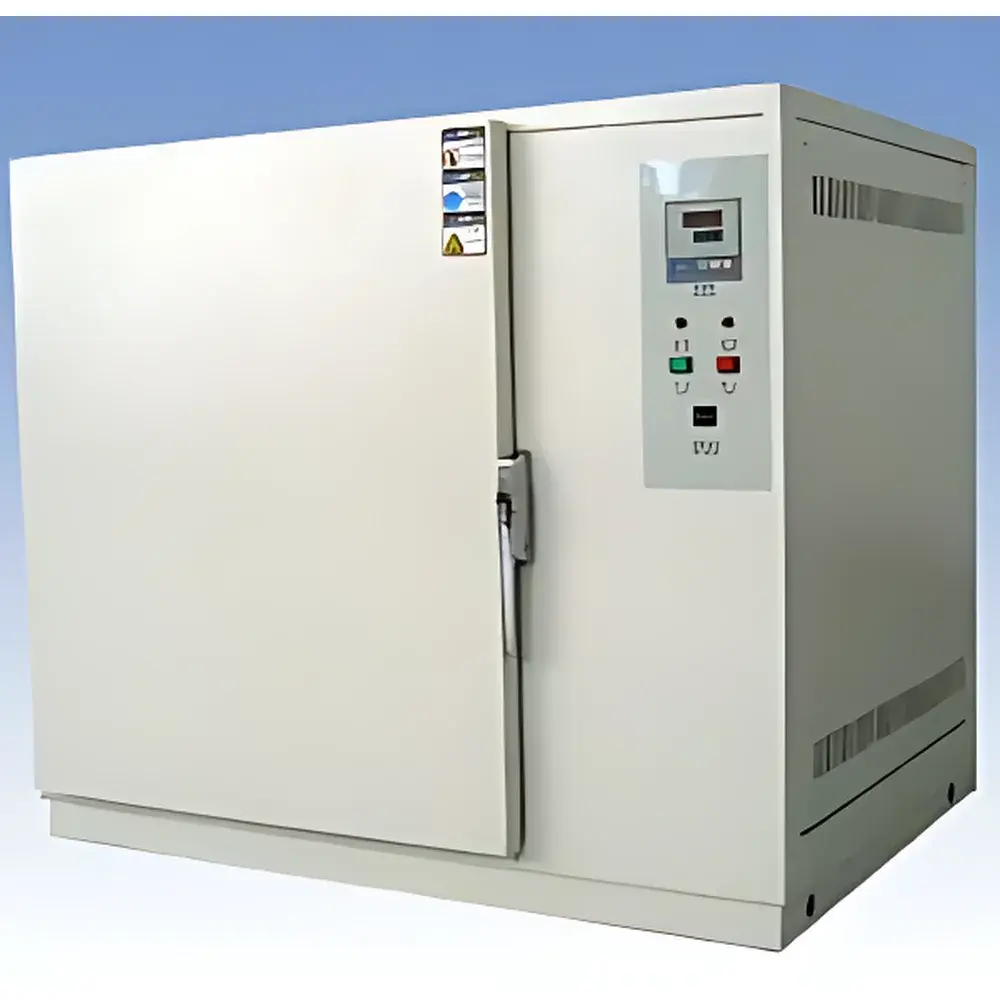
LabCompanion CS101-E Forced-Air Circulating Drying Oven
| Brand | LabCompanion |
|---|---|
| Origin | Guangdong, China |
| Manufacturer Type | Direct Manufacturer |
| Product Category | Domestic |
| Model | CS101-E |
| Pricing | Upon Request |
| Circulation Method | Forced Convection |
| Temperature Range | R.T. +10°C to 300°C |
| Temperature Fluctuation | ±0.5°C |
| Temperature Uniformity | ±2.5% |
| Heating Rate (to 200°C) | ≤70 min |
| Control System | PID Digital Controller with Self-Tuning |
| Temperature Sensor | Industrial Platinum RTD (PT100) |
| Display | Dual LED Display (Set & Actual Temperature) |
| Timer Range | 0–999 min |
| Interior Material | SUS304 Mirror-Finish Stainless Steel (BN variant) or Pre-Painted Cold-Rolled Steel with High-Temp Silver Coating (EN variant) |
| Exterior Material | Powder-Coated Cold-Rolled Steel with Anti-Rust Treatment |
| Viewing Window | Double-Layer Heat-Resistant Tempered Glass |
| Insulation | Ultra-Fine Glass Fiber |
| Door Seal | Eco-Friendly Silicone Rubber Gasket |
| Exhaust Port | Φ45 mm × 1 (Rear-Mounted) |
| Blower | Centrifugal Fan with Condenser Motor |
| Heating Element | Nickel-Chromium Alloy Sheathed Heater |
| Safety Features | Independent Over-Temperature Protection Circuit & Over-Current Trip Breaker |
| Internal Dimensions (W×D×H, mm) | 450×400×400 / 550×500×500 / 650×600×600 |
| External Dimensions (W×D×H, mm) | 610×575×905 / 710×675×1025 / 810×775×1175 |
| Capacity | 72 L / 137.5 L / 234 L |
| Power Supply | AC 220 V, 50 Hz |
| Rated Power | 1.5 kW / 2.5 kW / 3.0 kW |
| Standard Compliance | JB/T 5520–1991 (Technical Specifications for Drying Ovens) |
| Accessories Included | 2 Stainless Steel Shelves, 4 Shelf Supports, Full User Manual |
| Optional Accessories | Additional Shelves, Programmable Temperature Controller, Cable Port (Φ50 mm), RS485 Communication Interface |
Overview
The LabCompanion CS101-E Forced-Air Circulating Drying Oven is an engineered thermal processing system designed for precision drying, baking, sterilization, and aging applications in regulated laboratory and production environments. Operating on the principle of forced convection—where a centrifugal blower circulates heated air uniformly across the chamber—the CS101-E ensures consistent thermal exposure across all sample positions. Its temperature control architecture employs a microprocessor-based PID algorithm with auto-tuning capability, enabling stable operation within ±0.5°C fluctuation and ±2.5% spatial uniformity (per JB/T 5520–1991). The oven’s working range spans from ambient +10°C to 300°C, making it suitable for low-temperature desiccation (e.g., moisture removal from pharmaceutical excipients), intermediate-range polymer curing, and high-temperature component aging (e.g., LED substrates, quartz crystals, and passive electronic components). All thermal performance metrics—including heating rate (≤70 min to 200°C), recovery time after door opening, and load-dependent stability—are validated under ISO/IEC 17025-aligned test conditions (23°C ±5°C, 65% RH ±20%, no-load state).
Key Features
- Microprocessor-controlled PID temperature regulation with self-tuning and manual parameter adjustment via intuitive ▲/▼ keys
- Dual-channel LED display showing both setpoint and real-time chamber temperature measured by a calibrated PT100 platinum resistance thermometer
- Independent mechanical over-temperature cut-off circuit—functionally isolated from the main controller—to satisfy IEC 61000-4-5 surge immunity and fail-safe requirements
- Optimized thermal insulation using ultra-fine glass fiber (≥80 mm thickness in side walls) and double-layer heat-resistant tempered glass viewing window (with argon-filled interlayer)
- Modular vertical assembly design minimizing footprint while maximizing internal volume-to-floor-space ratio; compatible with standard laboratory benchtop or floor-standing configurations
- Robust chamber construction: SUS304 mirror-finish stainless steel interior (BN variant) for corrosion resistance in humid or solvent-laden atmospheres, or high-temp silver-coated cold-rolled steel (EN variant) for cost-sensitive industrial QA/QC workflows
- Energy-efficient heating system utilizing sheathed NiCr alloy elements with zero-crossing thyristor power control—reducing EMI and extending heater service life
Sample Compatibility & Compliance
The CS101-E accommodates non-flammable, non-explosive solid and powder samples across diverse sectors: semiconductor packaging (die attach curing), medical device sterilization validation (dry-heat cycle qualification per ISO 17665), pharmaceutical stability testing (ICH Q1A–Q1E), and materials science (polymer crosslinking kinetics, ceramic sintering pre-bake). Chamber geometry supports standardized sample trays (up to 300 mm × 300 mm), stacked PCBs, and multi-layer wafer carriers. All models comply with JB/T 5520–1991 and are CE-marked per EN 61000-6-2 (immunity) and EN 61000-6-4 (emission). For GLP/GMP environments, optional RS485 interface enables integration with LIMS or SCADA systems supporting audit-trail-capable data logging (21 CFR Part 11 compliant when paired with validated software).
Software & Data Management
While the base CS101-E operates via embedded firmware without external software dependency, the optional programmable temperature controller (PCT) module provides ramp-soak profiles, multi-segment scheduling, and real-time data export via RS485 Modbus RTU protocol. Logged parameters include timestamped temperature values, alarm events (e.g., over-temp, fan failure), and timer status—exportable as CSV for traceability. Firmware supports user-defined calibration offsets to compensate for sensor drift, ensuring long-term metrological integrity. No proprietary drivers or cloud services are required; communication adheres to open industrial standards for seamless interoperability with third-party data acquisition platforms.
Applications
- Electronics manufacturing: Burn-in testing of LEDs, LCD drivers, MLCCs, and crystal oscillators under controlled thermal stress
- Academic research: Kinetic studies of solvent evaporation, thermal degradation of biopolymers, and catalyst activation protocols
- Pharmaceutical QC: Residual solvent analysis prep (USP <467>), tablet coating drying, and lyophilized product secondary drying
- Food science: Moisture content determination (AOAC 950.46), enzyme inactivation validation, and shelf-life modeling
- Materials engineering: Pre-curing of composite laminates, outgassing of aerospace adhesives, and thermal aging of elastomers per ASTM D573
FAQ
What is the maximum allowable load mass for thermal uniformity compliance?
The specified ±2.5% uniformity is guaranteed at ≤70% chamber volume occupancy with evenly distributed loads. For full-volume validation, contact technical support for load-specific mapping protocols.
Can the CS101-E be used for sterilization of surgical instruments?
No—it lacks steam generation, pressure control, and biological indicator validation pathways required for autoclave-grade sterilization. It meets dry-heat disinfection criteria (e.g., 160°C for 2 hours per ISO 15883-1) only when validated per site-specific SOPs.
Is the PT100 sensor NIST-traceable?
Yes—each unit ships with a factory calibration certificate referencing NIST SRM 1750. Field recalibration is supported using certified reference thermometers per ISO/IEC 17025 procedures.
Does the oven support continuous operation beyond 999 minutes?
The built-in timer caps at 999 min, but uninterrupted operation is achievable by disabling the timer function—operating in “constant temperature” mode with manual supervision per local safety policy.
What maintenance intervals are recommended for the blower motor and heating elements?
Inspect fan bearings and clean inlet filters quarterly; verify heater continuity annually. Replace silicone door gaskets every 24 months or upon visible compression set (>20% thickness loss).



