
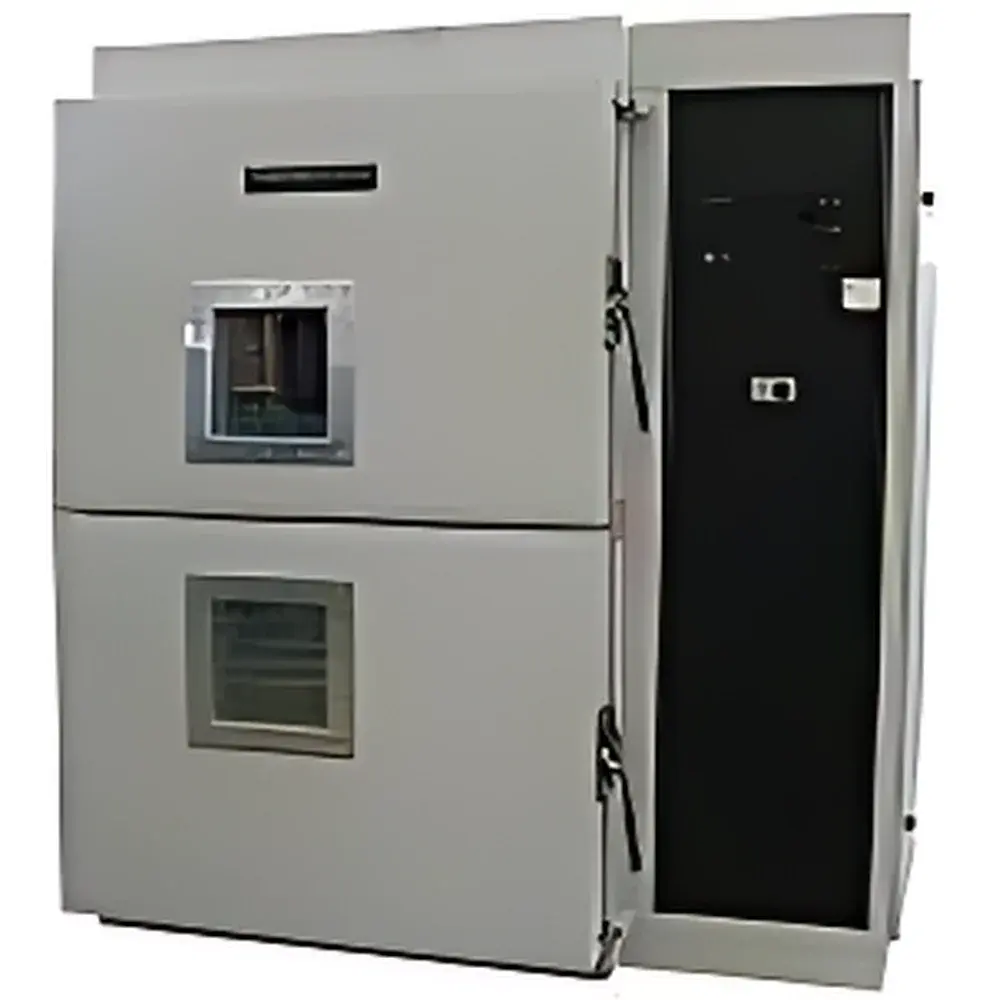
LabCompanion LTS-80-2P Gas-Actuated Thermal Shock Test Chamber (Two-Chamber Moving-Test-Specimen Type)
| Brand | LabCompanion |
|---|---|
| Origin | Guangdong, China |
| Manufacturer Type | Direct Manufacturer |
| Model | LTS-80-2P (Two-Chamber, Specimen-Transfer Design) |
| Temperature Range | −40 °C to +100 °C (optional +150 °C) |
| Low-Temp Chamber | −70 °C to −10 °C |
| High-Temp Chamber | +60 °C to +200 °C |
| Specimen Weight Capacity | 2.5 kg |
| Transfer Time | ≤10 s |
| Temp. Rise Time (−40 °C → +100 °C) | 40 min |
| Temp. Fall Time (+100 °C → −40 °C) | 70 min |
| Chamber Dimensions (L×W×H, mm) | Low-Temp: 400×500×400 |
| High-Temp | 400×400×400 |
| Test Zone | 200×130×200 |
| Control System | Microprocessor-based PID + SSR |
| Refrigerant | Eco-friendly HFC blend |
| Internal Material | SUS304 stainless steel |
| External Finish | Zinc-coated steel with high-grade resin enamel coating |
| Safety Protections | Overheat protection, compressor overload protection, control system overload protection, high/low pressure cut-off switches |
| Optional Interfaces | RS-232 serial communication port |
Overview
The LabCompanion LTS-80-2P is a gas-actuated, two-chamber thermal shock test chamber engineered for precise and repeatable evaluation of material integrity under rapid, alternating extreme temperature exposure. Unlike single-chamber or liquid-immersion systems, this model employs a specimen-transfer architecture: the test sample is pneumatically moved between independently controlled high-temperature and low-temperature chambers. This design eliminates thermal mass interference from heating/cooling media and ensures sharp, well-defined thermal transitions—critical for simulating real-world operational stresses in electronics, automotive components, aerospace assemblies, and polymer-based systems. The chamber operates on a thermodynamic principle grounded in controlled convective heat transfer within sealed, insulated environments, enabling accurate replication of thermal cycling profiles defined by industry standards such as MIL-STD-810H Method 503.7, IEC 60068-2-14, and JESD22-A104D.
Key Features
- Gas-driven pneumatic actuation system for specimen transfer—ensures consistent, contamination-free movement between chambers in ≤10 seconds, minimizing dwell time and maximizing thermal gradient fidelity.
- Dual independent chamber configuration: high-temperature chamber (60 °C to 200 °C) and low-temperature chamber (−70 °C to −10 °C), each equipped with dedicated refrigeration and heating circuits for stable setpoint maintenance.
- Microprocessor-based controller with PID algorithm and solid-state relay (SSR) output delivers high-resolution temperature regulation (±0.5 °C typical stability) and programmable ramp/soak profiles.
- Integrated 3.5-inch color LCD touchscreen with bilingual (English/Chinese) interface and dust-resistant keypad supports intuitive operation, real-time parameter monitoring, and on-device data logging.
- 1.44 MB internal floppy disk drive (legacy-compatible) enables local backup of test programs, runtime curves, and event logs—exportable via USB or RS-232 for post-test analysis in third-party software (e.g., MATLAB, Excel, or custom QA platforms).
- Energy-efficient thermal recovery system recaptures waste heat from the hot chamber to pre-condition the cold chamber air stream, reducing overall power consumption and refrigerant load.
- Hermetic auto-sealing lid mechanism on both chambers prevents cross-contamination and maintains uniform thermal distribution during transfer cycles.
Sample Compatibility & Compliance
The LTS-80-2P accommodates specimens up to 200 mm (W) × 130 mm (H) × 200 mm (D) and 2.5 kg maximum weight—suitable for PCB assemblies, IC packages, solder joints, plastic housings, elastomeric seals, and small mechanical subassemblies. Its construction meets structural and safety requirements per IEC 61000-6-2 (EMC immunity) and UL 61010-1 (electrical safety). All internal wetted surfaces are fabricated from electropolished SUS304 stainless steel to resist corrosion from condensate and thermal oxidation. External housing features zinc-coated carbon steel substrate with high-adhesion, UV-stable resin enamel finish—rated for continuous laboratory and industrial QC floor use. The system supports GLP-compliant validation protocols, including IQ/OQ documentation templates and audit-ready event logging with timestamped operator actions.
Software & Data Management
While the LTS-80-2P operates autonomously via its embedded controller, optional RS-232 connectivity enables bidirectional communication with host PCs running Windows-based test management software. Logged data—including chamber temperatures, specimen transfer timestamps, alarm events, and PID output status—are stored in CSV-compatible format with millisecond-level resolution. Traceability is reinforced through configurable user access levels, password-protected parameter editing, and non-volatile memory retention across power cycles. For regulated environments, the system’s deterministic behavior and deterministic cycle timing align with FDA 21 CFR Part 11 expectations when deployed with validated third-party data acquisition software that implements electronic signatures and audit trails.
Applications
- Qualification testing of surface-mount technology (SMT) assemblies per IPC-J-STD-020 and JEDEC JESD22-A104D.
- Evaluation of coefficient of thermal expansion (CTE) mismatch effects in multi-material packaging (e.g., die attach delamination, wire bond lift-off).
- Accelerated aging studies for polymer gaskets, adhesives, and encapsulants exposed to cyclic thermal stress.
- Reliability screening of automotive ECUs, sensors, and lighting modules prior to field deployment.
- Material compatibility verification for cryogenic-to-high-temp applications in aerospace hydraulics and avionics enclosures.
- Failure mode identification in MEMS devices, optical components, and thin-film coatings subjected to repeated thermal transients.
FAQ
What distinguishes the LTS-80-2P from liquid-immersion thermal shock testers?
The LTS-80-2P uses dry, gas-actuated specimen transfer between isolated air chambers—eliminating risks of fluid contamination, residue formation, and thermal inertia associated with liquid baths. It offers faster transition times, superior repeatability, and broader compatibility with moisture-sensitive or electrically active samples.
Can the chamber be validated for ISO/IEC 17025 accredited testing laboratories?
Yes—the unit’s stable thermal performance, traceable calibration points (via external PT100 probe inputs), and comprehensive event logging support full metrological validation. LabCompanion provides factory calibration certificates and IQ/OQ protocol guidance upon request.
Is remote monitoring supported beyond RS-232?
RS-232 is standard; Ethernet or Modbus TCP integration requires optional hardware add-ons and firmware upgrade—contact technical support for compatibility assessment.
What maintenance intervals are recommended for long-term reliability?
Compressor oil and refrigerant levels should be verified annually; pneumatic cylinder seals and door gaskets inspected quarterly; and internal chamber surfaces cleaned with isopropyl alcohol after high-soiling tests. Full preventive maintenance is advised every 24 months by certified service engineers.
Does the system comply with environmental regulations regarding refrigerants?
Yes—it utilizes HFC-based refrigerant blends compliant with current EU F-Gas Regulation (EU) No 517/2014 and EPA SNAP program requirements, with zero ozone depletion potential (ODP = 0) and globally accepted global warming potential (GWP) profiles.



