
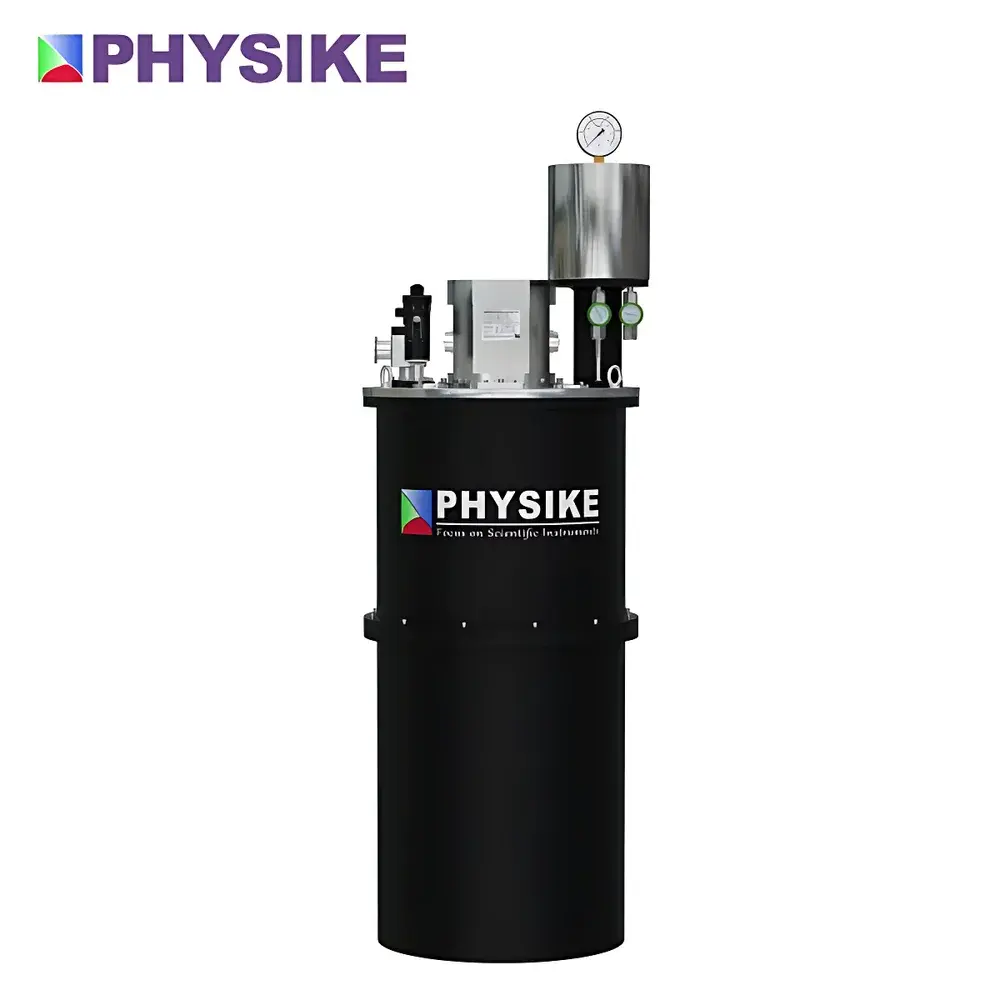
Physik Ucryo-300 Integrated Sub-Kelvin Cryogenic Thermostat
| Brand | Physik |
|---|---|
| Origin | Beijing, China |
| Manufacturer Type | Direct Manufacturer |
| Origin Category | Domestic (China) |
| Model | Ucryo-300 |
| Pricing | Available Upon Request |
Overview
The Physik Ucryo-300 is an integrated, single-cryostat sub-kelvin cryogenic thermostat engineered for stable, long-duration operation below 1 K. It employs either a pulse-tube cryocooler or a Gifford-McMahon (GM) cryocooler as its primary cooling stage, enabling reliable precooling to ~4 K. A compact, top-mounted helium-4 (⁴He) storage reservoir feeds liquid helium into an integrated ⁴He pot located within the cryostat’s inner vacuum space. The system incorporates an in-situ low-temperature adsorption pump—cooled by the 4 K stage—that actively pumps the vapor phase above the ⁴He bath. This continuous pumping induces evaporative cooling of the liquid ⁴He, achieving and sustaining base temperatures below 780 mK. Thermal stability at the sample stage is maintained via high-thermal-conductivity copper wiring, multi-stage radiation shielding, and optimized thermal anchoring. Designed for laboratory-based quantum science infrastructure, the Ucryo-300 delivers reproducible sub-K performance without requiring external liquefaction infrastructure or complex dilution refrigerator plumbing.
Key Features
- Integrated single-cryostat architecture eliminates external cryogen transfer lines and reduces system footprint
- Self-contained ⁴He condensation and pumping cycle—no need for external helium liquefiers or recirculation systems
- Base temperature ≤ 780 mK with hold time exceeding 100 hours at minimum temperature
- Modular cold head compatibility: supports both pulse-tube and GM cryocoolers (4 K class)
- Onboard ⁴He storage reservoir with integrated level monitoring and pressure regulation
- Hermetically sealed internal He circulation path with zero external venting during operation
- Optimized thermal design featuring multi-layer superinsulation, OFHC copper thermal anchors, and low-vibration mounting interfaces
- Standard 120 mm vertical access bore with customizable flange configurations (CF-100, CF-150, or DN160 ISO-KF options)
Sample Compatibility & Compliance
The Ucryo-300 accommodates diverse experimental configurations including SQUID magnetometers, transition-edge sensors (TES), superconducting qubits, high-pressure diamond anvil cells (DAC), neutron scattering sample environments, and low-temperature transport measurement platforms. Sample mounting is facilitated via a removable cold finger with electrical feedthroughs (up to 48 coaxial + 24 twisted-pair channels) and optional optical access (UV–IR broadband windows). All internal materials comply with ultra-high vacuum (UHV) standards (<1×10⁻⁹ mbar base pressure), and surface treatments meet ASTM E1559 outgassing specifications. The system adheres to CE safety directives (2014/30/EU EMC, 2014/35/EU LVD) and incorporates redundant temperature monitoring (Cernox™ and RuO₂ sensors) with hardware interlocks for over-temperature and loss-of-coolant protection.
Software & Data Management
Operation is managed through Physik’s CryoControl Suite—a cross-platform application supporting Windows, Linux, and macOS. The suite provides real-time PID-controlled temperature ramping, automated cooldown sequences, and programmable hold profiles. All sensor readings, heater outputs, and pressure transducer data are logged with microsecond timestamp resolution and stored in HDF5 format for traceability. Audit trails comply with GLP and GMP requirements, including user authentication, electronic signatures, and 21 CFR Part 11–compliant data integrity features (e.g., immutable logs, change history, and role-based access control). Remote monitoring and control are supported via Ethernet (TCP/IP) or optional fiber-optic isolation interface.
Applications
- Quantum device characterization: coherence time measurements, microwave reflectometry of superconducting circuits
- Ultra-low-noise metrology: current-source calibration, Josephson voltage standards, and nanovolt-level thermoelectric measurements
- High-pressure physics: in situ resistivity, Hall effect, and AC susceptibility under DAC conditions down to 800 mK
- Neutron scattering sample environment: magnetic and structural studies requiring sub-K thermal stability and minimal background scattering
- Low-temperature transport: magneto-transport, thermal conductivity, and specific heat measurements on correlated electron systems
- Fundamental physics experiments: tests of quantum gravity models, axion search platforms, and dark matter detector R&D
FAQ
What cooling technologies are compatible with the Ucryo-300?
The system is designed to integrate with commercially available 4 K pulse-tube cryocoolers (e.g., Sumitomo RDK-415D, BlueFors LD400) or GM cryocoolers (e.g., Cryomech PT415, SHI RP-120). Custom integration kits are provided for mechanical and thermal interface alignment.
Does the Ucryo-300 require liquid helium refills during operation?
No. The integrated ⁴He reservoir contains sufficient helium for >100 hours at base temperature. Refill is only required between extended experimental campaigns and is performed via standard UHV-compatible gas-handling manifolds.
Can the system be upgraded to support dilution refrigerator functionality?
The Ucryo-300 is not a dilution refrigerator and does not support mixing chamber operation. However, its mechanical and vacuum architecture is compatible with third-party DR insert modules that utilize the same 4 K cold plate and bore geometry.
What vacuum level can be achieved and maintained?
With standard turbo-molecular pumping and the integrated低温 adsorption pump active, the system achieves and sustains <5×10⁻¹⁰ mbar in the sample space during sub-K operation.
Is remote operation supported for unattended long-term experiments?
Yes. Full bidirectional communication, alarm notification (email/SMS via optional gateway), and script-based automation (Python API included) enable robust 24/7 operation with minimal onsite supervision.



