
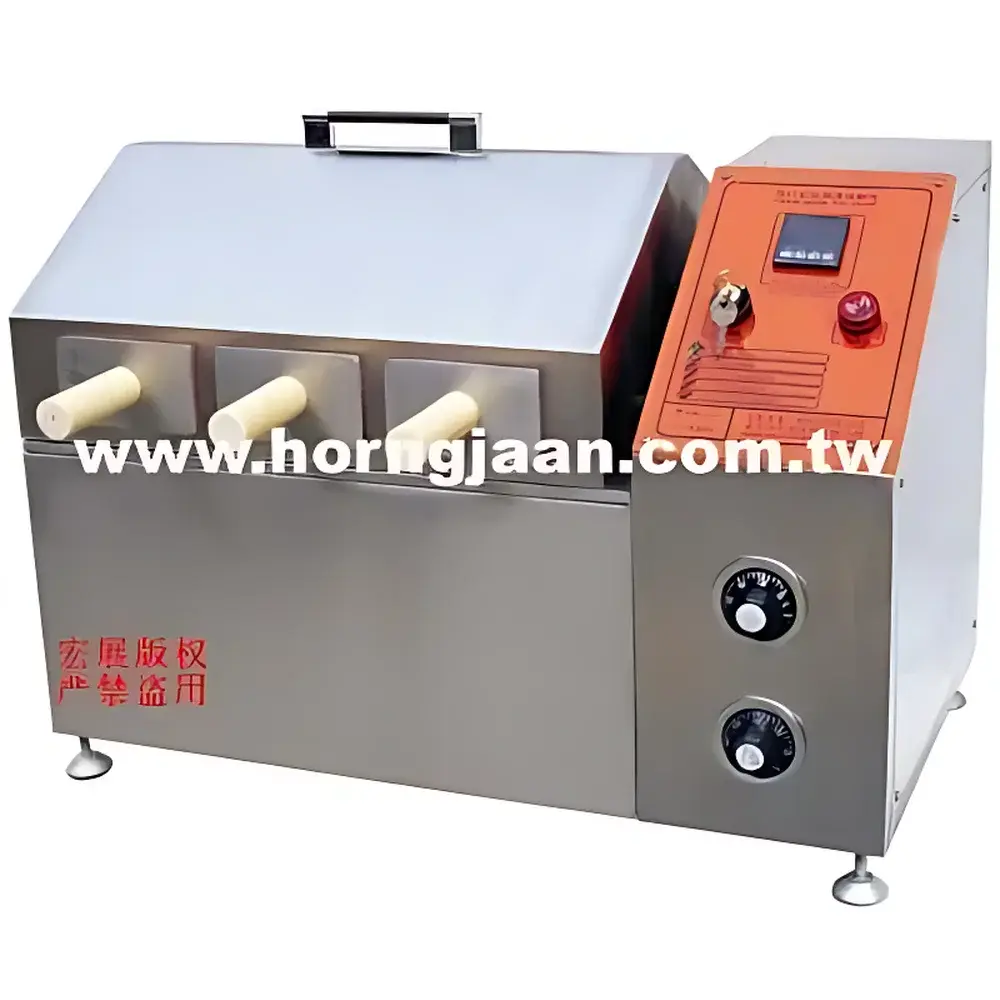
LabCompanion ZA-3 Steam Aging Test Chamber
| Brand | LabCompanion |
|---|---|
| Origin | Guangdong, China |
| Manufacturer Type | Direct Manufacturer |
| Country of Origin | China |
| Model | ZA-3 |
| Pricing | Available Upon Request |
| Construction | Interior & Exterior Chambers in SUS#304 Stainless Steel |
| Temperature Control | PID + PWM + SSR System with Dual Over-Temperature Protection |
| Temperature Resolution | 0.1 °C (T-type Thermocouple Sensor) |
| Chamber Dimensions (W×D×H) | 50 × 17 × 40 cm |
| External Dimensions (W×D×H) | 75 × 57 × 50 cm |
| Test Tray Configuration | Triple-Slot Design (Each Slot: 10 × 38 × 10 cm) |
| Safety Features | Low-Water Level Indicator, Steam Venting Port |
| Optional Accessories | Programmable Power-On Scheduler, RO-Purified Water Auto-Fill System |
Overview
The LabCompanion ZA-3 Steam Aging Test Chamber is a precision-engineered environmental test system designed to evaluate material stability and degradation behavior under saturated steam exposure at elevated temperatures. Unlike conventional thermal aging chambers, the ZA-3 operates on a controlled steam-saturation principle—generating and maintaining a stable 100 °C (±0.5 °C) saturated vapor environment within a sealed stainless-steel test chamber. This methodology replicates accelerated hydrothermal aging conditions encountered during sterilization, long-term storage, or high-humidity service life scenarios. The unit is widely deployed in quality assurance laboratories for validating polymer seal integrity, medical device packaging barrier performance, rubber compound resilience, and printed circuit board (PCB) solder mask adhesion under steam-induced stress. Its operation conforms to standardized test protocols referenced in ASTM D573, ISO 188, and IEC 60068-2-66 for steam aging and humid heat resistance assessment.
Key Features
- Double-walled SUS#304 stainless steel construction ensures corrosion resistance, structural rigidity, and long-term dimensional stability under repeated steam cycling.
- PID + PWM + SSR temperature regulation architecture delivers high reproducibility and minimal thermal overshoot; integrated dual over-temperature protection circuits meet IEC 61000-4-5 surge immunity requirements.
- T-type thermocouple sensor array with 0.1 °C resolution enables precise real-time monitoring and closed-loop control of chamber saturation temperature.
- Triple-slot test tray configuration (10 × 38 × 10 cm per slot) supports parallel evaluation of multiple sample batches while maintaining uniform steam distribution via optimized internal airflow geometry.
- RO-purified water auto-fill option eliminates manual refilling and minimizes mineral deposition risks—critical for maintaining consistent steam purity and avoiding chamber scaling over extended test durations.
- LED-based digital interface provides intuitive parameter entry, runtime tracking, and alarm status visualization without reliance on proprietary software or external controllers.
Sample Compatibility & Compliance
The ZA-3 accommodates rigid and semi-rigid specimens up to 9 cm in height per slot, including molded elastomers, thermoplastic housings, laminated films, and pre-packaged sterile devices. Samples are placed directly on perforated stainless trays to ensure unobstructed steam contact across all surfaces. The chamber design complies with mechanical safety provisions outlined in EN 61010-1 and incorporates fail-safe interlocks aligned with UL 61010-1 requirements. While not certified as a Class II medical device, its operational parameters support GLP-compliant documentation when paired with external audit-trail-capable data loggers. Test methods executed using this chamber may be referenced in regulatory submissions requiring evidence of hydrothermal aging resistance per FDA guidance documents on packaging validation (e.g., Guidance for Industry: Container Closure Systems for Packaging Human Drugs and Biologics).
Software & Data Management
The ZA-3 operates as a standalone hardware platform with no embedded firmware or network connectivity. All operational parameters—including setpoint temperature, elapsed test time, and cycle count—are manually configured and displayed locally. For traceable data capture, users integrate third-party compliant data loggers (e.g., Omega OM-DAQPRO or Testo 176 T4) connected to the chamber’s analog output terminals (0–10 V or 4–20 mA). Such configurations enable full 21 CFR Part 11–compliant electronic records when paired with validated LIMS or ELN systems supporting electronic signatures, audit trails, and user access controls. No proprietary drivers or cloud services are required or supported.
Applications
- Evaluation of elastomeric gasket compression set after prolonged steam exposure per ASTM D395.
- Accelerated aging of polyolefin-based medical tubing to assess extractables profile shift under autoclave-relevant conditions.
- Validation of peel strength retention in Tyvek®-based sterile barrier systems following ISO 11607-1 accelerated aging cycles.
- Thermal-oxidative stability screening of silicone encapsulants used in high-reliability electronics.
- Corrosion resistance testing of coated metallic substrates under cyclic steam condensation regimes.
FAQ
What standards does the ZA-3 support for steam aging validation?
It is engineered to facilitate test execution aligned with ASTM D573, ISO 188, and IEC 60068-2-66. Full compliance requires user-defined SOPs and external calibration verification.
Can the chamber operate continuously for 72+ hours?
Yes—provided RO-purified water supply is maintained and ambient room temperature remains below 30 °C with adequate ventilation around exhaust ports.
Is third-party calibration certification available?
LabCompanion provides factory calibration reports traceable to NIM (China National Institute of Metrology); ISO/IEC 17025-accredited field calibration is available through authorized regional partners.
Does the unit include a built-in data logging function?
No—the ZA-3 is a hardware-only platform. Data acquisition must be implemented externally using compatible analog-input loggers.
What maintenance intervals are recommended?
Monthly inspection of steam vent path integrity and quarterly descaling (if non-RO water is used); annual verification of thermocouple accuracy against NIST-traceable reference sources.



