
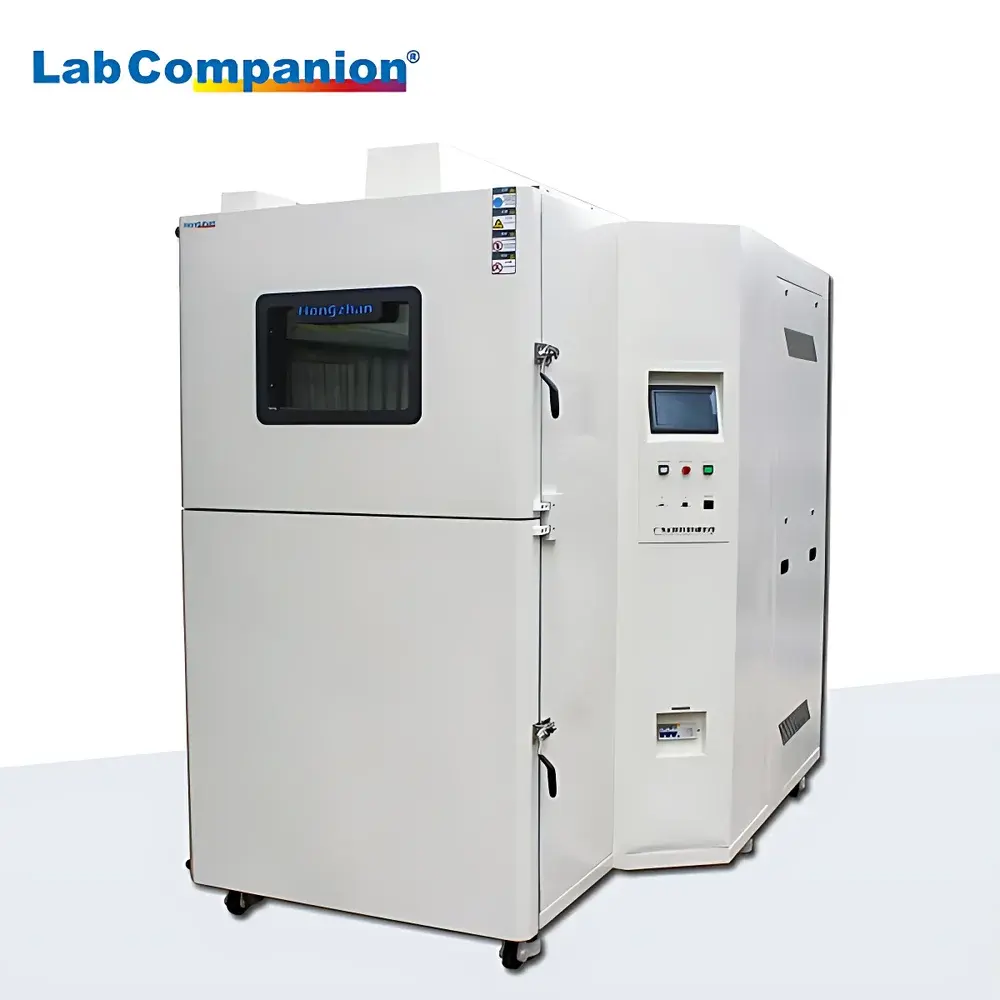
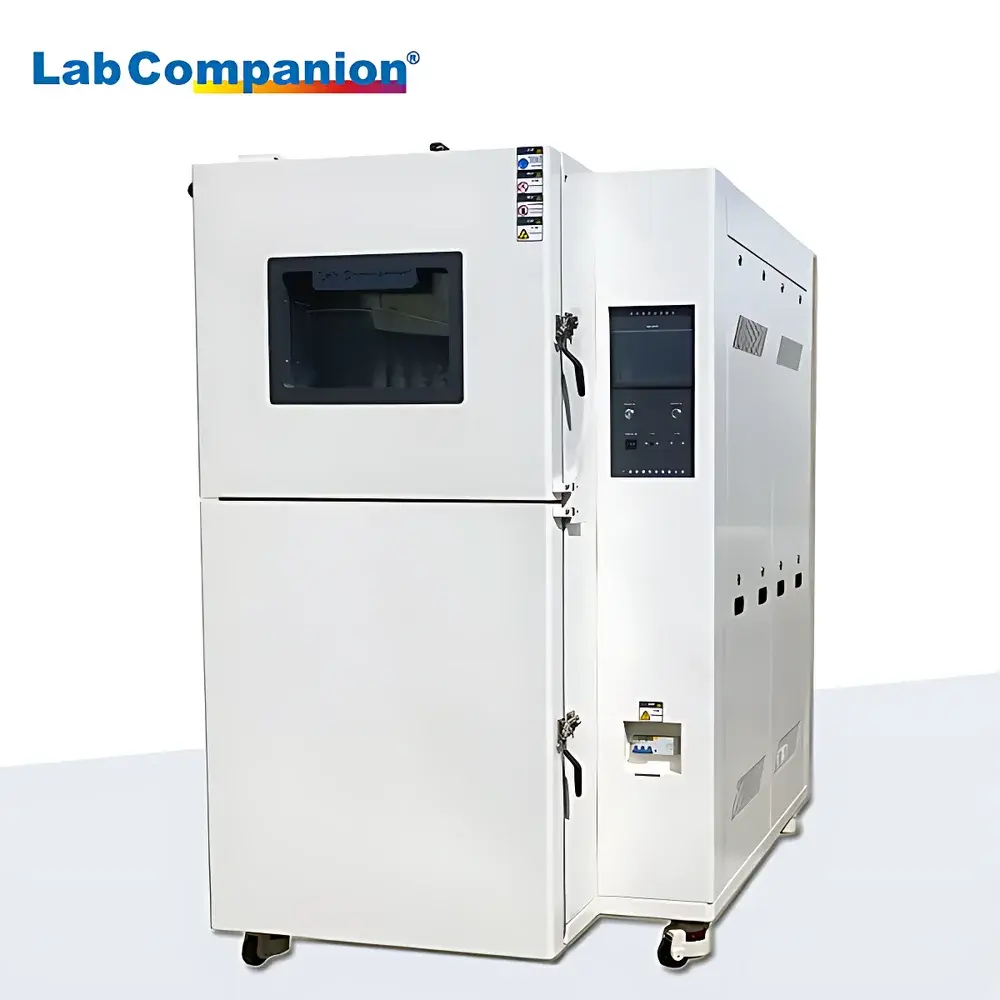
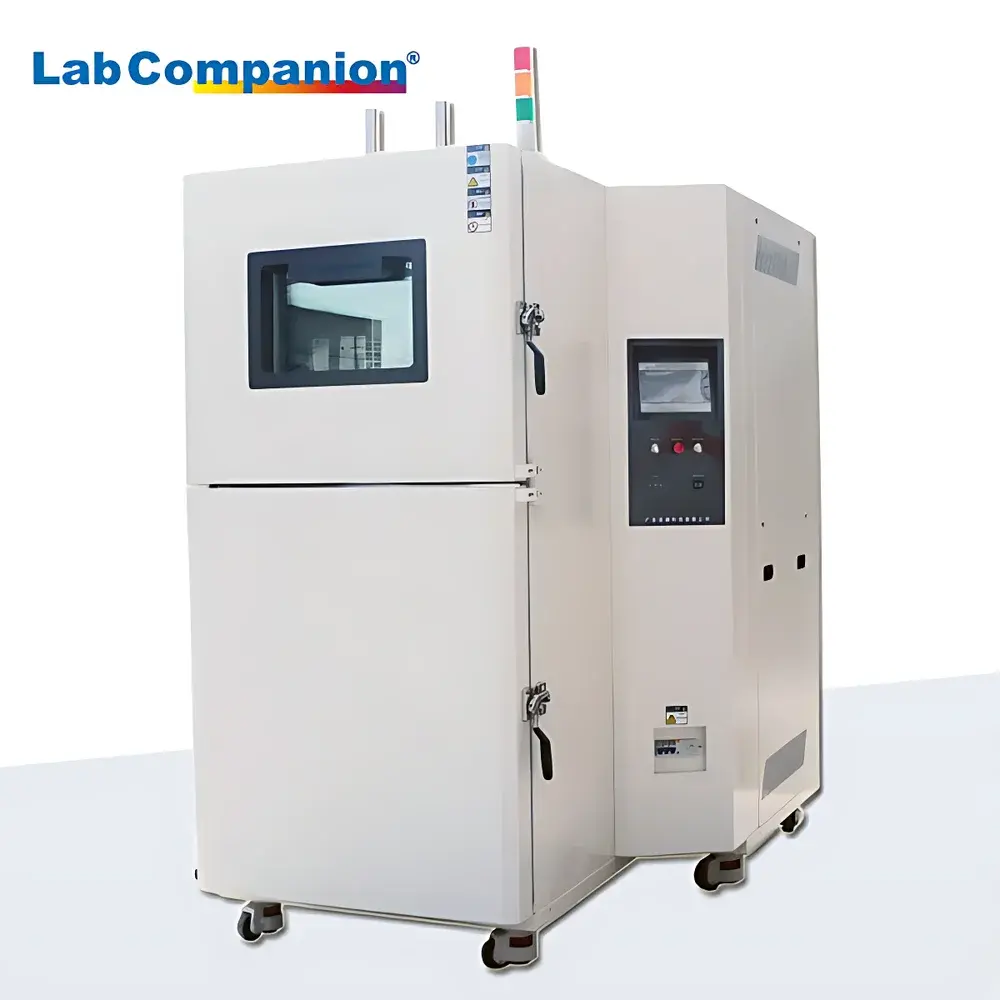
LabCompanion CTU-50W Basket-Type Thermal Shock Test Chamber
| Brand | LabCompanion |
|---|---|
| Origin | Guangdong, China |
| Manufacturer Type | Direct Manufacturer |
| Model | CTU-50W |
| High-Temperature Range | +60 °C to +200 °C |
| Low-Temperature Range | 0 °C to −70 °C |
| Thermal Shock Range | −55 °C to +200 °C |
| Temperature Stability | ±2 °C |
| Heating Rate | R.T. → +200 °C in ~40 min |
| Cooling Rate | R.T. → −70 °C in ~60 min |
| Transfer Time | ≤5 s |
| Temperature Recovery Time | ≤5 min |
| Internal Dimensions (W×H×D) | 300×460×350 mm |
| External Dimensions (W×H×D) | 2250×1200×1950 mm |
| Construction | Cold-Rolled Steel Exterior (Ivory White Powder Coating), #304 Mirror-Finish Stainless Steel Interior (1.2 mm), Eco-Friendly Fiberglass Insulation |
| Refrigeration | Air-Cooled or Water-Cooled (W suffix denotes water-cooled configuration) |
| Compressor | Imported Hermetic Scroll Compressor |
| Temperature Sensor | Armored Pt100 Platinum Resistance Thermometer |
| Controller | Siemens PLC Module + 7″ Color TFT Touchscreen (LabCompanion PlatinumV1.0 Embedded Control Software) |
| Data Interface | USB 2.0 (CSV logging, non-hot-pluggable), RJ45 Ethernet (TCP/IP, supports up to 5 concurrent client connections |
| Power Supply | AC 380 V, 50 Hz, 3-phase + PE |
| Compliance | GJB 150.3–150.5, GB/T 2423.1–2423.2 |
Overview
The LabCompanion CTU-50W Basket-Type Thermal Shock Test Chamber is an engineered solution for accelerated reliability assessment under extreme thermal cycling conditions. Designed around the dual-chamber basket-transfer principle, it subjects test specimens to rapid, repeatable transitions between high- and low-temperature environments—enabling precise simulation of thermal stress encountered during operational life cycles, transportation, or storage. Unlike single-chamber ramp-based systems, this configuration eliminates thermal inertia delays by physically moving samples between independently controlled hot and cold zones via a motorized stainless steel basket. The chamber operates on a defined thermal shock profile per MIL-STD-810G Method 503.5, IEC 60068-2-14, and relevant clauses of GJB 150.3 (High Temperature), GJB 150.4 (Low Temperature), and GJB 150.5 (Temperature Shock). Its architecture ensures minimal thermal overshoot and stable dwell conditions, critical for evaluating solder joint integrity, polymer dimensional stability, coating adhesion, and semiconductor package delamination.
Key Features
- Independent dual-zone temperature control: Hot chamber (up to +200 °C) and cold chamber (down to −70 °C) maintain setpoints with ≤±2 °C uniformity across working volume.
- High-speed pneumatic basket transfer mechanism achieving ≤5-second transition time between zones, minimizing thermal lag and ensuring sharp thermal gradients.
- Temperature recovery time ≤5 minutes post-transfer, verified per GB/T 5170.2–2017 and GB/T 5170.3–2017 test protocols.
- Robust thermal insulation using non-hazardous, low-conductivity fiberglass (λ ≤ 0.035 W/m·K), compliant with RoHS and REACH environmental directives.
- Siemens S7-1200 PLC-based control system with deterministic real-time scheduling, integrated with LabCompanion’s PlatinumV1.0 embedded firmware for deterministic PID tuning and alarm management.
- 7-inch industrial-grade TFT touchscreen with capacitive multi-touch interface, supporting parameter locking, user-level access control (Operator/Engineer/Admin), and on-screen trend visualization of up to four channels (Thot, Tcold, Tbasket, chamber status).
Sample Compatibility & Compliance
The CTU-50W accommodates samples up to 300 × 460 × 350 mm (W × H × D) within its stainless steel interior. Its basket design supports both rigid and semi-flexible specimens—including PCB assemblies, automotive ECUs, aerospace connectors, medical device housings, and battery modules—without requiring custom fixtures. All internal surfaces are electropolished #304 stainless steel (1.2 mm thickness), ensuring corrosion resistance and ease of cleaning for GLP-compliant validation. The system meets structural and performance requirements of GB/T 2423.1 (cold testing), GB/T 2423.2 (dry heat), and GJB 150.5 (temperature shock), and supports IQ/OQ documentation packages aligned with ISO/IEC 17025 and FDA 21 CFR Part 11 when paired with optional audit-trail-enabled software modules. Calibration traceability follows CNAS-accredited procedures against NIST-traceable reference standards.
Software & Data Management
Data acquisition and reporting are governed by LabCompanion’s PlatinumV1.0 ecosystem. Real-time process data—including chamber temperatures, basket position status, elapsed cycle time, and deviation alarms—are logged at 1-second intervals to internal flash memory and simultaneously exported via USB 2.0 to CSV files (non-hot-pluggable; requires continuous U-disk presence). For networked environments, the RJ45 TCP/IP interface enables integration with enterprise LIMS or MES platforms using Modbus TCP or custom RESTful API endpoints (available under extended license). The optional PlatinumV1.0 Supervisory Software provides remote monitoring, multi-chamber scheduling, electronic signature support, and automated report generation (PDF/Excel) compliant with 21 CFR Part 11 Annex 11 requirements—including full audit trail, user authentication, and data integrity verification.
Applications
- Qualification testing of electronic components per JEDEC JESD22-A104 (Temperature Cycling) and A106 (Thermal Shock).
- Validation of thermal interface materials (TIMs), encapsulants, and underfill compounds under cyclic thermal load.
- Assessment of glass-to-metal seal integrity in hermetic packaging for aerospace sensors and MEMS devices.
- Accelerated aging studies of lithium-ion battery cells under alternating thermal extremes to evaluate electrolyte decomposition and SEI layer evolution.
- Verification of adhesive bond strength retention in composite aircraft structures subjected to ground-to-altitude thermal transients.
FAQ
What is the difference between CTU, CTL, and CTS model series?
CTU models feature water-cooled refrigeration (‘W’ suffix), optimized for continuous operation in ambient temperatures >30 °C or high-duty-cycle applications; CTL uses air-cooling for standard lab environments; CTS offers extended low-temperature capability (−65 °C) for cryogenic qualification.
Does the CTU-50W support programmable multi-step thermal shock profiles?
Yes—the PlatinumV1.0 controller supports up to 99 segments per program, including dwell time, ramp rate, and loop count, with automatic step progression triggered by time or temperature threshold.
Is calibration certificate included with shipment?
A factory calibration report (per GB/T 5170.2 and GB/T 5170.3) is provided; ISO/IEC 17025-accredited field calibration services are available upon request.
Can the chamber be integrated into an existing test automation framework?
Yes—Modbus TCP, OPC UA (via optional gateway), and ASCII command protocol documentation are supplied for third-party SCADA or test executive integration.
What maintenance intervals are recommended for long-term reliability?
Compressor oil and refrigerant analysis every 24 months; condenser coil cleaning quarterly (air-cooled) or cooling tower water quality monitoring biannually (water-cooled); annual verification of door gasket compression and basket guide rail lubrication.



