
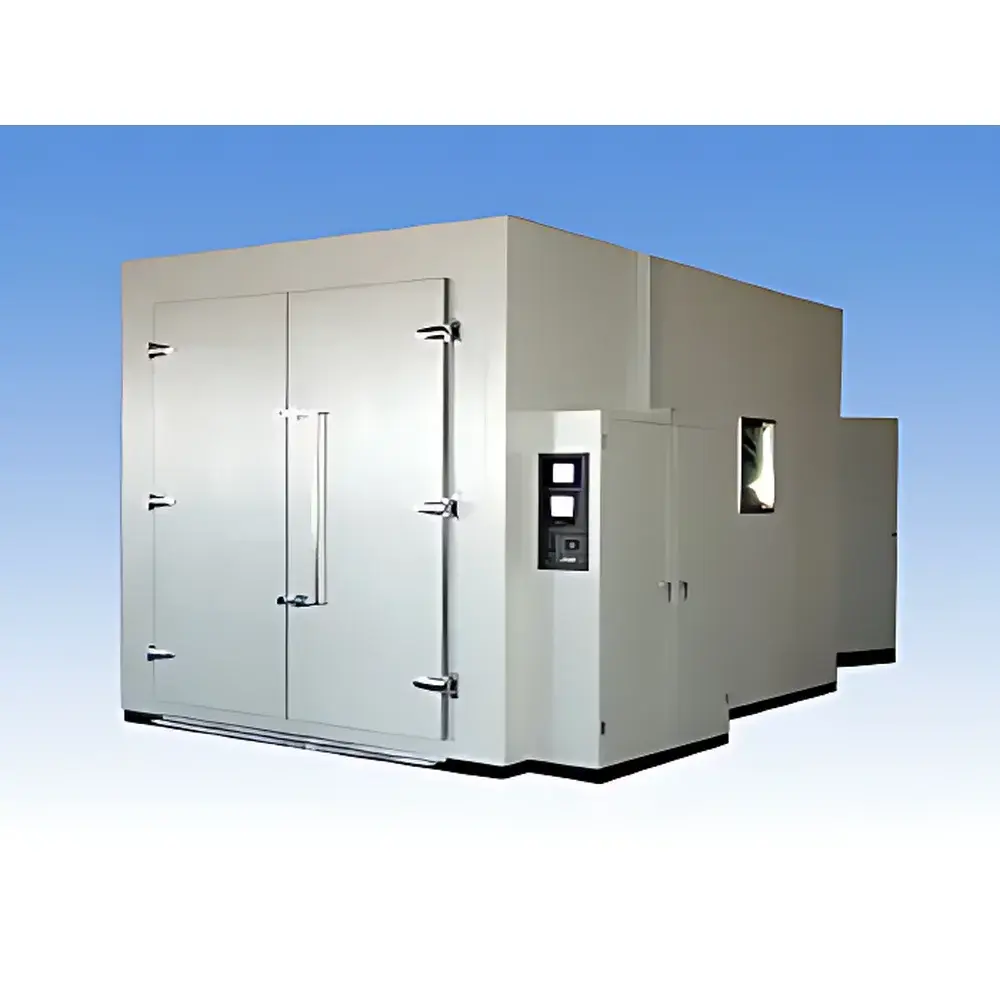
LabCompanion P-Series Large-Scale Temperature and Humidity Controlled Environmental Test Chamber
| Brand | LabCompanion |
|---|---|
| Origin | Guangdong, China |
| Manufacturer Type | OEM/ODM Manufacturer |
| Country of Origin | China |
| Model | Customizable P-Series |
| Temperature Range | −70 to +150 °C |
| Humidity Range | 10–98% RH (with optional dehumidification module) |
| Internal Volume | 80–1000 L |
| Temperature Uniformity | ≤ ±2.0 °C |
| Humidity Uniformity | ±2.5% RH |
| Temperature Fluctuation | ±0.5 °C |
| Heating Rate | −70 °C → +150 °C in ≤60 min |
| Cooling Rate | +20 °C → −70 °C in ≤75 min |
| Control Resolution | ±0.1 °C / ±1% RH |
| Programmable Steps | 50 programs × 2500 segments |
| Controller | UMC1200 Touchscreen HMI with Integrated PLC |
| Refrigeration System | Dual-stage cascade compression (R507/R23) or single-stage (R507), air-cooled, imported hermetic rotary compressors |
| Construction | SUS304 stainless steel interior |
| Safety Features | Dry-heater protection, independent over-temperature cutoff, water-level monitoring, compressor overload/overcurrent protection, high-pressure refrigerant switch, leakage current protection |
| Compliance | GB/T 10586, GB/T 10592, GB/T 2423.1, GB/T 2423.3, GB/T 2423.4, GB/T 2423.34, MIL-STD-810D Method 502.2 & 507.2, GJB 150.9, IEC 60068-2-3 |
Overview
The LabCompanion P-Series Large-Scale Temperature and Humidity Controlled Environmental Test Chamber is an industrial-grade programmable environmental simulation system engineered for rigorous reliability testing under dynamic thermal and hygrothermal stress conditions. Designed according to the fundamental principles of psychrometric control and forced-air convection thermodynamics, it delivers precise, repeatable, and traceable environmental profiles across wide operational envelopes—spanning −70 °C to +150 °C and 10–98% RH (with optional deep-dehumidification capability down to <10% RH). Its dual-stage cascade refrigeration architecture—utilizing R507/R23 eco-friendly refrigerants—enables stable low-temperature performance while maintaining compliance with global environmental regulations (e.g., EU F-Gas Regulation, EPA SNAP). The chamber’s structural integrity, thermal inertia management, and airflow homogenization are optimized to meet the stringent uniformity requirements defined in ISO 16750-4, IEC 60068-2, and MIL-STD-810G, making it suitable for qualification testing of mission-critical components in aerospace, automotive electronics, telecommunications, and medical device manufacturing.
Key Features
- Modular large-volume design: Configurable internal volumes from 80 L to 1000 L, with customizable internal dimensions (e.g., 100 × 100 × 100 cm) to accommodate full-system assemblies such as server racks, battery modules, or PCB production batches.
- BTHC (Balanced Temperature & Humidity Control) algorithm: Independently actuated heating, cooling, humidification, and dehumidification subsystems enable simultaneous, non-interfering regulation—minimizing overshoot and stabilizing setpoints within ±0.5 °C and ±1% RH (control resolution).
- Advanced control architecture: Integrated UMC1200 color touchscreen HMI paired with industrial-grade PLC logic ensures deterministic real-time execution of up to 50 multi-segment programs (2500 total steps), supporting complex cycling protocols including temperature-humidity combined stress (e.g., GB/T 2423.34, MIL-STD-883C Method 1004.2).
- Dual-stage cascade refrigeration: Imported hermetic rotary compressors, air-cooled condensers, and precision refrigerant metering via FastAIT monitoring deliver rapid thermal transitions (≤60 min from −70 °C to +150 °C) with minimal thermal lag and long-term compressor durability.
- Robust mechanical construction: Interior chamber fabricated from electropolished SUS304 stainless steel; exterior housing available in either brushed SUS304 or electrostatically coated cold-rolled steel; insulation comprises layered high-density polyurethane foam (≥100 mm) and fiberglass for optimal thermal resistance and condensation suppression.
- Comprehensive safety ecosystem: Redundant hardware-level protections—including dry-heater cutoff, independent over-temperature sensor, refrigerant high-pressure switch, phase-loss detection, and ground-fault circuit interruption—meet IEC 61000-6-2 EMC and UL 61010-1 functional safety requirements.
Sample Compatibility & Compliance
The P-Series chamber accommodates diverse sample geometries—from compact optical sensors and lithium-ion pouch cells to large-format LCD panels, telecom base station enclosures, and automotive ECUs—via standardized cable ports (Φ50 mm), adjustable stainless-steel shelves, and a front-access water reservoir (15 L capacity). Its performance validation adheres to internationally recognized test standards, including GB/T 10586 (humidity chamber specifications), GB/T 10592 (climatic chamber tolerances), IEC 60068-2-1 (cold), -2 (dry heat), -3 (damp heat, steady state), -14 (change of temperature), and MIL-STD-810G Method 507.5 (temperature/humidity cycling). All units undergo factory calibration traceable to NIM (National Institute of Metrology, China) and support post-installation verification per ISO/IEC 17025 requirements. Optional configuration enables compliance with FDA 21 CFR Part 11 for electronic records and signatures when integrated with validated data logging software.
Software & Data Management
The embedded controller supports native LAN-based communication (TCP/IP), enabling centralized fleet monitoring via SCADA-compatible architectures. Real-time data—including chamber setpoints, actual temperature/humidity readings, alarm status, and compressor duty cycles—is continuously logged with timestamped metadata and stored internally on non-volatile memory. USB 2.0 export allows secure transfer of CSV-formatted datasets for statistical process control (SPC) analysis in JMP, Minitab, or Python-based QA workflows. Optional remote monitoring software provides role-based web access (HTTPS), configurable email/SMS alerts, and audit-trail generation compliant with GLP and GMP Annex 11. Curve recording functionality displays up to 72 hours of historical trends on-screen, while auto-diagnostic logs capture fault codes, runtime statistics, and maintenance intervals for predictive servicing.
Applications
This chamber serves as a core qualification tool in product development and quality assurance laboratories. It is routinely deployed for accelerated life testing of printed circuit board assemblies (PCBAs) per IPC-9701, thermal shock evaluation of fiber-optic transceivers (SFP+, QSFP-DD), humidity-induced corrosion screening of metal-plated connectors (ASTM B117), and validation of battery thermal runaway propagation thresholds (UN 38.3, UL 1642). In R&D settings, its programmability supports failure mode identification under combined stress profiles—such as ramp-and-soak sequences mimicking diurnal desert-to-mountain transit or cyclic condensation events simulating coastal storage environments. Automotive Tier-1 suppliers use it for component-level validation against LV 124 and GMW 3172 specifications; medical device manufacturers apply it for packaging integrity testing per ASTM D4332 and ISO 11607-1.
FAQ
What is the standard warranty period for the P-Series chamber?
LabCompanion provides a 24-month comprehensive parts-and-labor warranty, extendable to 36 months with annual preventive maintenance contracts.
Can the chamber be validated for ISO 17025-compliant calibration?
Yes—each unit ships with a factory calibration certificate (NIM-traceable); on-site IQ/OQ/PQ documentation packages and third-party validation support are available upon request.
Is remote firmware update supported?
Firmware updates are performed via encrypted USB drive; network-based OTA updates are not enabled by default for cybersecurity compliance (IEC 62443-3-3).
How is humidity controlled below 20% RH?
A dedicated refrigerant-based dehumidification module—installed upstream of the main chamber—lowers dew point to −40 °C, enabling stable operation at 10–15% RH without desiccant consumables.
Does the system support automated report generation for regulatory submissions?
When paired with LabCompanion’s optional Validation Suite software, the chamber generates PDF reports with digital signatures, revision history, and deviation tracking aligned with FDA 21 CFR Part 11 and EU Annex 11 requirements.



