
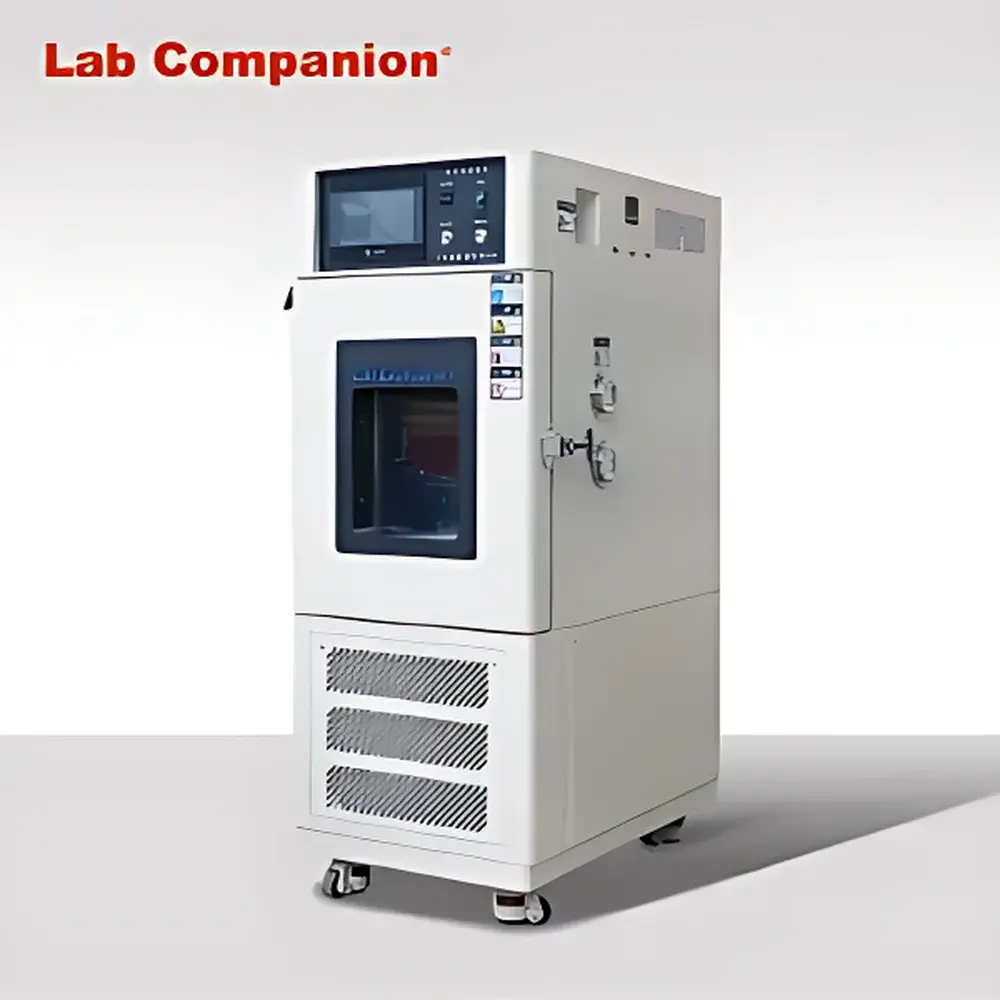
LabCompanion PU36 Compact High-Low Temperature Environmental Test Chamber
| Brand | LabCompanion |
|---|---|
| Origin | Guangdong, China |
| Manufacturer Type | Direct Manufacturer |
| Country of Origin | China |
| Model | PU36 |
| Temperature Range | −40 °C to +150 °C |
| Refrigeration Method | Mechanical Compression Cooling |
| Explosion-Proof Design | Standard (Non-Explosion-Proof) |
| Temperature Fluctuation | ±0.5 °C |
| Temperature Uniformity | ±2.0 °C |
| Temperature Deviation | ±2.0 °C |
| Heating Rate | 3.0–3.5 °C/min |
| Cooling Rate | 1.2 °C/min |
| Internal Chamber Dimensions (W×H×D) | 300 × 400 × 300 mm |
Overview
The LabCompanion PU36 is a compact, high-reliability environmental test chamber engineered for precise thermal stress evaluation of materials, components, and electronic assemblies under controlled high- and low-temperature conditions. Based on forced-air convection and dual-stage mechanical compression refrigeration, the PU36 delivers stable thermal profiles across its full operating range of −40 °C to +150 °C—suitable for accelerated aging, thermal cycling, storage simulation, and pre-conditioning protocols required in R&D laboratories, quality assurance departments, and contract testing facilities. Its 36 L internal volume (300 × 400 × 300 mm) balances spatial efficiency with functional utility, enabling validation of small-to-medium-sized samples without compromising thermal fidelity. The chamber’s architecture adheres to fundamental thermodynamic design principles: insulated double-wall construction with high-density polyurethane foam, PID-controlled heating/cooling modulation, and calibrated air distribution ducting to minimize stratification.
Key Features
- Large observation window with tempered glass and anti-fog coating for real-time visual monitoring without thermal interruption
- Ergonomic lever-type door lock mechanism ensuring positive sealing and repeatable closure force
- Dual-side cable access ports (standard φ50 mm; optional φ80/φ100/φ150 mm) with silicone grommets for electrical feedthrough and sensor integration
- Independent sample power control terminals rated for 250 VAC / 10 A, supporting powered-in-situ testing
- Triple independent over-temperature protection: digital controller limit, mechanical backup thermostat, and external thermal cutoff fuse
- Fully proprietary temperature controller with 0.1 °C resolution, programmable ramp-soak profiles, and non-volatile memory for up to 100 segments
- Modular expansion capability: optional 180 °C high-temp upgrade, low-humidity configuration (down to 5 °C / 5 % RH), and integrated pure-water humidification system (for humidity-enabled variants)
Sample Compatibility & Compliance
The PU36 accommodates diverse sample geometries—including PCBs, polymer films, medical device housings, battery cells, and optical subassemblies—within its uniformly heated/cooled workspace. Its ±2.0 °C temperature uniformity (per IEC 60068-3-5) and ±0.5 °C stability meet baseline requirements for MIL-STD-810G, GB/T 2423.1/2, and JIS C 0042 thermal testing standards. While the standard model is non-explosion-proof, it complies with general-purpose electrical safety per GB 4793.1 and CE marking directives (2014/30/EU EMC, 2014/35/EU LVD). Optional accessories—including traceable NIST-calibrated reference sensors, GLP-compliant audit trails via RS485/Modbus, and 21 CFR Part 11–enabled data logging software—support regulated environments subject to FDA or ISO 17025 accreditation.
Software & Data Management
The embedded controller supports local profile programming and real-time parameter display. For advanced data governance, optional LabCompanion DataLink software enables remote chamber supervision via Ethernet or Wi-Fi, with encrypted TLS 1.2 communication. Logged data—including chamber setpoint, actual temperature, ramp rate, and alarm history—is stored in CSV and PDF formats with time-stamped digital signatures. Audit trail functionality records all user actions (login/logout, parameter edits, start/stop commands) with immutable timestamps—fully compliant with ALCOA+ data integrity principles. Integration with enterprise LIMS or MES platforms is achievable through OPC UA or RESTful API interfaces.
Applications
- Thermal shock screening of solder joints and conformal coatings per IPC-J-STD-020
- Pre-conditioning of lithium-ion battery modules prior to electrochemical cycling tests
- Stability assessment of pharmaceutical packaging under ICH Q1A(R3) long-term storage conditions
- Material coefficient-of-thermal-expansion (CTE) correlation studies using in-chamber displacement sensors
- Validation of automotive ECU thermal derating behavior at extreme ambient extremes
- Calibration verification of temperature-sensitive transducers and RTDs
FAQ
What is the maximum allowable sample weight inside the PU36 chamber?
Standard configuration supports up to 15 kg distributed evenly on the stainless-steel shelf; heavy-duty reinforced shelves (optional) increase capacity to 40 kg.
Can the PU36 be integrated into an automated test sequence with external PLCs?
Yes—via Modbus RTU over RS485 or Ethernet/IP, enabling synchronized start/stop, setpoint updates, and fault status polling.
Is calibration documentation provided with shipment?
Each unit ships with a factory calibration certificate (traceable to CNAS-accredited labs), including as-found/as-left data for temperature uniformity and stability at three critical points (−40 °C, 25 °C, +150 °C).
Does the chamber support continuous operation at −40 °C?
Yes—the refrigeration system is designed for uninterrupted 7×24 operation at minimum temperature, with automatic defrost cycles scheduled during idle periods to maintain coil efficiency.
How is temperature uniformity verified during qualification?
Per ISO 17025–accredited IQ/OQ protocols, nine-point mapping is performed using nine calibrated PT100 sensors positioned per IEC 60068-3-5 Annex B, with results documented in the User Qualification Report.
Related Products



