
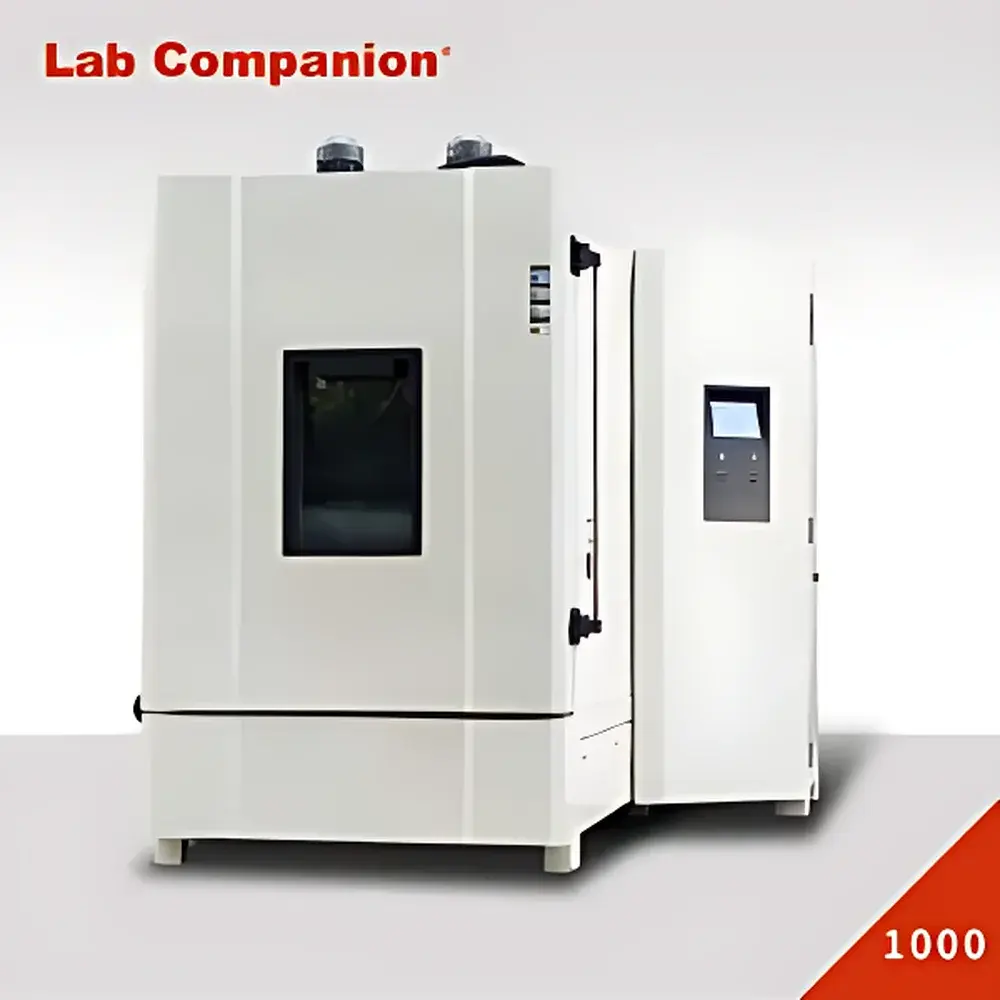
LabCompanion TS2/TS3 Thermal Shock Test Chamber
| Brand | LabCompanion |
|---|---|
| Origin | Guangdong, China |
| Manufacturer Type | Direct Manufacturer |
| Product Category | Domestic |
| Model Series | TS2, TS3 |
| Price Range | USD 14,000–28,000 (FOB) |
| High-Temperature Range | +150 °C |
| Low-Temperature Range | −65 °C |
| Thermal Shock Range | −65 °C to +150 °C |
| Heating Rate | +60 °C to +200 °C ≤ 20 min |
| Cooling Rate | +20 °C to −75 °C ≤ 60 min |
Overview
The LabCompanion TS2 and TS3 Thermal Shock Test Chambers are engineered for precise, repeatable evaluation of material and component reliability under rapid, extreme temperature transitions. Based on the two-chamber or three-chamber air-blast thermal shock principle, these systems subject test specimens to abrupt shifts between independently controlled high- and low-temperature zones—enabling accelerated aging, solder joint integrity assessment, and failure mode analysis in electronics, aerospace components, automotive modules, and advanced packaging materials. Unlike conventional cycling chambers, the TS series employs pneumatic door actuation and optimized airflow management to achieve sub-5-minute temperature recovery times (per MIL-STD-810H Method 503.5 and GJB 150.5A-2009), minimizing dwell time variability and ensuring compliance with stringent qualification protocols for mission-critical hardware.
Key Features
- Three configurable thermal shock architectures: Two-zone (hot/cold) lift-type basket, three-zone (hot/ambient/cold) horizontal shuttle, and static ambient chamber variants—each selected to match specimen geometry, throughput requirements, and thermal mass constraints.
- High-strength SUS304 stainless steel working chamber with electropolished interior finish—resistant to thermal fatigue, corrosion, and condensation-induced degradation over >15,000 operational cycles.
- Dual-stage refrigeration system utilizing environmentally compliant R-404A/R-23 cascade configuration, integrated with variable-speed scroll compressors and proportional expansion valves for 0–100% cooling capacity modulation—reducing energy consumption by up to 30% versus fixed-heating-balance control schemes.
- Multi-layer insulation comprising high-density polyurethane foam (≥150 kg/m³) and vacuum-deposited aluminum foil reflectors—limiting heat leakage to <0.8 K/h at steady-state extremes.
- IP65-rated silicone rubber gasketing with dual-lip sealing profile and pneumatic compression lock—maintaining chamber integrity at ±0.5 kPa differential pressure during rapid pressure equalization.
- Industrial-grade PLC controller with 10.4″ TFT-LCD HMI, supporting both programmable ramp-soak profiles (up to 99 segments) and fixed-point thermal shock sequences per IEC 60068-2-14 and JEDEC JESD22-A104E.
Sample Compatibility & Compliance
The TS2/TS3 accommodates test loads up to 30 kg on reinforced stainless steel shelves, with maximum specimen dimensions of 850 mm (W) × 600 mm (H) × 800 mm (D) across the TS3-W variant. Standard configurations support plastic-encapsulated ICs, PCB assemblies, MEMS sensors, and polymer housings; optional features include 50 mm diameter cable/port access ports, embedded PT100 sensor arrays, and inert gas purge capability (N₂ or dry air) for oxidation-sensitive samples. The chambers are fully compliant with GB/T 10592–2008, GB/T 2423.1–2008 (Test A: Cold), GB/T 2423.2–2008 (Test B: Dry Heat), GJB 150.3A–2009, GJB 150.4A–2009, and GJB 150.5A–2009. Optional validation packages include IQ/OQ documentation aligned with ISO/IEC 17025 and GLP audit requirements.
Software & Data Management
Embedded firmware supports real-time logging of chamber temperatures (hot zone, cold zone, payload surface), door position status, compressor discharge pressure, and refrigerant superheat—all timestamped at 1 Hz resolution. Data export is available via USB 2.0 mass storage or Ethernet TCP/IP (Modbus TCP and HTTP REST API supported). Optional LabCompanion DataSuite software provides automated report generation (PDF/CSV), statistical process control (SPC) charts (X̄-R, Cpk), and electronic signature-enabled audit trails compliant with FDA 21 CFR Part 11 when deployed on validated Windows OS platforms. All firmware updates are digitally signed and verified prior to installation.
Applications
- Qualification testing of avionics modules per DO-160 Section 4.5 (Temperature Shock).
- Reliability screening of automotive ECUs under ISO 16750-4 temperature cycling stress.
- Failure analysis of lead-free solder joints using JEDEC JESD22-A104E-defined profiles (e.g., −55 °C ↔ +125 °C, 15 min dwell, 10 s transfer).
- Accelerated life testing of OLED display substrates and flexible printed circuits.
- Material coefficient-of-thermal-expansion (CTE) mismatch validation in multi-layer ceramic packages.
- Pre-conditioning of optical coatings and precision metrology fixtures prior to interferometric measurement.
FAQ
What is the difference between two-chamber and three-chamber thermal shock configurations?
Two-chamber systems use a mechanical basket to move samples between hot and cold zones, minimizing thermal inertia but requiring higher actuator duty cycles. Three-chamber designs maintain a stable ambient intermediate zone, enabling more precise dwell control and reduced thermal stress on moving mechanisms—ideal for high-mass or vibration-sensitive payloads.
Can the TS series perform standard temperature cycling tests in addition to thermal shock?
Yes. When configured with optional ambient chamber integration and extended controller firmware, the TS2/TS3 supports continuous ramp-and-soak cycling (e.g., −40 °C → +85 °C → −40 °C) per IEC 60068-2-14, with programmable ramp rates from 1 °C/min to 15 °C/min.
Is remote monitoring and control supported?
Standard Ethernet connectivity enables remote parameter adjustment, alarm acknowledgment, and live data streaming via secure HTTPS interface. Integration with enterprise MES/SCADA systems is supported through Modbus TCP and OPC UA (via optional gateway module).
What calibration and traceability options are available?
Factory calibration includes NIST-traceable PT100 sensors at chamber corners and center, with certificate of calibration (ISO/IEC 17025 accredited lab option available). On-site verification kits and annual recalibration services are offered globally through LabCompanion’s authorized service network.
Are custom internal dimensions or non-standard temperature ranges possible?
Yes. LabCompanion provides engineering consultation and custom build services—including extended low-temperature capability down to −80 °C (with LN₂ assist), high-temperature operation up to +200 °C, and bespoke chamber geometries—to meet application-specific qualification requirements.



