
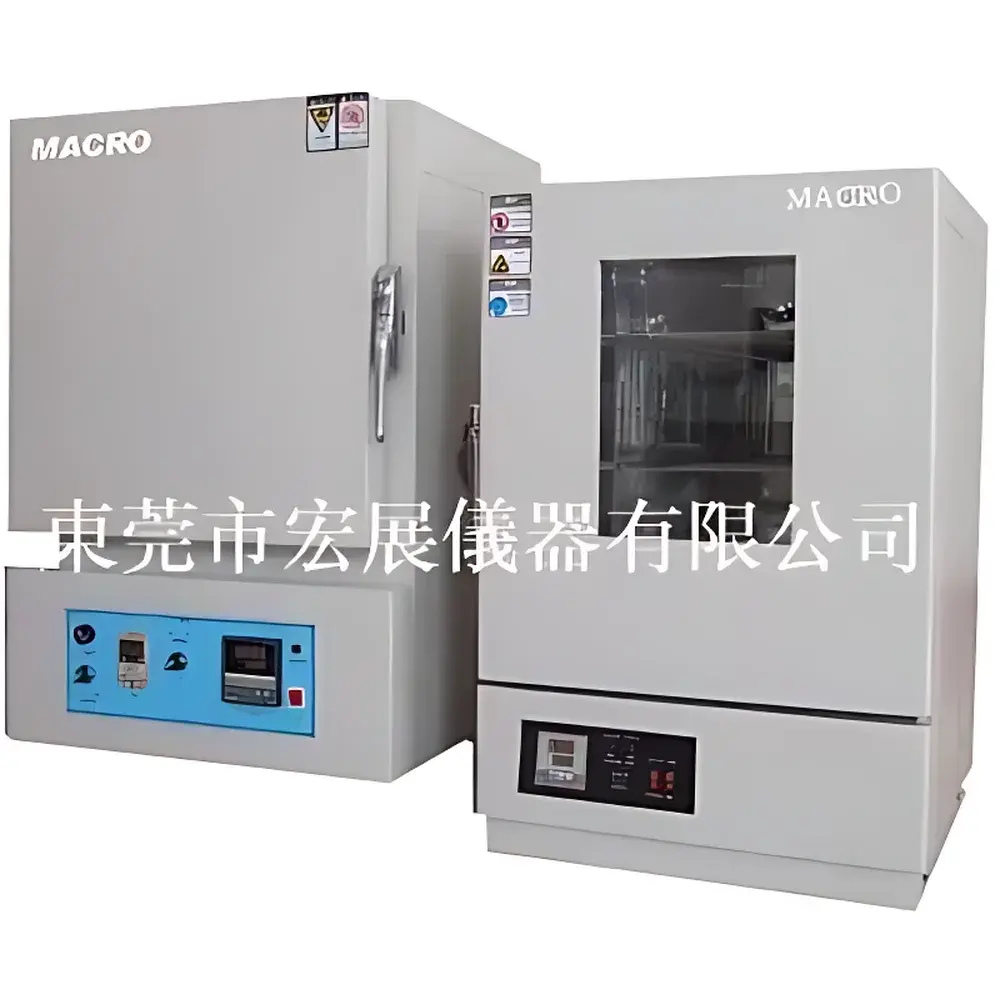
LabCompanion HD/HH Series Precision Drying Oven
| Brand | LabCompanion |
|---|---|
| Model | HD/HH Series |
| Temperature Range | Ambient +5°C to 300°C |
| Temperature Stability | ±1°C |
| Temperature Uniformity | ±1.5°C |
| Interior Dimensions (W×H×D) | 450×400×400 mm |
| Exterior Dimensions | 610×905×575 mm |
| Interior Material | Mirror-Finish Stainless Steel |
| Exterior Material | Powder-Coated Steel |
| Insulation | High-Density Compressed Glass Wool |
| Heating System | Finned-Tube Electric Heaters |
| Air Circulation | Forced-Air Convection with Optimized Outlet Design |
| Power Supply | 3-Phase 380 VAC ±10% or Single-Phase 220 VAC ±10% |
| Safety Protections | Bimetallic Over-Temperature Cut-Off, MCCB Overload Protection, Dual-Stage Thermal Alarm (Alarm → Cut-off), Fuse-Protected Circuit |
| Controller | Microprocessor-Based PID Temperature Controller with Setpoint & Real-Time Display |
| Accessories | 2–6 Adjustable Stainless Steel Shelves |
| Optional | Time-Based Auto-Shutdown, Programmable Ramp-Soak Profiles |
Overview
The LabCompanion HD/HH Series Precision Drying Oven is an engineered solution for controlled thermal processing in research laboratories, quality control environments, and industrial manufacturing settings. Designed around the principle of forced-air convection heating, it delivers stable, repeatable, and spatially uniform temperature conditions across its working chamber—critical for applications such as moisture removal, polymer curing, pre-weighing sample conditioning, thermal aging of materials, and residue drying prior to gravimetric analysis. Its operational envelope spans from ambient +5°C up to 300°C, accommodating both low-temperature stabilization and high-temperature drying protocols without thermal overshoot or drift. The oven’s architecture integrates thermodynamic efficiency with mechanical robustness: a double-wall construction insulated with high-density compressed glass wool minimizes heat loss and external surface temperature rise, while the finned-tube electric heating system ensures rapid thermal response and long-term reliability under continuous duty cycles.
Key Features
- Microprocessor-based PID temperature controller with intuitive up/down key interface; displays both setpoint and real-time chamber temperature simultaneously.
- Dual-stage thermal safety system: first-stage audible alarm at preset over-temperature threshold, second-stage automatic power cutoff via bimetallic thermal cut-off switch—compliant with IEC 61000-4-11 surge immunity and EN 60519-1 electrical safety requirements for heating equipment.
- Forced-air circulation system featuring a centrifugal blower and strategically positioned exhaust/supply ducts to achieve ≤±1.5°C temperature uniformity (measured per ASTM E145 Annex A4 methodology at steady state).
- Interior chamber fabricated from mirror-finish 304 stainless steel for corrosion resistance, ease of cleaning, and minimal particulate shedding—essential for ISO 14644-compliant cleanroom-adjacent workflows.
- Modular upright assembly design optimizes floor space utilization while maintaining structural rigidity and door seal integrity across repeated thermal cycling.
- Standard configuration includes two to six load-bearing, height-adjustable stainless steel shelves; shelf supports are recessed to avoid airflow obstruction.
Sample Compatibility & Compliance
The HD/HH Series accommodates a broad range of sample formats—including Petri dishes, crucibles, beakers, trays, and component assemblies—without compromising thermal homogeneity. Its chamber geometry and airflow dynamics have been validated for compatibility with USP drying procedures, ASTM D1654 (coating corrosion testing preconditioning), and ISO 554 (standard atmospheres for conditioning and testing). All electrical components meet CE marking requirements under the Low Voltage Directive (2014/35/EU) and Electromagnetic Compatibility Directive (2014/30/EU). The unit is suitable for GLP-regulated environments when operated with documented calibration records and maintenance logs; optional time-stamped event logging (via RS-485 interface) supports 21 CFR Part 11 audit readiness when integrated with validated LIMS platforms.
Software & Data Management
While the base model operates via standalone microcontroller logic, optional digital interfaces enable integration into centralized lab infrastructure. An RS-485 port supports Modbus RTU communication for remote parameter setting, real-time temperature telemetry, and alarm status polling. When paired with LabCompanion’s optional PC-based monitoring software (v3.2+), users gain access to automated data logging at user-defined intervals (1 s to 60 min), graphical trend visualization, deviation alerts, and export to CSV or PDF report templates compliant with internal QA documentation standards. Firmware updates preserve backward compatibility and include enhanced PID auto-tuning algorithms for improved stability during ramp-and-soak sequences.
Applications
- Moisture content determination per AOAC 950.46 and ISO 554 for food, pharmaceutical, and agricultural commodities.
- Thermal preconditioning of test specimens prior to tensile, impact, or dielectric testing (ASTM D638, D256, D149).
- Curing of epoxy resins, powder coatings, and printed circuit board laminates under defined time-temperature profiles.
- Residue drying in analytical chemistry workflows—including ash content analysis (AOAC 923.03) and total solids quantification (EPA 160.1).
- Accelerated aging studies for packaging materials and elastomers per ASTM D573 and ISO 188.
- Pre-heating of glassware and metal fixtures to eliminate condensation prior to vacuum or inert-atmosphere processes.
FAQ
What is the maximum recommended operating temperature for continuous use?
The HD/HH Series is rated for continuous operation at temperatures up to 250°C; operation at 300°C is permissible for short-duration cycles (≤2 hours) with adequate cooling intervals between runs.
Can the oven be calibrated to NIST-traceable standards?
Yes—each unit ships with a factory calibration certificate referencing PTB-traceable reference sensors; field recalibration using Class A platinum RTDs (IEC 60751) is supported via service mode.
Is the interior lighting compatible with photolabile samples?
The standard LED chamber light emits negligible UV radiation (<0.1 µW/cm² at 365 nm); for photosensitive applications, the light can be disabled via control panel menu or hardwired bypass.
Does the unit support programmable multi-step temperature profiles?
Programmable ramp-soak functionality is available as an upgrade option (HD/HH-P series), supporting up to 16 segments with independent rate, dwell, and end-action parameters.
What maintenance intervals are recommended for optimal performance?
Blower motor lubrication and filter inspection every 6 months; annual verification of thermal cut-off activation point and PID controller linearity using certified dry-block calibrators.



