
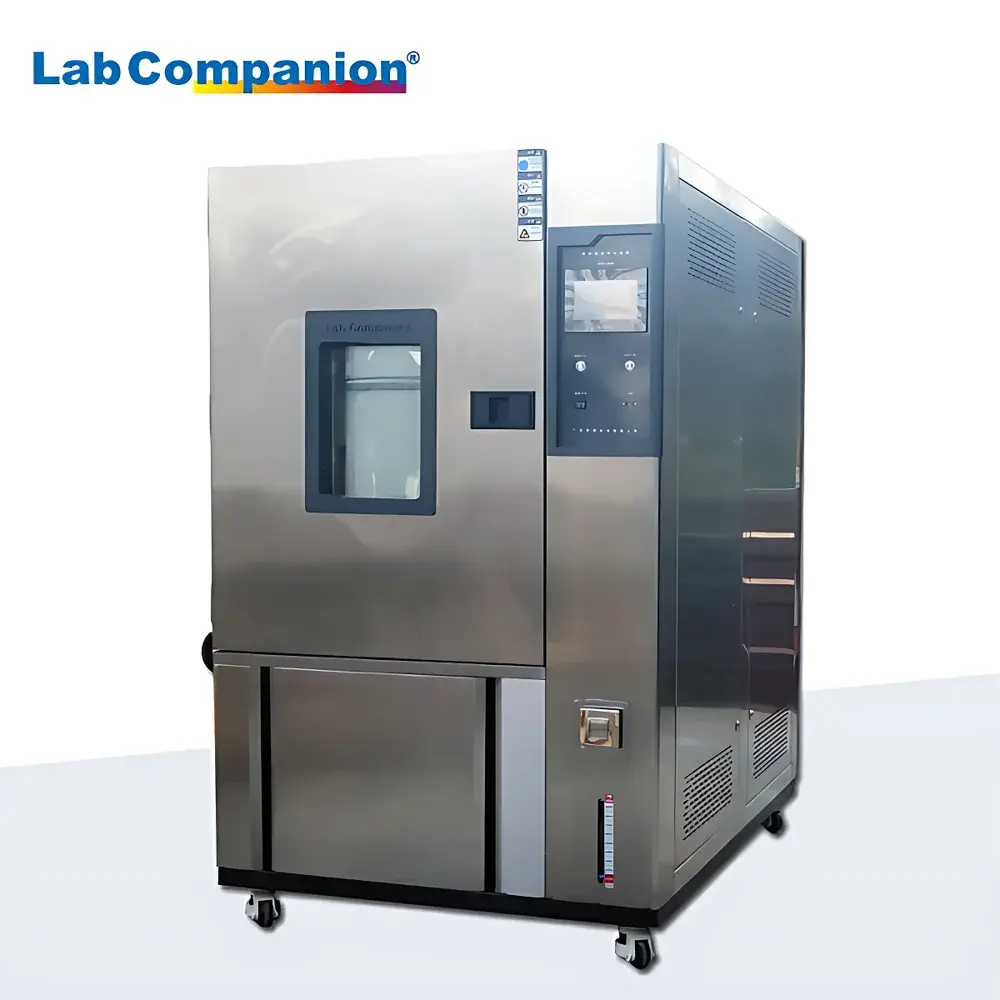
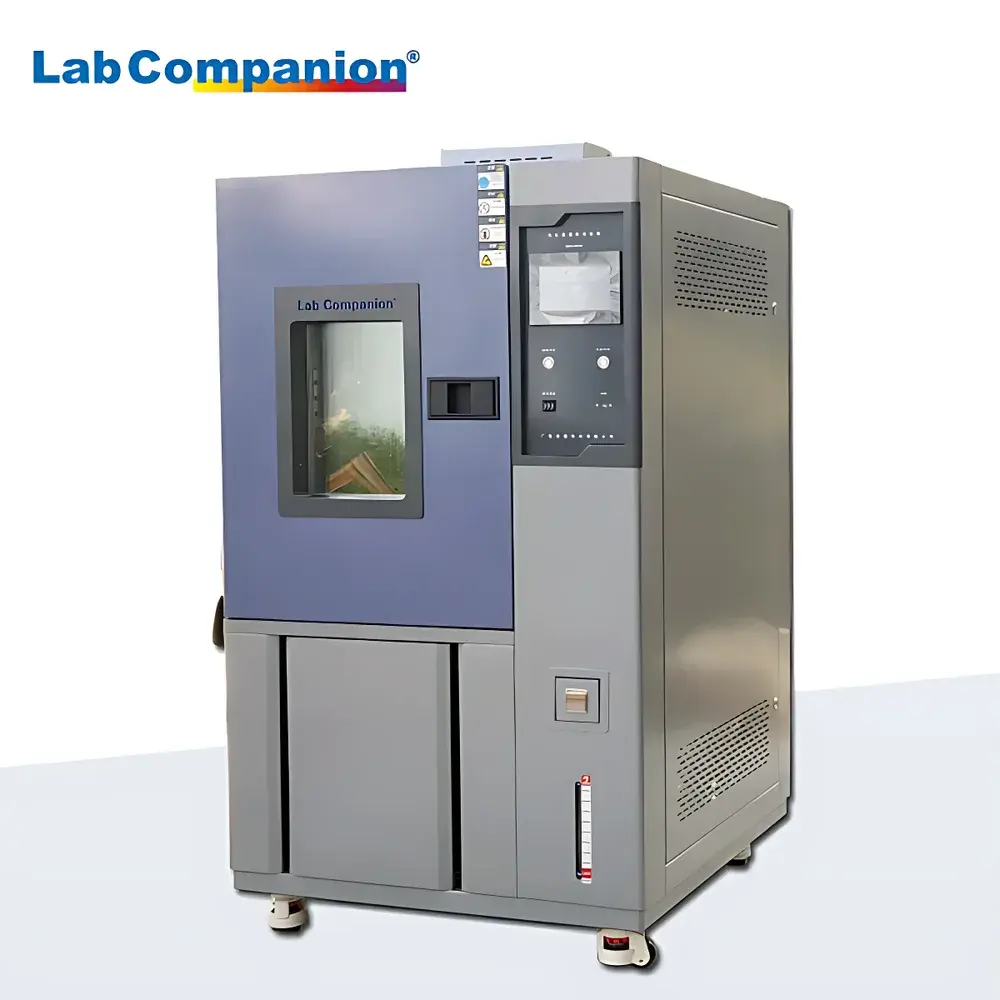
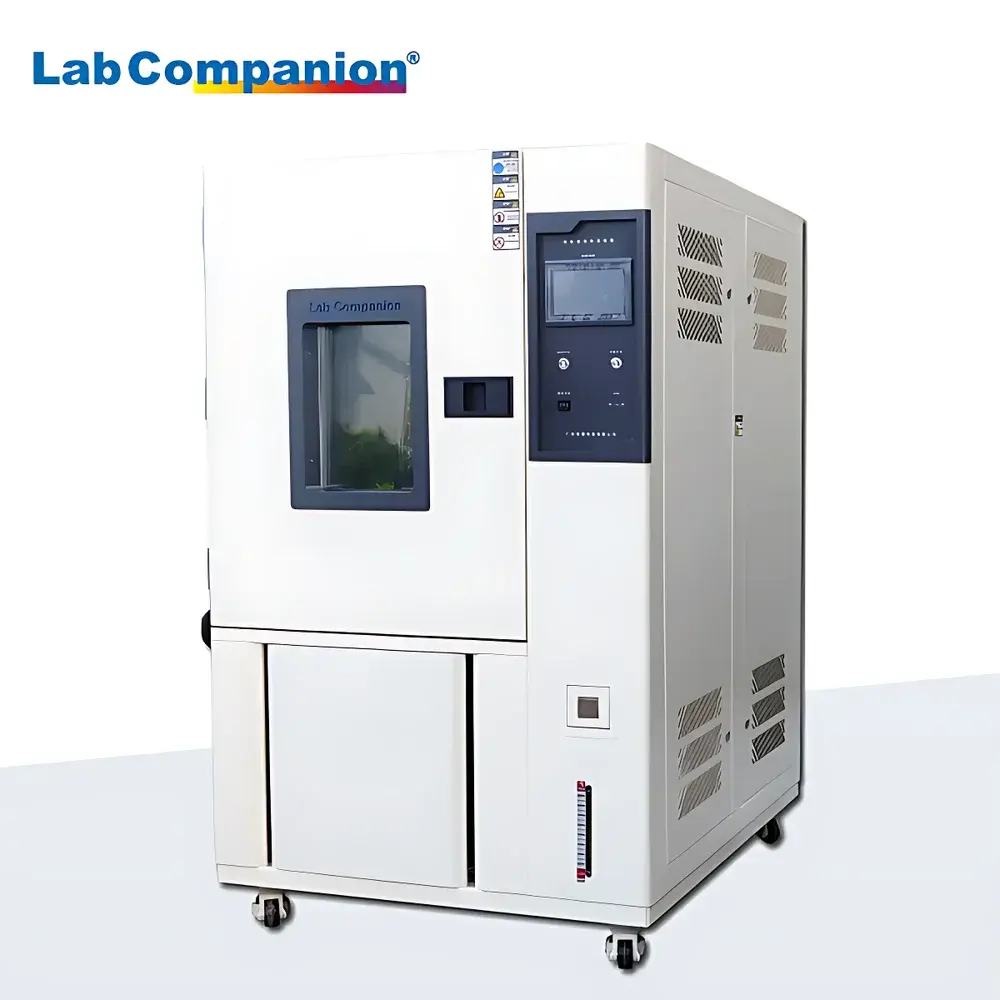
LabCompanion PDR-408 Temperature and Humidity Environmental Test Chamber
| Brand | LabCompanion |
|---|---|
| Origin | Guangdong, China |
| Manufacturer Type | Direct Manufacturer |
| Product Category | Domestic |
| Model | PDR-408 |
| Instrument Type | Upright |
| Humidity Range | 5–98 % RH |
| Temperature Fluctuation | ±0.5 ℃ |
| Humidity Deviation | ±2.5 % RH |
| Heating Rate | ~3.5 ℃/min (non-linear, unloaded, 20 ℃ to +150 ℃) |
Overview
The LabCompanion PDR-408 is a precision-engineered upright temperature and humidity environmental test chamber designed for rigorous reliability testing of materials, components, and finished products under controlled climatic conditions. It operates on the principle of forced-air convection combined with dual-channel PID-controlled refrigeration and steam-based humidification systems, enabling stable and repeatable simulation of real-world thermal and hygroscopic stress environments. The chamber supports standardized environmental stress screening (ESS), accelerated aging, and qualification testing per international standards including IEC 60068-2-1 (cold), IEC 60068-2-2 (dry heat), IEC 60068-2-30 (damp heat, cyclic), and MIL-STD-810H Method 507.5. Its operational envelope—spanning −20 ℃ to +150 ℃ and 5–98 % RH—covers critical test profiles for electronics, automotive ECUs, medical device packaging, aerospace composites, and polymer-based consumer goods.
Key Features
- Robust stainless-steel inner chamber (SUS304) with seamless welded construction and electrostatically applied epoxy-coated outer housing for corrosion resistance and long-term dimensional stability.
- Dual independent control loops: one for temperature (using platinum RTD sensors and high-efficiency finned-tube heaters) and another for humidity (employing stainless-steel steam generator and precision dew-point-based humidity sensor).
- High-reproducibility performance: ±0.5 ℃ temperature fluctuation and ±2.5 % RH humidity deviation across the full operating range, verified via NIST-traceable calibration protocols.
- Intelligent safety architecture including over-temperature cut-off, compressor high-pressure protection, water shortage alarm, and door-open interlock with automatic system shutdown.
- Modular refrigeration system utilizing environmentally compliant R404A/R23 cascade refrigerant blend, optimized for rapid cooling down to −20 ℃ without condensation-induced chamber wall frosting.
- Ergonomic upright configuration with double-layer insulated observation window (heated anti-fog glass), adjustable interior shelves (3× SUS304 perforated trays), and front-access cable ports (Φ50 mm, sealed with silicone grommets).
Sample Compatibility & Compliance
The PDR-408 accommodates test specimens up to 600 mm (W) × 850 mm (H) × 800 mm (D) internal volume (0.408 m³), supporting standard test load configurations per ASTM D4332 and ISO 22309. Its design complies with CE marking requirements (2014/30/EU EMC Directive and 2014/35/EU LVD Directive), and meets electrical safety Class I protection per IEC 61010-1. For regulated industries, the chamber supports optional validation packages—including IQ/OQ documentation, temperature/humidity mapping reports (per ISO 14644-3), and audit-ready calibration records traceable to CNAS-accredited laboratories. When integrated with LabCompanion’s optional data logger module, it satisfies FDA 21 CFR Part 11 requirements for electronic records and signatures, including user access control, audit trail logging, and electronic signature enforcement.
Software & Data Management
The PDR-408 is equipped with a 7-inch capacitive touchscreen HMI running embedded Linux OS, offering intuitive multi-segment programmable profiles (up to 99 steps, 99 cycles), real-time graphing, and USB export of CSV-formatted time-stamped logs (temperature, humidity, setpoints, alarms). Optional Ethernet/Wi-Fi connectivity enables remote monitoring via LabCompanion’s web-based platform, which supports role-based user permissions, automated report generation (PDF/Excel), and integration with enterprise LIMS or MES systems through Modbus TCP or OPC UA protocols. All logged data include timestamp, sensor ID, measurement unit, and operator ID—ensuring full traceability required under GLP and GMP environments.
Applications
- Electronics: Thermal cycling of PCB assemblies, moisture sensitivity level (MSL) testing per J-STD-020, and solder paste stability assessment.
- Automotive: Validation of infotainment modules, battery management systems (BMS), and plastic trim under humid tropical conditions (e.g., ISO 16750-4).
- Pharmaceuticals: Stability testing of primary packaging (blister packs, HDPE bottles) per ICH Q1A(R2) guidelines in long-term and accelerated conditions.
- Aerospace: Environmental qualification of avionics enclosures per DO-160G Section 4 (temperature) and Section 5 (humidity).
- Materials Science: Hygrothermal aging of composites, adhesives, and elastomers to assess dimensional stability, delamination resistance, and tensile property degradation.
FAQ
What is the minimum achievable humidity at −20 ℃?
At −20 ℃, the practical lower humidity limit is approximately 20 % RH due to condensation constraints; however, the specified 5–98 % RH range applies above 0 ℃. For sub-zero low-humidity operation, dehumidification is achieved via deep-dry air purge mode (optional accessory).
Can the PDR-408 perform ramp-soak-cycle profiles with humidity modulation?
Yes—the controller supports fully independent ramp/soak programming for both temperature and humidity, including simultaneous or staggered transitions, dwell times, and conditional branching based on elapsed time or sensor thresholds.
Is third-party validation support available?
LabCompanion provides IQ/OQ protocol templates, on-site commissioning services, and certified calibration certificates (with uncertainty budgets) issued by CNAS-accredited partners upon request.
How is data integrity ensured during power interruption?
The system features non-volatile memory retention for all active profiles and logs, with automatic resume functionality post-power recovery. Optional UPS integration preserves runtime continuity for mission-critical tests.
What maintenance intervals are recommended?
Routine maintenance includes quarterly steam generator descaling, biannual refrigerant pressure verification, annual sensor recalibration, and semi-annual inspection of door gasket compression and heater terminal torque—detailed in the included Maintenance Logbook.



