
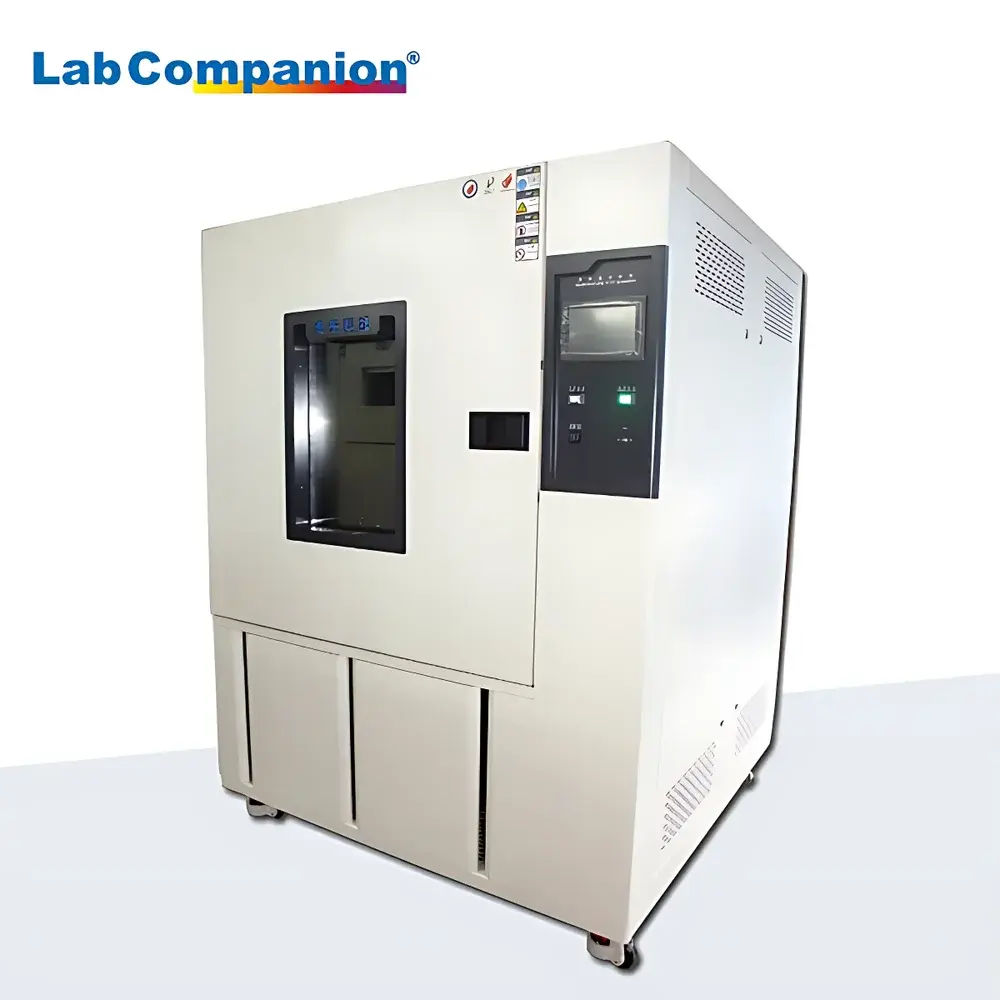
LabCompanion PG-408 Programmable Thermal Cycling Chamber
| Brand | LabCompanion |
|---|---|
| Origin | Guangdong, China |
| Manufacturer Type | OEM Manufacturer |
| Model | PG-408 |
| Temperature Range | −70 °C to +150 °C |
| Temperature Fluctuation | ±0.5 °C |
| Temperature Uniformity | ±2.0 °C |
| Temperature Deviation | ≤±2.0 °C |
| Heating Rate (20 °C to +150 °C, no-load, non-linear) | ~3.5 °C/min |
| Cooling Rate (20 °C to −70 °C, no-load, non-linear) | ~1.0 °C/min |
| Internal Dimensions (W×H×D) | 800×850×600 mm |
| Inner Chamber Material | SUS#304 Stainless Steel |
| Insulation | 100 mm Fire-Retardant PU Foam + Glass Wool |
| Controller | EYECOM (Japan) |
| Compressor | Tecumseh (France) |
| Safety Protections | Over-temperature/under-temperature cut-off, compressor high-pressure/over-current/over-heat protection, phase sequence protection, fan motor thermal overload protection, leakage circuit breaker, SSR/PWM/PID balanced control algorithm |
Overview
The LabCompanion PG-408 Programmable Thermal Cycling Chamber is an engineered environmental test system designed for precise, repeatable, and traceable temperature stress profiling across industrial R&D, quality assurance, and reliability validation workflows. Based on forced-air convection with dual-stage refrigeration and PID-controlled resistive heating, the chamber delivers stable thermal environments compliant with core requirements of IEC 60068-2-1 (Cold), IEC 60068-2-2 (Dry Heat), and MIL-STD-810G Method 502.5. Its −70 °C to +150 °C operating range supports accelerated life testing, thermal shock pre-conditioning, and storage simulation for electronic assemblies, aerospace components, automotive ECUs, medical devices, and semiconductor packaging. The chamber’s structural architecture—featuring 100 mm composite insulation, SUS#304 interior, and corrosion-resistant electro-galvanized exterior—ensures long-term thermal integrity and minimal energy drift under continuous operation.
Key Features
- High-fidelity temperature control via EYECOM programmable controller with 0.1 °C resolution, real-time data logging, and multi-segment ramp-soak profiles (up to 99 cycles, 999 steps)
- Dual-stage cascade refrigeration system using Tecumseh compressors, enabling deep-cold capability down to −70 °C without liquid nitrogen dependency
- Balanced P.I.D + P.W.M + S.S.R control algorithm ensuring <±0.5 °C temperature fluctuation and <±2.0 °C uniformity across the full working volume
- Robust mechanical design: 800×850×600 mm internal workspace accommodates standard test specimens, PCB trays, and small enclosures; reinforced door seal and double-glazed observation window minimize thermal leakage
- Comprehensive safety architecture including compressor overpressure/overcurrent/overheat protection, phase sequence monitoring, thermal cut-offs at upper/lower limits, and integrated SSR-based heater fail-safe logic
- Standard configuration includes two adjustable 304 stainless steel shelves, dual Φ50 mm cable ports with silicone gaskets, and optional humidity integration (20–98% RH, with low-humidity extension to 5% RH)
Sample Compatibility & Compliance
The PG-408 accommodates a broad spectrum of physical samples—from bare printed circuit boards and MEMS sensors to sealed medical device housings and automotive control modules—without requiring sample-specific fixtures or modifications. Its uniform airflow distribution ensures representative thermal exposure per ISO 16750-4 (Road vehicles – Environmental conditions and testing) and JEDEC JESD22-A104 (Temperature Cycling). All thermal profiles are fully auditable and support GLP/GMP-aligned documentation when paired with optional external data acquisition systems. While the base model meets CE, RoHS, and CCC requirements, optional calibration certificates (traceable to NIM or NIST standards) and IQ/OQ documentation packages are available for regulated industries including FDA-regulated medical device manufacturing and AS9100-certified aerospace suppliers.
Software & Data Management
The embedded EYECOM controller provides local profile programming, real-time trend visualization, alarm history (with timestamped event logs), and USB export of CSV-formatted temperature records. For enterprise integration, LabCompanion offers optional Ethernet-enabled remote monitoring via Modbus TCP or OPC UA protocols, enabling synchronization with LIMS, MES, or PLM platforms. Audit trail functionality—including user login tracking, parameter change logging, and firmware version stamping—supports compliance with FDA 21 CFR Part 11 when used with validated electronic signature modules. Raw time-series data can be imported into MATLAB, Python (Pandas), or JMP for statistical process control (SPC), Weibull analysis, or Arrhenius modeling of failure acceleration factors.
Applications
- Temperature cycling qualification per AEC-Q200 for passive and active automotive electronics
- Thermal aging studies of polymer encapsulants and conformal coatings in semiconductor packaging
- Pre-conditioning of lithium-ion battery modules prior to vibration or shock testing
- Stability assessment of diagnostic reagents and biologics under controlled thermal stress
- Validation of thermal management solutions for 5G base station RF modules
- Environmental screening of avionics hardware per DO-160 Section 4 (Operating Temperature)
FAQ
What is the standard calibration interval recommended for the PG-408?
Annual calibration against NIST-traceable reference probes is recommended for ISO/IEC 17025-compliant labs; quarterly verification using Class A PT100 sensors is advised for high-throughput QA environments.
Can the PG-408 be integrated into an automated test cell with PLC-level control?
Yes—digital I/O terminals (start/stop, alarm reset, cycle complete) and analog 4–20 mA temperature feedback outputs are provided as standard; optional Profibus DP or EtherCAT interfaces are available upon request.
Is the chamber suitable for testing samples with outgassing materials?
The SUS#304 interior and positive-pressure airflow design minimize cross-contamination; however, for high-outgassing applications (e.g., adhesives, potting compounds), optional activated carbon filtration and exhaust ducting are recommended.
Does the PG-408 support rapid thermal transients (e.g., >10 °C/min)?
Standard configuration achieves ~3.5 °C/min heating and ~1.0 °C/min cooling (non-linear, no-load); optional high-speed air circulation kits and enhanced refrigeration capacity enable up to 25 °C/min linear ramp rates—subject to custom engineering review.
How is temperature uniformity verified across the working volume?
Per IEC 60068-3-5, uniformity is validated using nine calibrated PT100 sensors placed at defined geometric locations (center + eight corners); LabCompanion provides factory uniformity reports with uncertainty budgets upon shipment.
Related Products



