
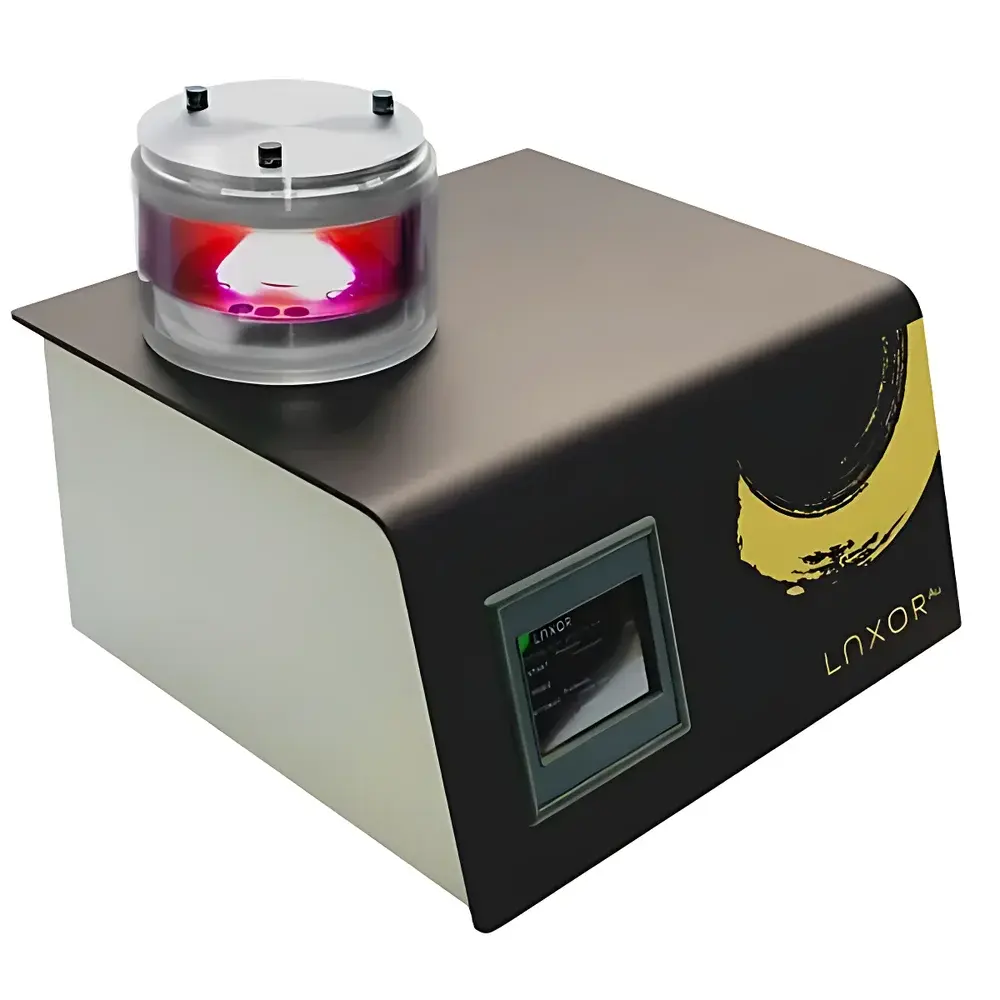
LUXOR Au Automatic Sputter Coater for SEM Sample Preparation
| Brand | LUXOR (Aptco Technologies, Belgium) |
|---|---|
| Origin | Belgium |
| Model | LUXOR Au |
| Target Material | Gold (Au) |
| Coating Method | Magnetron Sputtering |
| Operating Atmosphere | Air or Argon |
| Max. Magnification Compatibility | 50,000× (for Tungsten Filament & Desktop SEMs) |
| Sample Capacity | Up to 7 × 12 mm stubs or 3 × 25 mm stubs |
| Target Diameter | 30 mm |
| Target Thickness | 100 µm |
Overview
The LUXOR Au Automatic Sputter Coater is a high-precision magnetron sputtering system engineered for reliable, repeatable conductive coating of non-conductive or semi-conductive specimens prior to scanning electron microscopy (SEM) analysis. Developed by Aptco Technologies in Belgium, the LUXOR Au leverages DC magnetron sputtering physics—where energetic argon (or ambient air) ions bombard a gold target, ejecting atomic-scale metal species that condense uniformly onto sample surfaces under controlled vacuum conditions. This process yields ultra-thin, continuous, and low-resistivity Au films (typically 2–15 nm), effectively mitigating charging artifacts, enhancing secondary electron emission, and improving signal-to-noise ratio during high-magnification imaging (up to 50,000×) on tungsten-filament and desktop SEM platforms. Unlike conventional planetary or rotating-stage coaters, the LUXOR Au integrates A² (Adaptive Algorithmic Architecture) technology—a proprietary real-time plasma behavior model—that dynamically optimizes ion flux distribution across complex topographies without mechanical sample motion.
Key Features
- Inverted chamber architecture: The lid serves as both vacuum seal and specimen loading platform, enabling tool-free, ergonomic access to stubs and eliminating the need for tweezers or alignment fixtures.
- Full electrical safety compliance: All high-voltage circuitry (up to −1.2 kV DC) and current-carrying components are fully encapsulated within grounded metal housings, meeting IEC 61010-1 requirements for laboratory equipment safety.
- A² Intelligent 3D Coating: Self-calibrating algorithm compensates for shadowing effects on irregular, porous, or high-aspect-ratio samples—eliminating reliance on rotation stages while maintaining film thickness uniformity (±8% across 12 mm diameter).
- Tool-free target exchange: Pre-assembled 30 mm × 100 µm gold targets (LU02-GOLD100) mount via push-in carriers; no wrenches or vacuum break required—target lifetime extended by >35% vs. standard holders due to optimized sputter erosion profile.
- Intuitive 7-inch capacitive touchscreen interface: Predefined protocols (e.g., “Au_5nm_WF-SEM”, “AuPd_10nm_FEG-EDS”) with adjustable parameters (sputter time, pressure setpoint, discharge current); all processes logged with timestamp, operator ID, and vacuum history.
Sample Compatibility & Compliance
The LUXOR Au accommodates standard SEM stub configurations—including up to seven 12.5 mm pin-type stubs or three 25 mm stubs—within its inverted chamber. Optional accessories expand versatility: resin-embedded sample holders (25–40 mm Ø, 10–50 mm H) secure irregular or bulk specimens via three M4 threaded inserts; cylindrical stub adapters support 9 mm, 12 mm, and 25 mm diameters compatible with Thermo Fisher (FEI), ZEISS, TESCAN, HITACHI, and JEOL instrumentation. All coatings comply with ASTM E1558–22 (Standard Guide for Preparation of Specimens for SEM) and ISO/IEC 17025–2017 metrological traceability requirements when used with calibrated quartz crystal microbalances (QCM). The system supports GLP/GMP-aligned operation through optional audit-trail-enabled firmware (21 CFR Part 11 compliant data logging available upon configuration).
Software & Data Management
Embedded firmware provides full process automation with configurable coating recipes, real-time vacuum monitoring (Pirani + cold cathode gauges), and discharge current profiling. Each run generates a digital log containing vacuum ramp rate, final pressure (1–5 × 10⁻² mbar), sputter duration, average power density (W/cm²), and endpoint detection status. Export formats include CSV and PDF reports compatible with LIMS integration. Optional remote diagnostics enable predictive maintenance alerts (e.g., target depletion estimation, pump oil saturation index) via encrypted HTTPS API. Firmware updates are delivered via USB or network (TLS 1.2 secured), ensuring continued alignment with evolving SEM workflow standards.
Applications
- Routine SEM sample preparation for biological tissues, polymers, ceramics, and geological sections requiring high secondary electron yield.
- EDS-compatible coating: Au/Pd (80:20) co-sputtering enables simultaneous topographic imaging and elemental quantification without spectral interference from pure Au L-lines.
- Nanomaterial characterization: Uniform 3–5 nm Au layers preserve fine surface features on nanofibers, aerogels, and MOFs while preventing beam-induced charging.
- Quality control in electronics failure analysis: Rapid coating of PCB cross-sections and solder joints for void inspection at ≤10 kV accelerating voltage.
- Teaching laboratories: Simplified operation reduces training time to <10 minutes; visual feedback (plasma glow intensity, pressure curve) reinforces fundamental vacuum and plasma physics concepts.
FAQ
Can the LUXOR Au operate in ambient air without external gas supply?
Yes—the system is uniquely validated for sputtering in dry compressed air, enabling rapid setup in resource-limited labs. Argon operation is optional for finer grain structure and lower resistivity films.
Is target material limited to gold?
No—while optimized for Au and Au/Pd (LU02-GOLDPD100), the same chamber accepts Pt (LU02-PLATINUM100) and other noble metals using identical carrier geometry.
How does the inverted design improve coating cleanliness?
Gravity-assisted particle clearance removes loose debris from stub surfaces before sputtering initiates, reducing contamination risk to SEM columns and improving long-term detector performance.
What vacuum level is required for stable plasma ignition?
The system initiates stable DC discharge between 1.5 × 10⁻² and 4.0 × 10⁻² mbar—achievable with the integrated two-stage rotary vane pump (<3.5 min typical pump-down from atmosphere).
Does the A² algorithm require user calibration?
No—A² self-initializes during first use by mapping chamber geometry and plasma impedance; subsequent runs auto-adapt based on real-time pressure and current feedback without manual intervention.



