
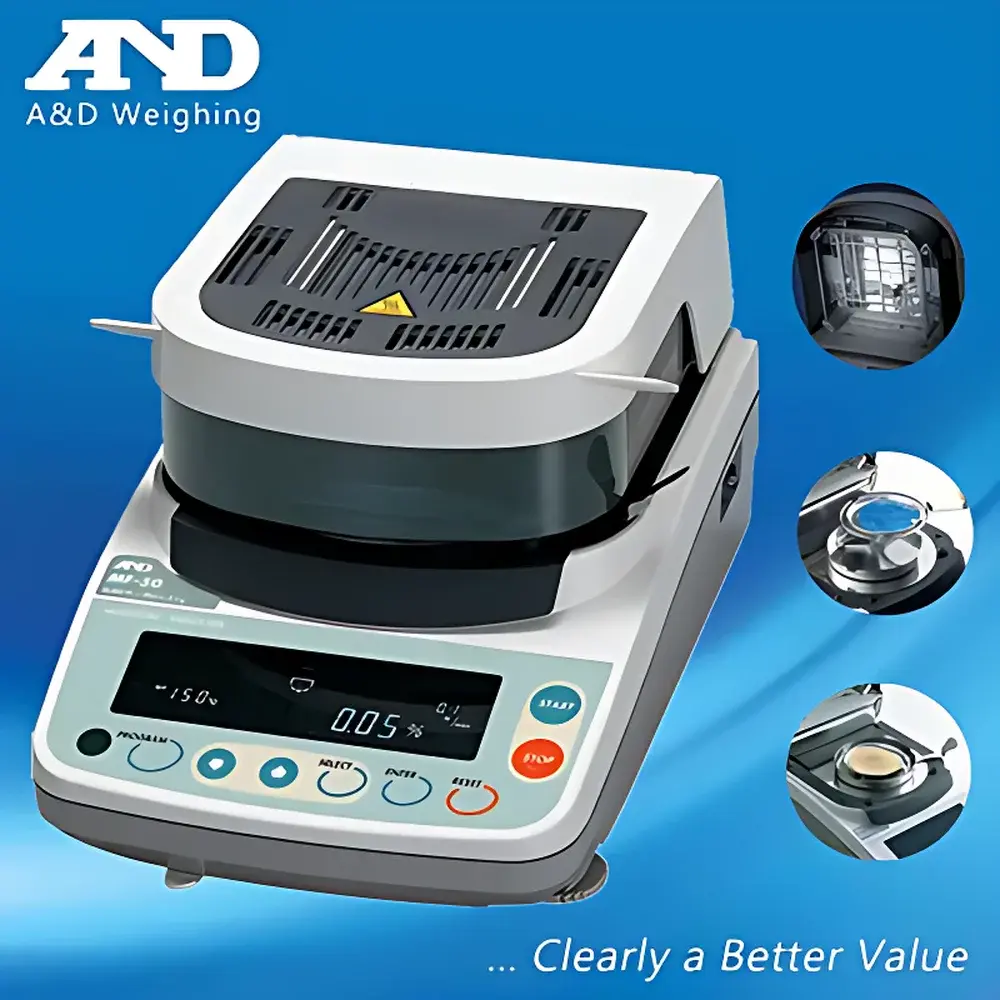
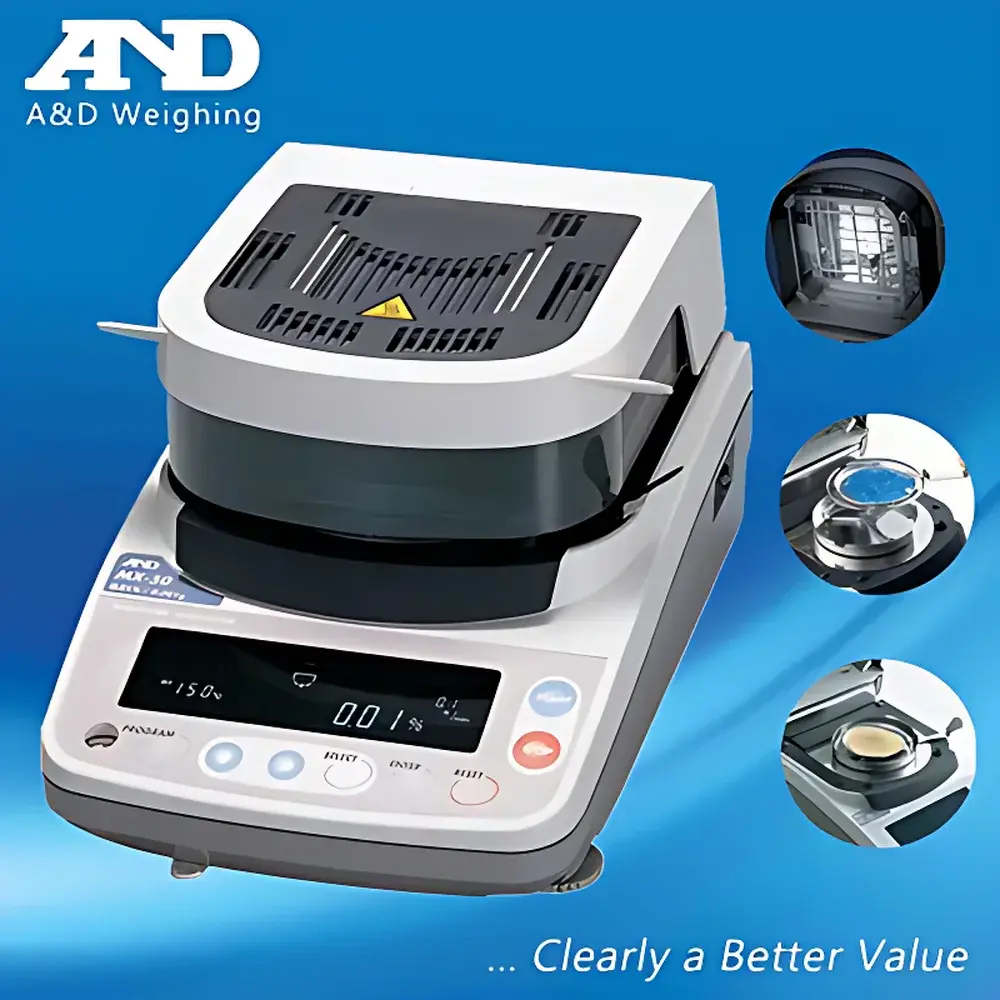
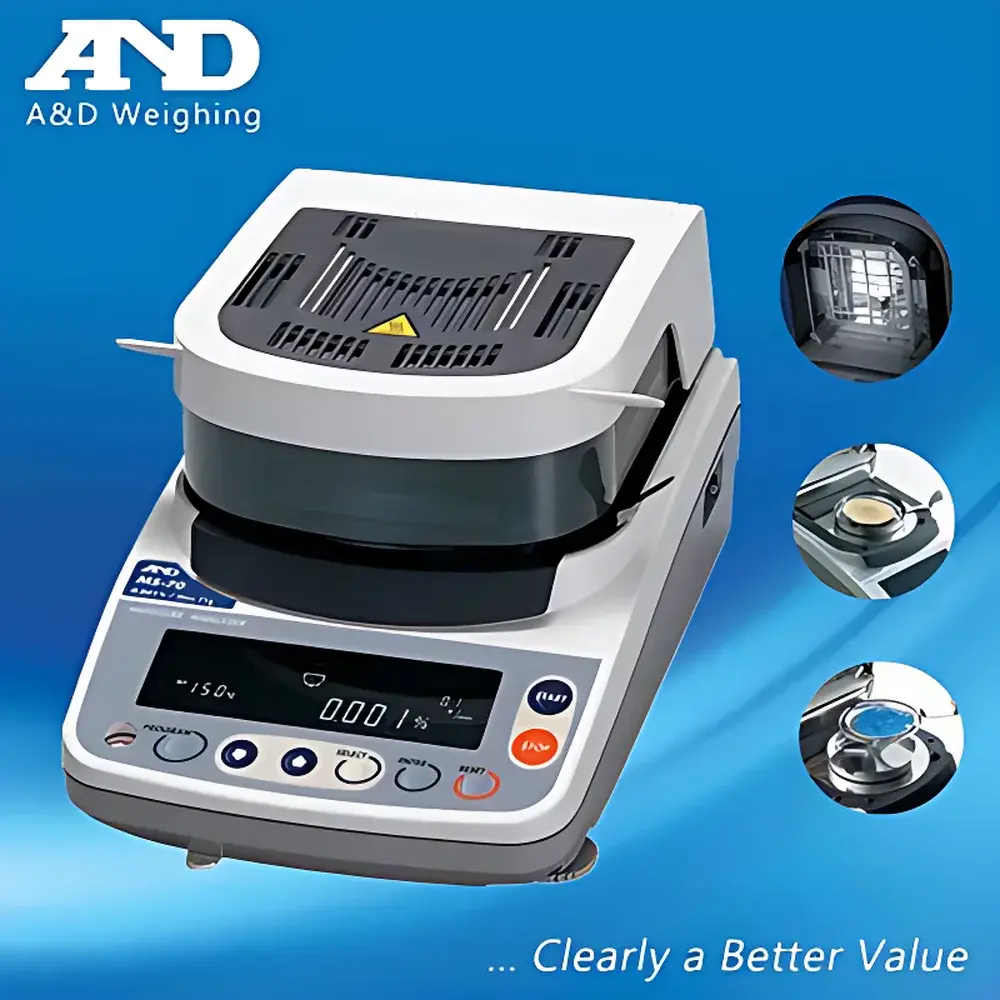
A&D MF-50 Halogen Moisture Analyzer
| Brand | A&D |
|---|---|
| Origin | Japan |
| Manufacturer | A&D Co., Ltd. |
| Type | Imported |
| Model | MF-50 |
| Heating Method | Halogen Lamp (400 W, Straight-Tube) |
| Maximum Sample Capacity | 51 g |
| Weighing Accuracy | 0.002 g |
| Moisture Resolution | 0.05 % / 0.1 % / 1 % |
| Drying Temperature Range | 50–200 °C |
| Measurement Modes | Relative Moisture Content / Absolute Moisture Content / Dry Basis / Wet Basis |
| Interface | RS-232C |
| Compliance | GLP/GMP/GCP, ISO 9001, ISO/IEC 17025 applicable |
| Calibration Standard | Sodium Tartrate Dihydrate (15.66 % ±0.3/−0.1 % H₂O) |
Overview
The A&D MF-50 Halogen Moisture Analyzer is a precision laboratory instrument engineered for rapid, gravimetric moisture determination based on the loss-on-drying (LOD) principle. It employs a high-intensity straight-tube halogen lamp (400 W) integrated with A&D’s proprietary Secondary Radiation Assistance (SRA) heating architecture to deliver uniform thermal energy distribution across the sample surface—minimizing thermal gradients and reducing measurement time without compromising repeatability. Unlike conventional infrared or convection ovens, the MF-50 combines real-time high-resolution mass monitoring (0.002 g readability) with programmable thermal profiles, enabling quantitative moisture analysis in accordance with internationally recognized reference methods including ASTM E1868, ISO 13732-1, and USP <921>. Designed and manufactured in Japan, the instrument meets stringent metrological requirements for regulated environments where traceability, audit readiness, and process consistency are mandatory.
Key Features
- Proprietary SRA (Secondary Radiation Assistance) heating system: Optimized halogen lamp geometry and reflective cavity design ensure rapid, homogeneous sample drying—reducing typical measurement duration by up to 40% compared to standard halogen analyzers.
- SHS (Super Hybrid Sensor) weighing mechanism: High-stability electromagnetic force compensation transducer delivers 0.002 g resolution and long-term drift stability (<0.005 g/24 h), critical for low-mass samples and high-precision LOD calculations.
- Five configurable measurement modes: Standard (adaptive endpoint detection), Automatic (moisture change rate threshold), Rapid (200 °C pre-heat for 3 min), Timer-based, and Manual—enabling method-specific optimization across diverse matrices.
- Four drying profile strategies: Standard (instant ramp), Progressive (stepwise temperature increase), Stepwise (multi-stage temperature/time segments), and Quick Dry (200 °C burst followed by controlled hold)—supporting thermally sensitive, heterogeneous, or high-fat content samples.
- GLP/GMP-compliant data handling: Built-in timestamped audit trail records operator ID, calibration history, measurement parameters, and final results—including moisture content, dry weight, and wet/dry ratios—with full export capability via RS-232C.
- Ergonomic sample chamber design: Heat-resistant winged lid handle and optimized sample pan geometry (Ø85 mm) minimize operator exposure during hot-sample loading/unloading; halogen lamp replacement requires no instrument downtime.
Sample Compatibility & Compliance
The MF-50 accommodates solid, granular, powdered, pasty, and low-viscosity liquid specimens within its 51 g capacity limit. Its adjustable drying temperature range (50–200 °C) supports applications ranging from heat-labile pharmaceutical excipients (e.g., lactose monohydrate, microcrystalline cellulose) to thermally robust industrial minerals and polymer resins. Validation protocols are supported through certified reference material (CRM) verification using sodium tartrate dihydrate (CAS 6381-59-5), which exhibits a certified moisture content of 15.66 % ±0.3/−0.1 % at 25 °C—providing an NIST-traceable benchmark for accuracy verification per ISO/IEC 17025 Clause 6.6. The analyzer conforms to regulatory documentation requirements under FDA 21 CFR Part 11 (when paired with compliant PC software), EU Annex 11, and ICH Q5C stability testing guidelines.
Software & Data Management
Data acquisition and reporting are managed via bidirectional RS-232C serial communication. Raw measurement logs—including real-time mass vs. time curves, endpoint criteria, and environmental metadata (ambient temperature/humidity)—are exportable in CSV or TXT format for integration into LIMS, ELN, or statistical process control platforms. Each stored result (up to 50 entries) retains full contextual metadata: date/time stamp, user ID, selected program number, drying profile, final moisture value, and deviation from reference standard. Calibration events—including zero, span, and linearity checks—are logged with operator signature and timestamp, satisfying internal quality audits and external accreditation reviews (e.g., ISO 9001:2015 Clause 8.5.2).
Applications
- Pharmaceuticals: Quantitative water content in active pharmaceutical ingredients (APIs), tablet granules, lyophilized powders, and medical device packaging materials—aligned with USP <921> and Ph. Eur. 2.2.32.
- Food & Agriculture: Rapid moisture profiling of cereals, dairy powders, spices, pet food, and feedstuffs—supporting HACCP critical control point monitoring and shelf-life modeling.
- Chemicals & Polymers: Residual solvent quantification in resins, catalysts, and specialty chemicals; moisture specification verification for silicone elastomers and engineering thermoplastics.
- Environmental & Research: Soil moisture characterization (ASTM D2216), sludge solids content analysis, and biomass drying kinetics studies in academic and governmental laboratories.
- Manufacturing QA/QC: In-process verification of desiccant efficacy, coating uniformity, and raw material acceptance testing across paint, ink, adhesive, and ceramic industries.
FAQ
What reference standard is recommended for routine accuracy verification?
Sodium tartrate dihydrate (C₄H₆O₆·2H₂O) is the primary CRM specified by A&D for daily performance checks, with a certified moisture content of 15.66 % ±0.3/−0.1 %.
Is the MF-50 compliant with FDA 21 CFR Part 11 requirements?
The instrument itself provides audit-trail-capable data logging; full Part 11 compliance requires implementation of validated third-party software for electronic signatures and secure data archiving.
Can the MF-50 measure moisture in volatile organic compounds?
Yes—provided appropriate drying temperature and endpoint criteria are selected to avoid premature volatilization; method development should include comparative validation against Karl Fischer titration per ASTM D6304.
What is the expected service life of the halogen lamp?
Rated operational lifetime is approximately 5,000 hours under standard usage conditions; lamps are field-replaceable without recalibration.
Does the MF-50 support automatic calibration?
No—calibration is performed manually using external weights; however, all calibration events are timestamped, operator-logged, and exportable as part of the GLP record set.
Related Products





