
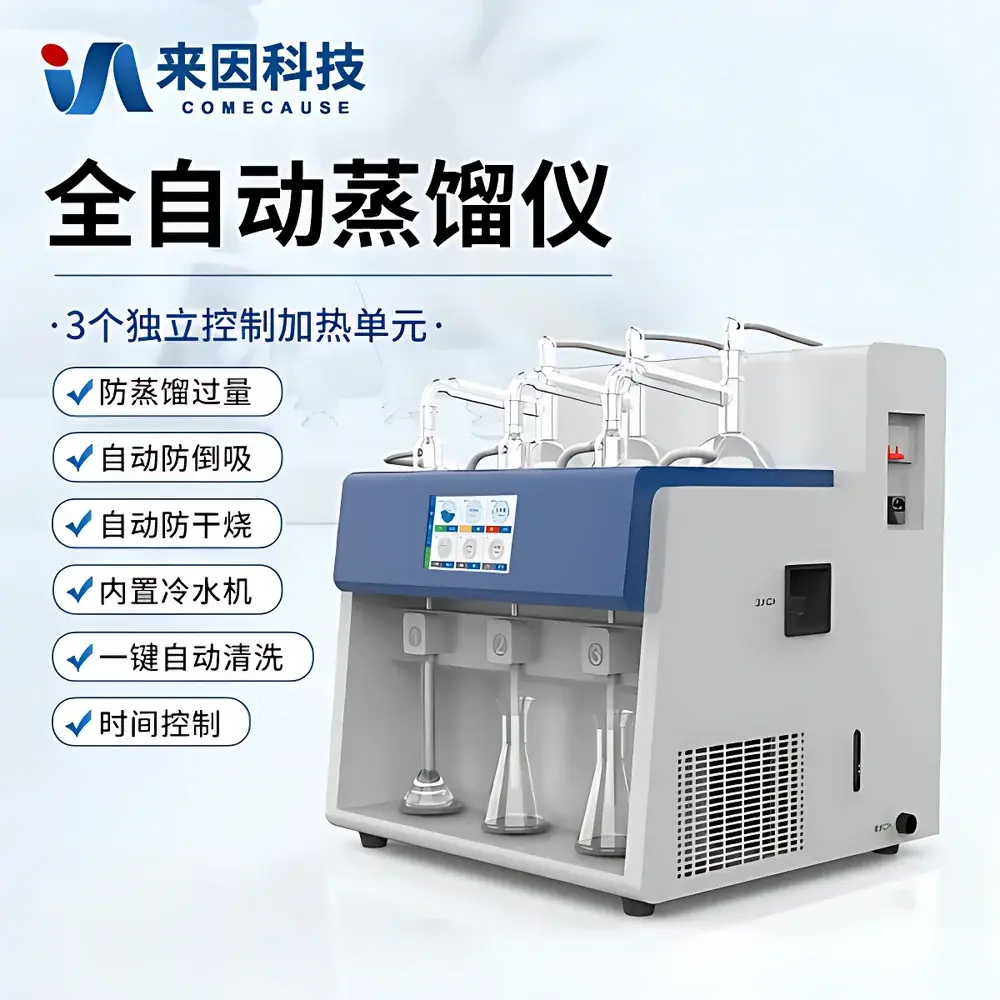
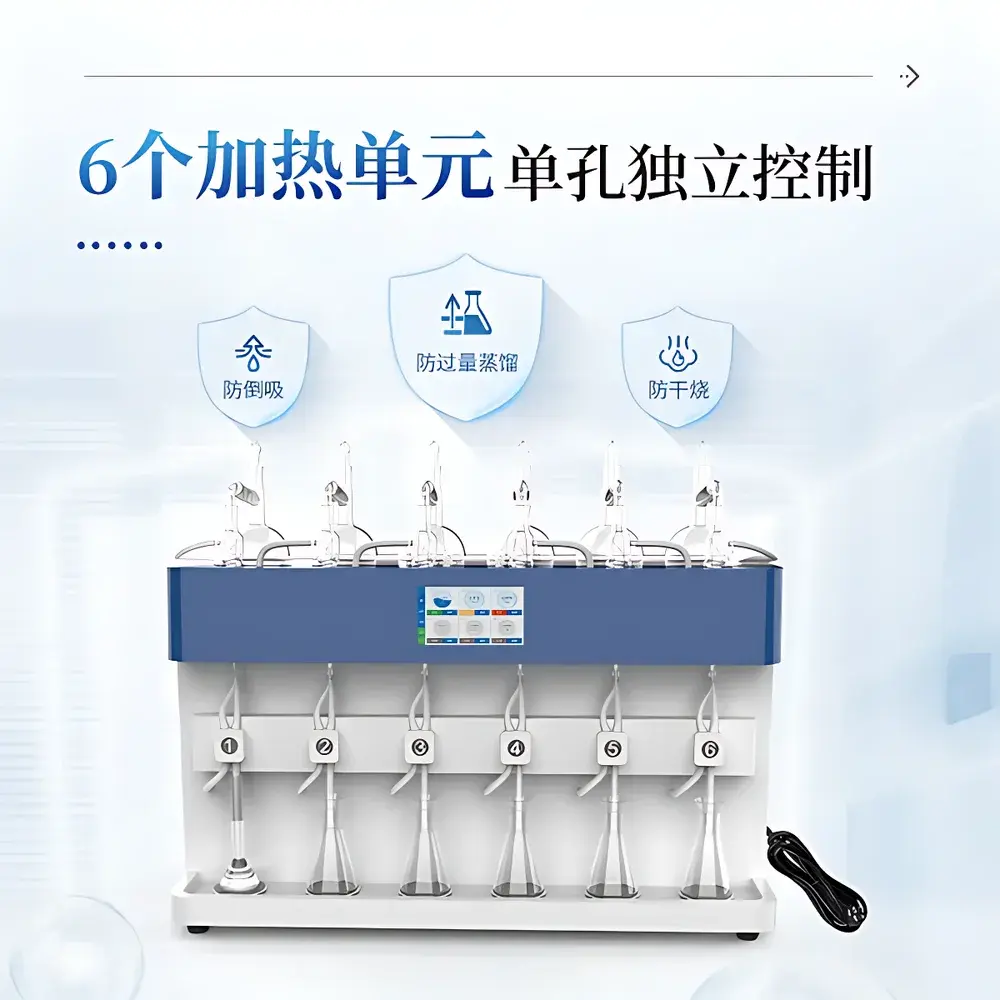
COMECAUSE IN-ZLD Automated Multi-Channel Distillation System
| Brand | COMECAUSE |
|---|---|
| Origin | Shandong, China |
| Manufacturer Type | Original Equipment Manufacturer (OEM) |
| Model | IN-ZLD |
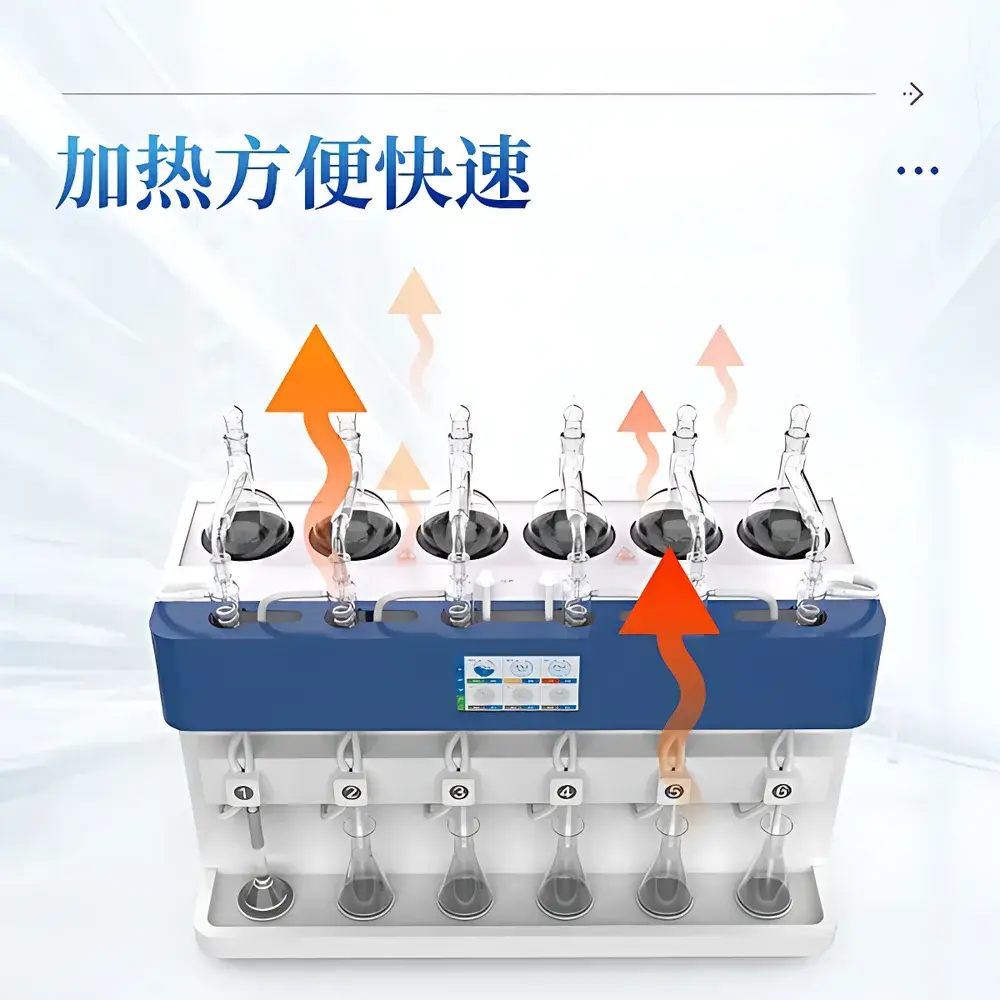
| Heating Method | Far-Infrared Ceramic Heating Bowl |
| Cooling Method | Integrated Closed-Loop Chiller, Temperature Control Range: 5–25 °C |
| Distillation Rate | 0–12 mL/min |
| Ramp-up Time | <20 min |
| Endpoint Control | Time-based |
| Heating Channels | 3 |
| Rated Power | 2000 W |
| Dimensions (W×D×H) | 560 × 533 × 634 mm |
| Weight | 46 kg (main unit + glassware) |
| Safety | Built-in Leakage Protection, Dry-Run Prevention, Anti-Suck-Back, Automatic Seal Integrity Check (≥ −80 kPa), Auto-Reverse Blow, Auto-Cleaning Cycle |
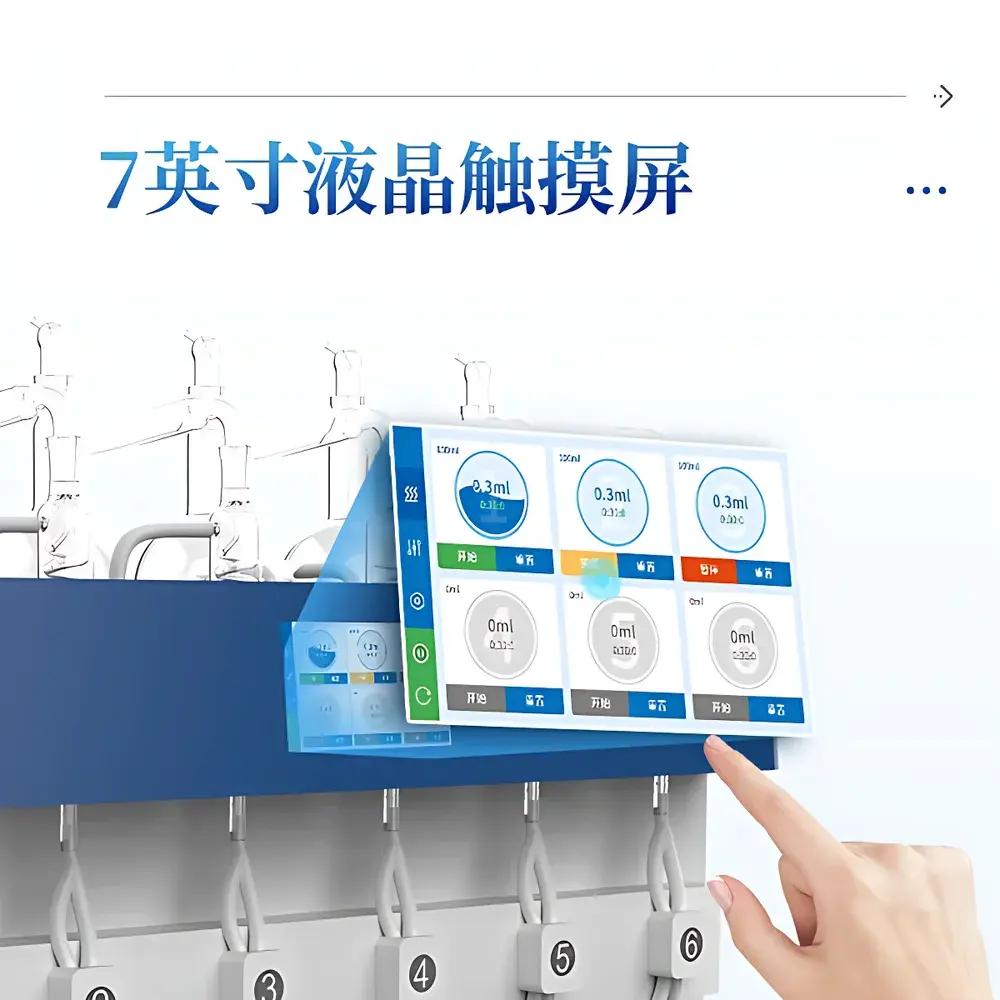
| Control Interface | 7-inch Capacitive Touchscreen |
| Method Storage | Up to 1000 user-defined methods |
| Distillation Accuracy | ±0.1 mL |
| Max Heating Temp | 400 °C |
| Flask Capacity | 500 mL spherical ground-joint round-bottom flasks |
| Condensate Receiving Vials | 250 mL × 3 (standard) |
Overview
The COMECAUSE IN-ZLD Automated Multi-Channel Distillation System is an engineered solution for standardized, reproducible distillation in environmental, food, and soil testing laboratories. It operates on the principle of controlled thermal separation—applying precise far-infrared ceramic heating to sample solutions in sealed, ground-joint glass assemblies while maintaining thermally stable condensation via an integrated closed-loop chiller. Unlike conventional manual or semi-automated setups, the IN-ZLD eliminates operator-dependent variability by enforcing consistent heating profiles, vapor-phase residence time, and condensate collection timing across all three independent channels. Its architecture supports method-driven workflows aligned with regulatory distillation protocols—including those requiring strict adherence to endpoint criteria (e.g., fixed distillation duration, volume cutoff, or temperature-triggered termination). Designed for routine compliance testing, the system delivers high inter-run repeatability and traceable operational integrity without compromising flexibility in method configuration.
Key Features
- Triple independent distillation channels with individual thermal and timing control—each equipped with dry-run prevention, anti-suck-back valves, and over-distillation cutoff logic.
- Far-infrared ceramic heating bowls delivering uniform thermal transfer to 500 mL spherical round-bottom flasks; maximum temperature rating of 400 °C with ramp time under 20 minutes.
- Integrated closed-loop chiller with programmable coolant setpoint (5–25 °C), enabling stable condensation efficiency across ambient fluctuations and extended run durations.
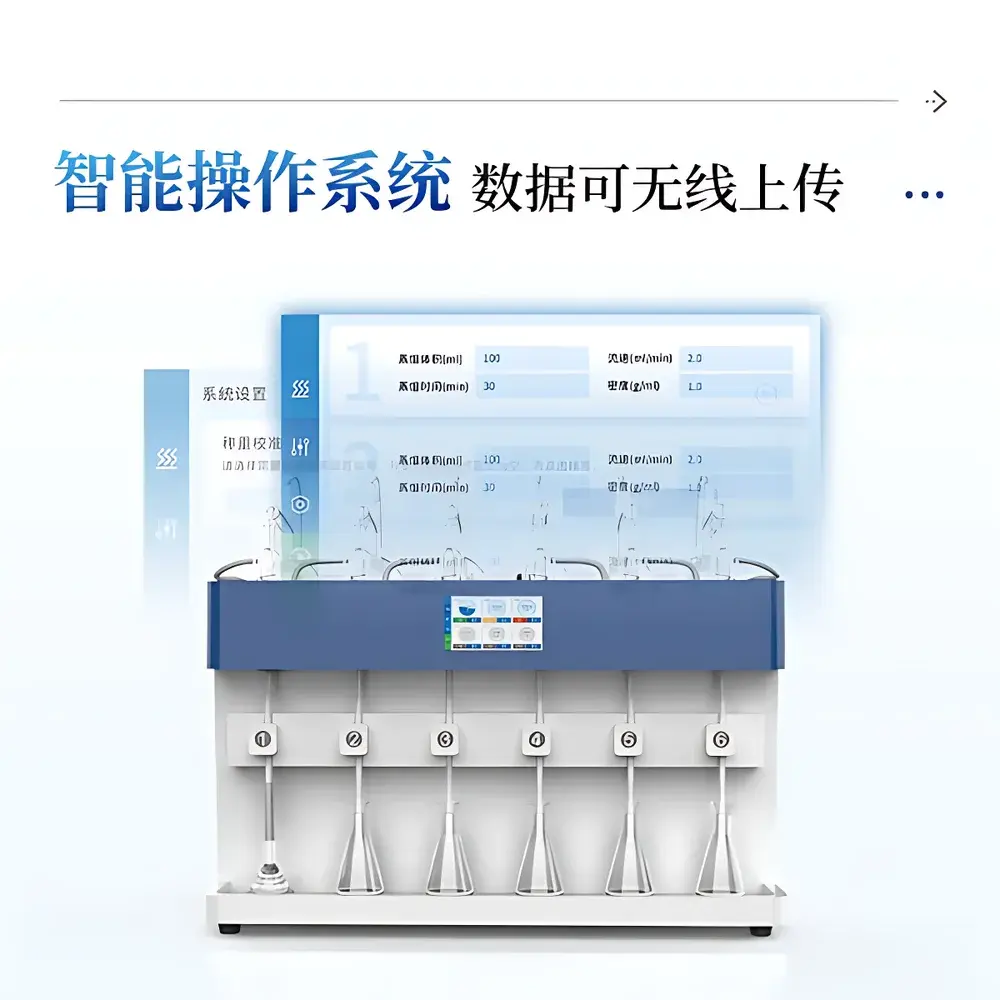
- 7-inch capacitive touchscreen interface supporting intuitive navigation, real-time parameter monitoring, and secure method management—including up to 1000 user-defined protocols and 18 preloaded GB/HJ standard methods.
- Endpoint determination via dual-mode logic: time-only, volume-only, or combined time/volume/temperature triggers—achieving ±0.1 mL volumetric accuracy through calibrated flow sensing and gravimetric verification support.
- Automated system diagnostics: seal integrity verification (vacuum hold test ≥ −80 kPa), reverse blow purge of condenser tubing post-run, and scheduled auto-cleaning cycles using solvent-compatible rinse sequences.
- Comprehensive safety architecture: leakage current protection, real-time power monitoring per channel, and fail-safe thermal cutoffs compliant with IEC 61010-1 requirements for laboratory electrical equipment.
Sample Compatibility & Compliance
The IN-ZLD accommodates aqueous, acidic, alkaline, and mildly organic matrices typical in environmental water, soil leachate, sediment extracts, and food digestates. Its glassware configuration—500 mL ground-joint flasks and 250 mL receiving vials—is compatible with standard analytical workflows involving cyanide, volatile phenols, ammonia nitrogen, sulfides, azides, and ethanol/methanol quantification. The system supports full alignment with Chinese national standards including GB/T 5750.5–2023, HJ 484–2009, HJ 503–2009, HJ 1226–2021, HJ 745–2015, and GB 5009.36–2023. While not certified to ISO/IEC 17025 or FDA 21 CFR Part 11 out-of-the-box, its audit-ready logging (timestamped method execution, parameter changes, error events) and configurable electronic signature support facilitate integration into GLP- or GMP-aligned QA/QC environments when paired with validated LIMS interfaces.
Software & Data Management
The embedded firmware records all critical process variables—including channel-specific heating power, coolant temperature, elapsed time, and endpoint confirmation status—with UTC timestamps and operator ID tagging (where enabled). Data export is supported via USB 2.0 to CSV or PDF report formats, preserving raw values and metadata required for method validation documentation. Remote firmware updates are delivered via secure OTA (Over-The-Air) protocol with cryptographic signature verification to ensure version integrity. The system does not include cloud connectivity or proprietary cloud services; all data remains resident on-device unless explicitly exported. Audit trail functionality meets minimum requirements for internal quality audits, though formal 21 CFR Part 11 compliance requires supplemental validation documentation and procedural controls established by the end-user laboratory.
Applications
- Environmental analysis: Ammonia nitrogen determination (HJ 537–2009), cyanide speciation (HJ 484–2009), volatile phenol recovery (HJ 503–2009), sulfide isolation (HJ 1226–2021), and azide quantification (HJ 1191–2021) from surface water, wastewater, and groundwater samples.
- Soil and sediment testing: Total cyanide extraction (HJ 745–2015), phenol release (HJ 998–2018), sulfide liberation (HJ 833–2017), and Kjeldahl nitrogen digestion support (HJ 717–2014).
- Food and beverage quality control: Ethanol concentration measurement in alcoholic beverages (GB 5009.225–2023), methanol detection in spirits (GB 5009.266–2016), and cyanide screening in natural mineral waters (GB 8538–2022).
- Method development labs: Rapid optimization of distillation parameters (e.g., temperature ramping, hold times, coolant setpoints) across parallel channels to establish robust SOPs prior to routine deployment.
FAQ
What types of glassware are compatible with the IN-ZLD?
Standard 500 mL spherical ground-joint round-bottom flasks and 250 mL receiving vials with PTFE stopcocks are supplied. Custom joint sizes (e.g., 24/40, 29/32) may be adapted using commercially available adapters.
Does the system support weight-based endpoint detection?
No—the IN-ZLD implements time-, volume-, and temperature-triggered endpoints only. Gravimetric endpoint control requires external balance integration via optional RS-232 or analog output modules (not included).
Can the chiller operate below 5 °C?
No—the integrated chiller is rated for 5–25 °C operation. Sub-ambient cooling necessitates external recirculating chillers connected via auxiliary ports (available upon request).
Is remote monitoring possible via Ethernet or Wi-Fi?
The base model supports USB data export and OTA firmware updates only. Network-enabled telemetry (Ethernet/Wi-Fi) is available as a factory-configurable option under custom order codes.
How is method validation documented for regulatory submissions?
The system logs all executed parameters and timestamps internally. Users must perform IQ/OQ/PQ validation per ISO/IEC 17025 or local regulatory guidance; COMECAUSE provides technical specifications and calibration certificates but does not supply pre-validated IQ/OQ protocols.



