
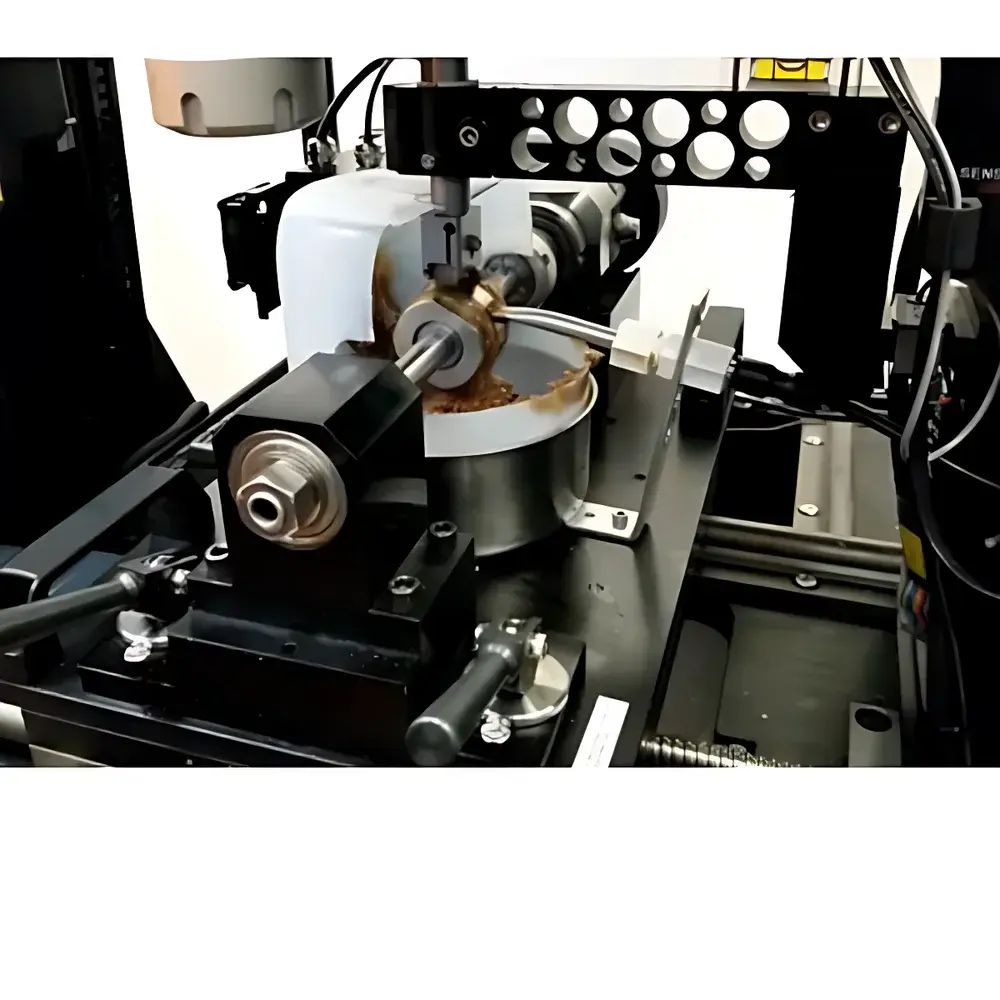
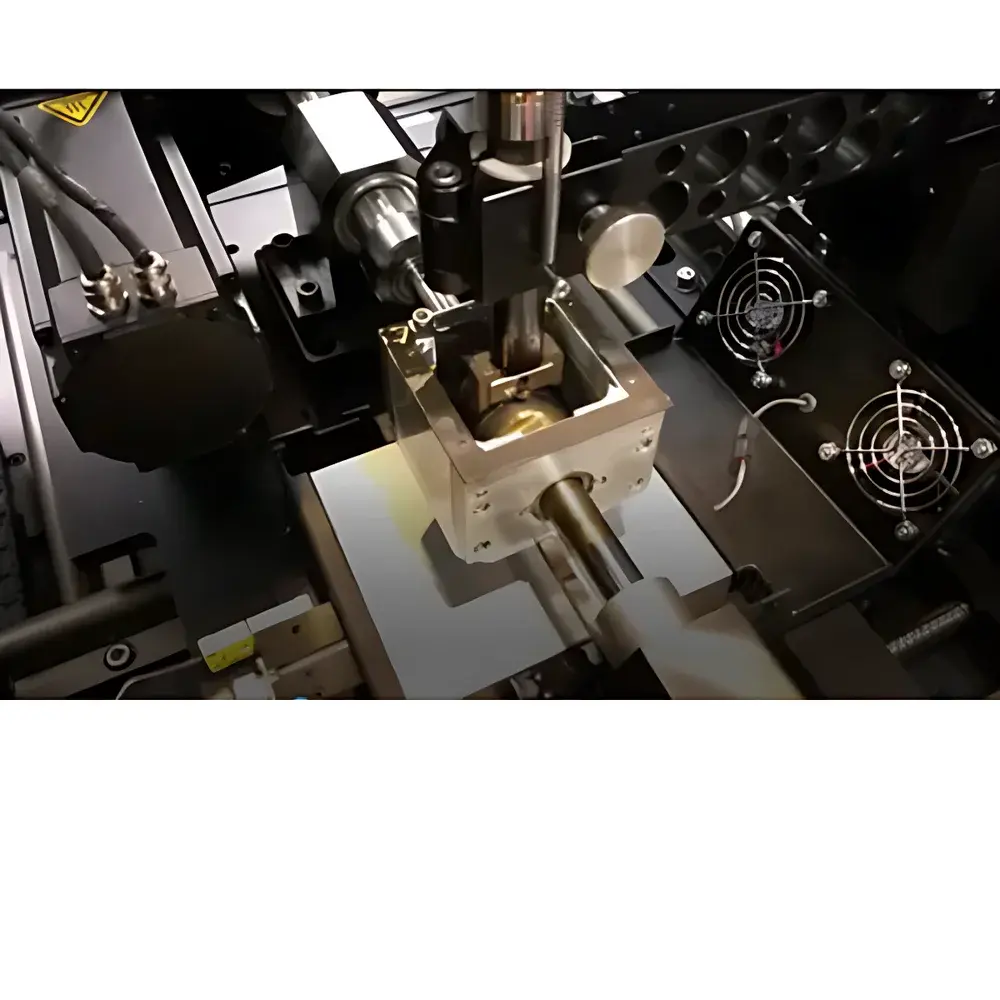
Rtec BOR-3000 Ring-on-Block Tribometer with Timken EP Testing Capability
| Brand | Rtec |
|---|---|
| Origin | Switzerland |
| Model | BOR-3000 |
| Application | Friction and Wear Testing |
| Compliance | ASTM D3704, D2509, D2782, D2981, G77, G176 |
| Max Load | 10,000 N |
| Max Speed | 5000 rpm |
| Temp Range | Up to 500 °C |
| Torque Measurement | In-line high-resolution |
| Test Modes | Continuous, Reciprocating, Stepped Load, Oscillatory |
| Sample Mounting | Modular block holder for shafts, bearings, seals, rings, thrust/conical rollers |
Overview
The Rtec BOR-3000 Ring-on-Block Tribometer is a precision-engineered, modular tribological testing platform designed for quantitative evaluation of friction, wear, and extreme pressure (EP) performance of lubricants, greases, solid lubricants, coatings, and mechanical components under controlled, reproducible conditions. Operating on the fundamental principle of sliding contact between a rotating ring (typically hardened steel or custom material) and a stationary or reciprocating block specimen, the system enables direct measurement of coefficient of friction (COF), wear volume, wear rate, and failure onset—critical parameters for lubricant formulation validation, component durability assessment, and materials screening in petroleum, aerospace, automotive, and bearing manufacturing sectors. Its rigid dual-supported rotating shaft architecture eliminates deflection at high loads (up to 10,000 N), while integrated high-fidelity torque transducers deliver real-time, low-noise frictional force data. Temperature control extends from ambient to 500 °C, supporting thermal stability evaluation of lubricants and thermally activated wear mechanisms.
Key Features
- Modular ring-on-block configuration compliant with ASTM D3704 (standard test method for evaluating lubricant EP performance using the Timken apparatus) and fully adaptable to ASTM D2509 (grease EP testing) and D2782 (lubricating oil EP testing).
- Dual-axis mechanical support for the rotating ring shaft ensures geometric stability and load integrity at maximum rated torque and axial force.
- In-line, calibrated torque sensor with sub-mN·m resolution enables precise COF calculation and detection of incipient seizure events during stepped-load EP tests.
- Programmable environmental control: independent regulation of test temperature (ambient to 500 °C), sliding velocity (0–5000 rpm), normal load (1–10,000 N), and loading ramp profile (linear or stepwise).
- Flexible lubrication delivery: accommodates immersion baths, continuous pump-fed oil circulation, grease dispensers, and dry-contact configurations.
- Oscillatory mode capability (± angular displacement or cycle-count control) for simulating reversing motion in gears, pivots, and oscillating bearings.
- Direct mounting interface for OEM components—including tapered roller bearings, thrust washers, shaft sections, and seal assemblies—without requiring sample geometry modification.
Sample Compatibility & Compliance
The BOR-3000 supports a broad spectrum of tribological specimens: standardized blocks (e.g., AISI 52100, HRC 30–65), coated substrates, polymer composites, ceramic inserts, and full-scale mechanical elements such as journal surfaces, bearing races, and sealing lips. All test protocols are traceable to internationally recognized standards including ASTM D3704 (Timken OK load determination), D2509/D2782 (EP grease/oil evaluation), D2981 (wear scar measurement), G77 (pin-on-disk abrasion), and G176 (scratch resistance). The system’s mechanical design, calibration procedures, and data acquisition firmware adhere to GLP-aligned documentation practices; audit trails, user access controls, and electronic signature support can be enabled to meet FDA 21 CFR Part 11 requirements for regulated laboratories.
Software & Data Management
Rtec’s proprietary Tribosoft™ platform provides synchronized acquisition of torque, normal force, rotational speed, temperature, and time-stamped video (optional). Real-time COF curves, wear depth profiling via post-test profilometry integration, and automated OK load determination per ASTM D3704 are embedded workflows. Raw data exports to CSV, MATLAB (.mat), and HDF5 formats ensure compatibility with third-party statistical analysis and machine learning pipelines. Calibration certificates are digitally linked to hardware IDs, and version-controlled test methods support method transfer across global R&D sites. All software modules undergo annual verification against NIST-traceable reference standards.
Applications
- Quantification of Timken OK load and wear scar diameter for industrial greases and engine oils.
- Screening of anti-wear (AW) and extreme pressure (EP) additive packages under thermal and mechanical stress.
- Comparative wear resistance evaluation of DLC, MoS₂, and WS₂ coatings on bearing steels.
- Frictional behavior analysis of polymer bushings and PTFE-impregnated composites under boundary lubrication.
- Validation of lubricant performance in high-temperature turbine applications (e.g., synthetic esters at >300 °C).
- Component-level testing of gear teeth flank materials, cam-follower interfaces, and hydraulic pump vanes.
- Correlation studies between laboratory ring-on-block results and field failure modes in wind turbine gearboxes and mining equipment.
FAQ
What distinguishes the BOR-3000 from conventional Timken testers?
Unlike legacy Timken machines limited to single-parameter OK load determination, the BOR-3000 delivers full friction–wear–temperature–load multidimensional datasets, supports ASTM-compliant oscillatory and reciprocating modes, and accepts real components—not just standardized blocks.
Can the system perform ASTM D2509 and D2782 without hardware modification?
Yes—preconfigured test templates, calibrated load cells, and temperature-controlled housing meet all geometric, dynamic, and instrumentation requirements specified in both standards.
Is third-party calibration and certification available?
Rtec provides ISO/IEC 17025-accredited calibration services, including traceable torque, force, and temperature verification, with documented uncertainty budgets per test point.
How is wear quantified after testing?
Wear volume is calculated from 3D profilometry scans (via optional integration with Zygo or Bruker systems) or gravimetric mass loss measurements; software automatically registers scan coordinates to original specimen geometry.
Does the system support automated pass/fail reporting for lubricant qualification?
Yes—customizable decision logic engines apply ASTM-defined thresholds (e.g., wear scar ≤ 0.85 mm for D3704) and generate PDF reports with digital signatures, revision history, and raw data annexes.
Related Products





