
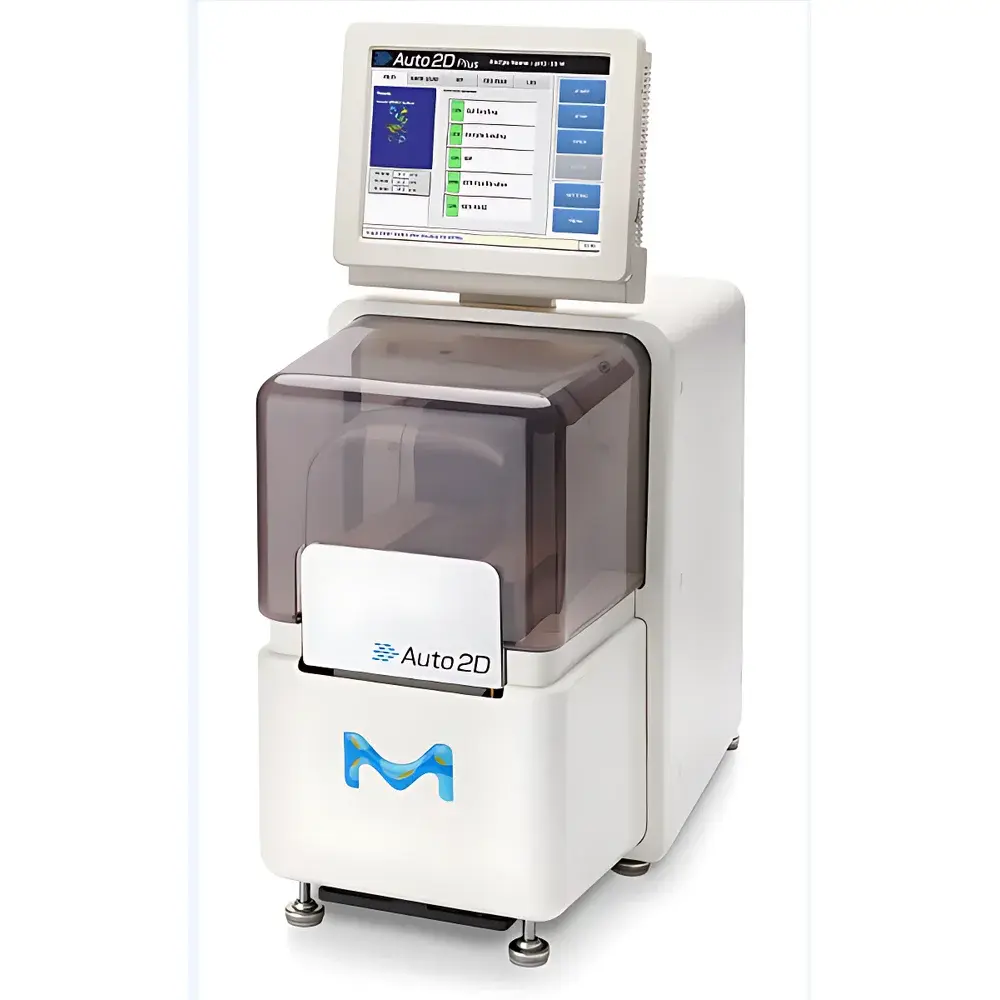
Millipore Auto2D® BM-100 Automated Two-Dimensional Electrophoresis System
| Brand | Millipore |
|---|---|
| Origin | Japan |
| Model | BM-100 |
| Category | Imported Instrument |
| Primary Function | Automated 2D Electrophoresis Platform |
| Compliance | Designed for GLP-compliant proteomics workflows |
Overview
The Millipore Auto2D® BM-100 Automated Two-Dimensional Electrophoresis System is an engineered platform for high-fidelity, reproducible separation of complex protein mixtures based on two orthogonal physicochemical properties: isoelectric point (pI) and molecular weight (MW). It implements standard 2D electrophoresis methodology—first-dimension isoelectric focusing (IEF) followed by second-dimension SDS-PAGE—within a fully integrated, temperature-controlled environment. Unlike manual or semi-automated systems, the BM-100 eliminates operator-dependent variability in gel casting, rehydration, focusing, equilibration, and second-dimension run initiation. Its architecture supports consistent IPG strip handling, precise voltage ramping, and real-time monitoring of IEF progress via impedance-based endpoint detection. The system is purpose-built for quantitative and comparative proteomics, where inter-gel reproducibility and spot resolution directly impact downstream identification confidence in mass spectrometry (MS) workflows.
Key Features
- Fully automated execution of both IEF (first dimension) and SDS-PAGE (second dimension), including strip rehydration, focusing, equilibration, gel loading, and electrophoresis run control
- Integrated thermal management system maintaining ±0.5 °C stability during IEF to minimize pH gradient distortion and protein denaturation
- Programmable voltage ramping profiles compliant with ISO 13843:2017 guidelines for electrophoretic separation validation
- Automated IPG strip handling with robotic gripper and optical alignment verification to ensure consistent positioning across gels
- Onboard calibration routines for voltage, current, and temperature sensors traceable to NIST-certified references
- Minimal hands-on time: full 2D separation cycle completed in 60–120 minutes depending on pI range and gel thickness
- Designed for compatibility with standard 13 cm and 18 cm IPG strips and 1.0–1.5 mm thick polyacrylamide gels
Sample Compatibility & Compliance
The BM-100 accepts lysates from mammalian cells, tissue homogenates, serum, plasma, and purified antibody preparations—including host cell protein (HCP) samples for biopharmaceutical process characterization. It supports common solubilization buffers (e.g., 7 M urea, 2 M thiourea, 4% CHAPS) and carrier ampholyte-free IPG strips (pH 3–10, 4–7, 5–8). All operational parameters are logged with timestamped audit trails meeting FDA 21 CFR Part 11 requirements for electronic records and signatures. The system conforms to ISO/IEC 17025:2017 general requirements for competence of testing and calibration laboratories when used in accredited QC/QA environments. Routine performance verification follows ASTM E2917–22 standard practice for evaluating electrophoretic resolution and spot-to-spot coefficient of variation (CV ≤ 8.2% for technical replicates).
Software & Data Management
Control and acquisition are managed through the Auto2D Control Suite v4.2, a Windows-based application supporting method creation, real-time monitoring, and event-driven protocol branching. Raw electropherogram data (including voltage, current, temperature, and impedance traces) are stored in vendor-neutral HDF5 format with embedded metadata (sample ID, operator, date/time, instrument serial number). The software exports TIFF and PNG images compatible with third-party analysis platforms such as PDQuest™, Progenesis SameSpots™, and MaxQuant. Audit trail logs record all user actions, parameter changes, and system alerts, enabling full traceability for GLP/GMP audits. Data integrity safeguards include automatic checksum validation upon file export and role-based access control (RBAC) with password-protected administrator privileges.
Applications
- Comparative proteomics: differential expression profiling of disease vs. control tissues, drug-treated vs. untreated cell lines
- HCP coverage assessment for monoclonal antibody manufacturing, supporting regulatory submissions per ICH Q5A(R2)
- Post-translational modification (PTM) mapping—e.g., phosphorylation, glycosylation, oxidation—via shift analysis and immunoblotting integration
- Quality control of recombinant proteins and biosimilars, including charge variant and aggregation state evaluation
- Validation of antibody specificity and epitope mapping using 2D immunoblotting workflows
- Reference map generation for species-specific proteome databases (e.g., Human Proteome Organization [HUPO] initiatives)
FAQ
Does the BM-100 support custom IPG strip pH gradients?
Yes—pre-cast immobilized pH gradient (IPG) strips from major suppliers (e.g., Cytiva, Bio-Rad, SERVA) in linear or nonlinear pH ranges (pH 3–12) are fully supported.
Can the system be integrated into a LIMS environment?
Yes—the Auto2D Control Suite provides ODBC-compliant database connectivity and RESTful API endpoints for bidirectional data exchange with laboratory information management systems.
Is training required for routine operation?
Operator certification requires only a 4-hour guided session covering safety protocols, method loading, and basic troubleshooting; no prior electrophoresis expertise is assumed.
What maintenance intervals are recommended?
Daily buffer level checks, weekly electrode cleaning, and quarterly calibration verification using certified reference standards are specified in the Maintenance Manual Rev. 3.1.
How is data integrity ensured during long-duration IEF runs?
All sensor outputs are continuously sampled at 1 Hz, written to non-volatile memory, and backed up to network storage every 5 minutes—ensuring recoverability after unexpected power loss.






