
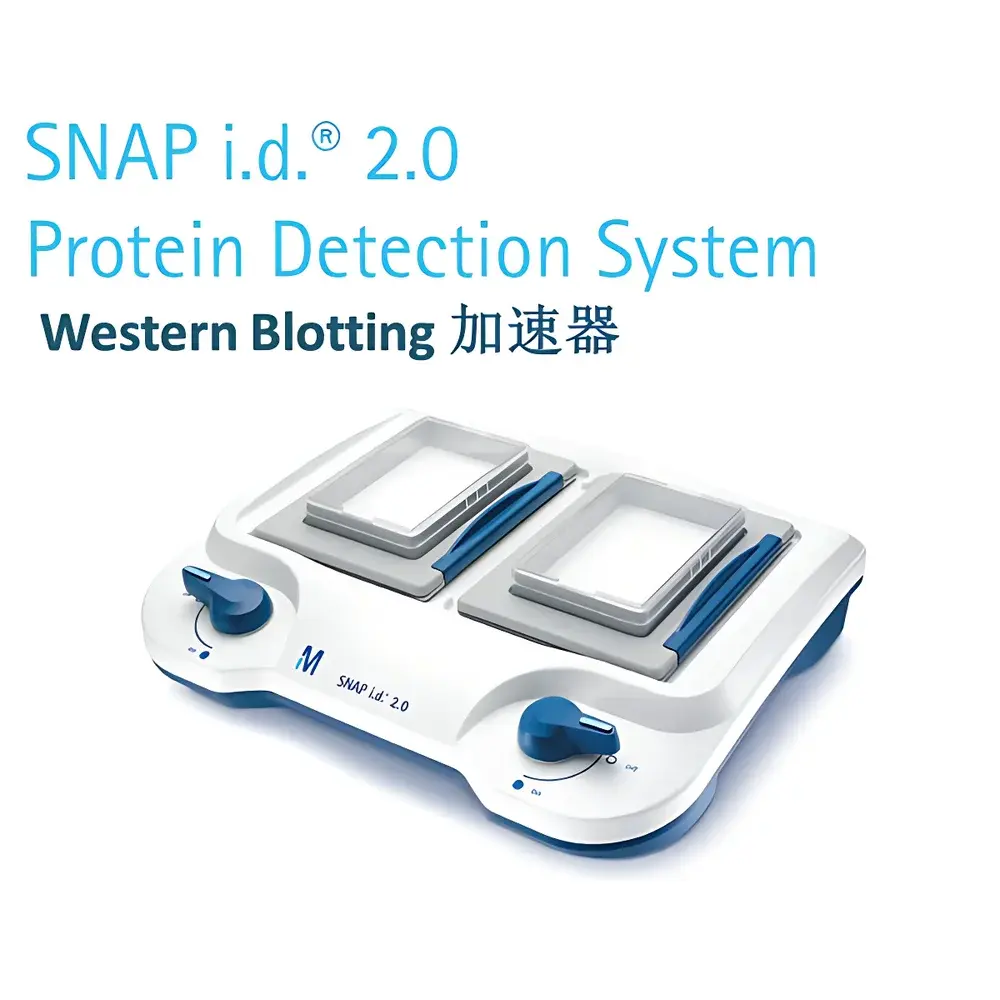
Merck Millipore SNAP i.d. 2.0 Western Blotting System
| Brand | Millipore |
|---|---|
| Origin | USA |
| Model | SNAP i.d. 2.0 |
| Automation Level | Semi-Automatic Western Blotting System |
| Operating Principle | Vacuum-Driven Fluidic Processing |
Overview
The Merck Millipore SNAP i.d. 2.0 Western Blotting System is a vacuum-driven, semi-automatic platform engineered to accelerate the post-transfer steps of immunodetection in Western blotting—specifically membrane blocking, primary and secondary antibody incubation, and washing—without compromising signal fidelity, reproducibility, or assay sensitivity. Unlike conventional manual or orbital-shaker-based protocols requiring 4–8 hours (or overnight incubations), the SNAP i.d. 2.0 reduces total processing time to ≤30 minutes through controlled, uniform vacuum-assisted reagent delivery and removal across the entire membrane surface. Its design adheres to core principles of fluid dynamics and mass transfer optimization: vacuum pressure creates laminar, edge-to-edge flow across nitrocellulose or PVDF membranes, minimizing diffusion-limited kinetics and ensuring consistent antibody binding kinetics across replicate samples. This system does not replace electrophoresis or electrotransfer equipment; rather, it integrates seamlessly into established WB workflows as a dedicated post-transfer module for labs prioritizing throughput, inter-operator consistency, and GLP-aligned documentation readiness.
Key Features
- Vacuum-actuated fluid handling: Delivers precise, repeatable reagent exchange across standard-sized (7 × 8.5 cm to 8.5 × 13.5 cm) blots with no manual pipetting or rocking required.
- Fixed-time protocol architecture: Pre-optimized 30-minute workflow includes blocking (5 min), primary antibody incubation (10 min), washes (3 × 2 min), secondary antibody incubation (10 min), and final wash (3 × 1 min)—all executed under programmable vacuum control.
- Modular hardware design: Compact benchtop unit with interchangeable cassette holders accommodating single or dual blots; integrated vacuum pump with pressure regulation and audible/visual cycle completion alerts.
- Reagent compatibility: Fully compatible with common blocking agents (BSA, non-fat dry milk, casein), HRP- or AP-conjugated secondary antibodies, chemiluminescent and fluorescent detection substrates, and all standard transfer membranes (including low-fluorescence PVDF).
- No thermal incubation: Ambient-temperature operation preserves epitope integrity and avoids heat-induced antibody denaturation or background artifacts associated with heated shakers.
Sample Compatibility & Compliance
The SNAP i.d. 2.0 supports all widely used Western blotting membranes (nitrocellulose, PVDF, low-fluorescence PVDF) and is validated for use with human, murine, bovine, and recombinant protein lysates, purified antigens, and cell/tissue extracts. It imposes no restrictions on upstream transfer methods—including wet, semi-dry, or rapid transfer systems—and maintains full compatibility with downstream detection modalities (ECL, fluorescence, near-infrared). From a regulatory standpoint, the system’s deterministic timing, operator-independent fluid handling, and absence of variable agitation parameters contribute to improved inter-batch reproducibility—a prerequisite for method validation under ISO 13485, CLIA, and FDA 21 CFR Part 11–aligned environments. While the device itself is not certified as GMP-grade hardware, its operational consistency supports audit-ready documentation when paired with electronic lab notebooks (ELNs) that log start/stop timestamps and user IDs per run.
Software & Data Management
The SNAP i.d. 2.0 operates via embedded firmware with push-button control—no PC connection or proprietary software installation is required. All protocol parameters (vacuum setpoints, dwell times, cycle counts) are factory-programmed and non-editable to ensure method standardization across users and sites. Cycle logs (date/time stamp, user ID if entered manually, completion status) are retained in internal memory for up to 1,000 runs and can be exported via USB interface in CSV format for integration into LIMS or ELN platforms. The system complies with ALCOA+ data integrity principles by providing attributable, legible, contemporaneous, original, and accurate records of each processing event—critical for laboratories subject to GLP audits or pharmaceutical QC validation.
Applications
- High-throughput target validation in academic and industrial proteomics labs where iterative antibody screening demands rapid turnaround.
- Quality control testing of recombinant therapeutic proteins, including identity, purity, and post-translational modification analysis.
- Teaching laboratories seeking to demonstrate full Western blotting workflow—including detection—within a single instructional session.
- Clinical research settings requiring standardized, auditable immunoblotting for biomarker verification studies under IRB-approved protocols.
- Core facilities implementing shared-resource scheduling, where reduced per-run time increases instrument utilization and lowers cost-per-sample.
FAQ
Does the SNAP i.d. 2.0 require special antibodies or buffers?
No. It works with all commercially available primary and secondary antibodies, as well as standard blocking and washing buffers (TBS-T, PBST, etc.). No formulation modifications are needed.
Can I process two membranes simultaneously?
Yes. The system supports dual-cassette configuration for parallel processing of two identical or different blots using the same reagent batch.
Is vacuum pressure adjustable by the user?
No. Vacuum levels are fixed and optimized per step (e.g., lower pressure for gentle blocking, higher for rapid washout) to ensure robust performance across membrane types and antibody concentrations.
What maintenance is required?
Routine cleaning of the gasket seal and cassette surfaces with 70% ethanol; annual calibration verification of vacuum sensors is recommended but not mandatory for routine use.
Is the system compatible with fluorescent detection?
Yes. Its ambient-temperature, non-agitating operation minimizes photobleaching and autofluorescence, making it suitable for near-infrared (e.g., LI-COR) and visible-fluorophore-based detection systems.
Related Products




