
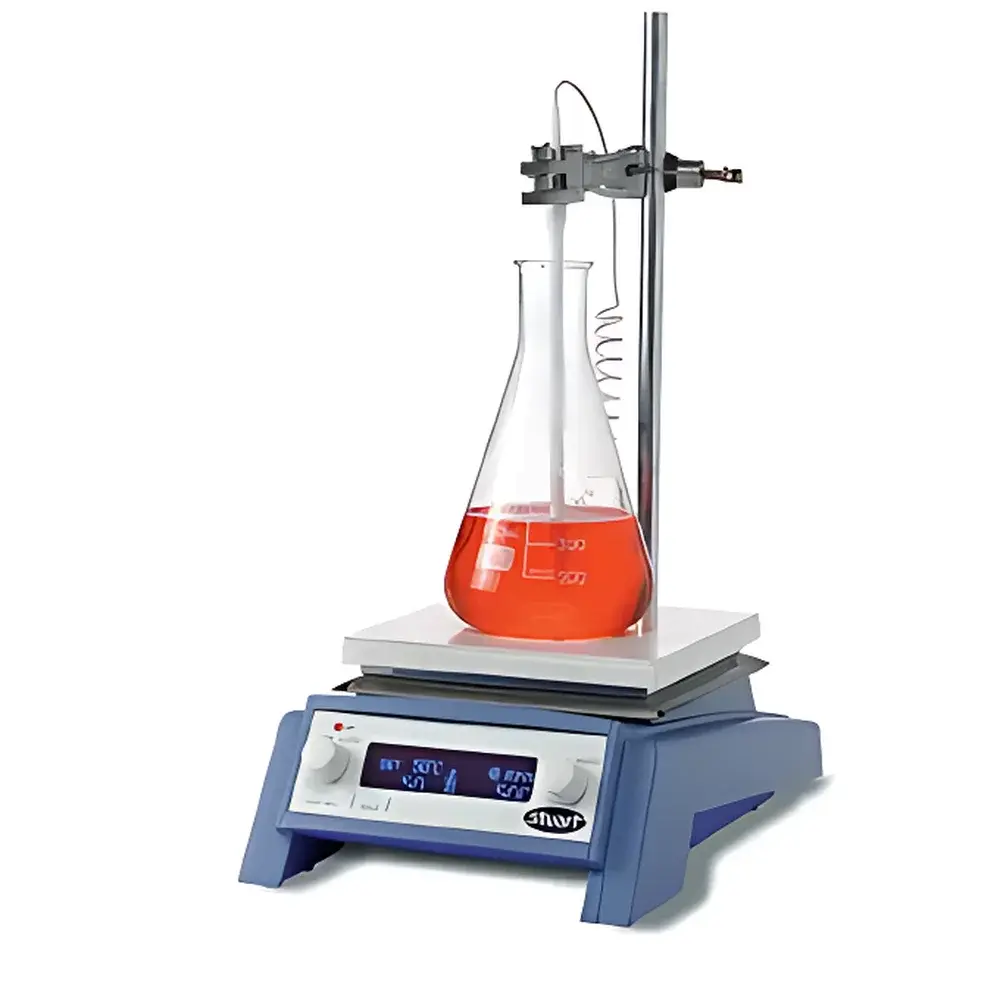
Stuart CD162 & SD162 Digital Magnetic Stirrer Hotplates
| Brand | Stuart |
|---|---|
| Origin | United Kingdom |
| Model | CD162 & SD162 |
| Plate Material | Glass Ceramic (CD162) / Aluminium-Silicon Alloy (SD162) |
| Plate Dimensions (mm) | 160 × 160 |
| Heated Area (mm) | 120 × 120 (CD162), 160 × 160 (SD162) |
| Heater Power (W) | 500 (CD162), 700 (SD162) |
| Display Resolution | 1 °C |
| Max. Plate Temperature (°C) | 450 (CD162), 300 (SD162) |
| Max. Liquid Temperature (°C, with probe) | 200 |
| Control Accuracy (°C, with probe) | ±0.5 |
| Stirring Speed Range (rpm) | 200–1300 |
| Max. Stirring Capacity (L) | 15 |
| Net Weight (kg) | 3.4 |
| Overall Dimensions (W × D × H, mm) | 190 × 300 × 110 |
| Electrical Supply | 230 V, 50/60 Hz |
Overview
The Stuart CD162 and SD162 are precision-engineered digital magnetic stirrer hotplates designed for reliable, reproducible heating and mixing in research laboratories, quality control environments, and routine analytical workflows. These instruments operate on the principle of electromagnetic induction to rotate a PTFE-coated stir bar within a vessel while simultaneously delivering controlled resistive heating through a thermally optimized top plate. Unlike analog alternatives, both models integrate microprocessor-based dual-loop control: one loop regulates heater output based on real-time feedback from an immersed temperature probe, while the second independently governs stirring motor speed. This architecture ensures high thermal stability (±0.5 °C accuracy at the sample) and mechanical consistency—critical for applications requiring strict adherence to ASTM E29, ISO/IEC 17025, or GLP-compliant protocols.
Key Features
- Dual digital control interface for independent, simultaneous adjustment of temperature (0–200 °C, probe-regulated) and stirring speed (200–1300 rpm), enabling precise method replication across operators and shifts.
- Two plate material options: CD162 features a chemically inert glass-ceramic surface offering rapid thermal response and resistance to acids, alkalis, and organic solvents; SD162 utilizes an aluminum-silicon alloy plate engineered for exceptional thermal uniformity and minimal gradient across the heated zone.
- Intelligent adaptive heating algorithm analyzes the rate of temperature rise upon startup to dynamically adjust power delivery—reducing overshoot and accelerating time-to-setpoint, particularly beneficial for viscous or low-thermal-conductivity media (e.g., oils, polymer solutions).
- Integrated safety architecture includes: (1) a flashing “HOT” indicator visible from 2 meters; (2) an independent hardware-based overtemperature cutoff set 20 °C above the user-defined limit; and (3) conformal coating on internal PCBs to inhibit corrosion from ambient humidity or incidental chemical exposure.
- Vacuum fluorescent display (VFD) simultaneously shows setpoint and actual liquid temperature, enhancing operational transparency during unattended operation—including overnight or extended incubation protocols.
Sample Compatibility & Compliance
Both models accommodate vessels ranging from 10 mL test tubes to 15 L beakers or jacketed reactors, provided magnetic coupling remains effective (standard 30–40 mm stir bars recommended). The PTFE-coated temperature probe is autoclavable and compatible with aqueous, buffered, and moderately aggressive organic systems. Units comply with IEC 61010-1:2010 for laboratory electrical equipment safety and meet EMC requirements per EN 61326-1. Their closed-loop probe-controlled operation supports audit-ready documentation under FDA 21 CFR Part 11 when integrated with validated LIMS or ELN platforms. No calibration certificate is supplied ex-factory; however, traceable NIST-compatible calibration procedures are supported via external reference thermometers and certified stir bar torque verification kits.
Software & Data Management
These are standalone benchtop instruments with no embedded software or network connectivity. All operational parameters—including setpoints, elapsed time, and status flags—are retained in non-volatile memory during power cycles. While no proprietary software is required, the VFD output and audible alert provide clear, human-readable process milestones suitable for manual logbook entries or integration into paper-based SOPs. For laboratories implementing electronic records, the stable ±0.5 °C control performance and repeatable rpm settings facilitate straightforward validation of thermal and mixing parameters per USP and ISO 17025 clause 7.7.
Applications
- Preparation of homogeneous reagent solutions and buffer stocks in molecular biology and clinical diagnostics labs.
- Controlled dissolution testing per USP , where consistent temperature and agitation are mandated for drug release profiling.
- Heating and mixing of catalyst slurries in synthetic chemistry workflows, including Grignard and Suzuki couplings.
- Long-duration sample digestion (e.g., EPA Method 3050B) under monitored thermal conditions without operator intervention.
- Calibration of thermometers and RTDs using stirred liquid baths with documented thermal stability.
FAQ
Can the CD162 and SD162 be used for reflux setups?
Yes—both models support round-bottom flasks with appropriate clamping and condenser assemblies; however, the maximum sustained liquid temperature remains 200 °C (probe-regulated), and open-vessel evaporation must be accounted for in method design.
Is the temperature probe included with every unit?
Yes—a detachable, PTFE-coated stainless-steel probe is supplied as standard equipment with each CD162 and SD162 unit.
What maintenance is required to ensure long-term accuracy?
Annual verification of probe response time and thermal drift against a calibrated reference thermometer is recommended; cleaning of the top plate with non-abrasive, pH-neutral cleaners preserves surface integrity and thermal transfer efficiency.
Do these units support external temperature controllers or PLC integration?
No—these are self-contained instruments with no analog outputs, digital I/O, or communication ports. Process automation requires external relay interfacing or third-party hardware gateways.
Are replacement stir bars available from Stuart?
Stuart does not supply stir bars directly; however, standard 30 mm and 40 mm PTFE- or glass-coated stir bars with embedded neodymium magnets are widely available from laboratory consumables vendors and fully compatible.



