
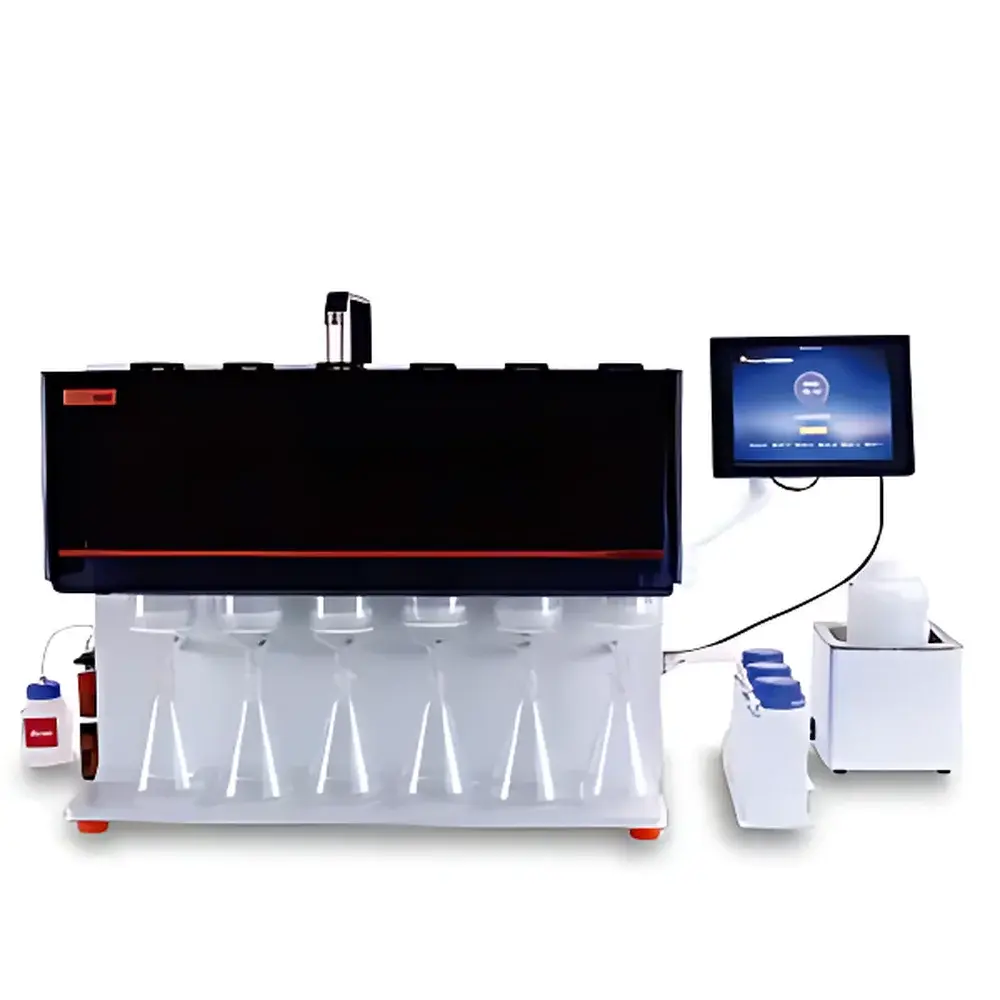
Hanon DF06 Automated Dietary Fiber Analyzer
| Brand | Hanon |
|---|---|
| Model | DF06 |
| Origin | Shandong, China |
| Type | Automated Enzymatic-Gravimetric Dietary Fiber Analyzer |
| Standards Compliance | GB 5009.88, GB/T 22224-2008, AOAC 985.29, AOAC 991.43 |
| Sample Capacity | 0.2–1 g per vessel |
| Throughput | 6 independent channels |
| Temperature Control Accuracy | ±1 °C |
| Repeatability (RSD) | ≤1% |
| Total Dietary Fiber (TDF) Assay Time | ~3.5 h |
| Insoluble (IDF) / Soluble (SDF) Fiber Assay Time | 1–3 h |
| Filtration Method | Vacuum-assisted membrane filtration (no backflush or external air supply) |
| Power Supply | AC 220 V ±10%, 50 Hz ±1 Hz |
| Rated Power | 1300 W |
| Dimensions (L×W×H) | 800 × 350 × 650 mm |
| Net Weight | 60 kg |
| Software Compliance | FDA 21 CFR Part 11–compliant user authentication and audit trail |
Overview
The Hanon DF06 Automated Dietary Fiber Analyzer is an integrated enzymatic-gravimetric system engineered for precise, high-throughput quantification of total dietary fiber (TDF), insoluble dietary fiber (IDF), and soluble dietary fiber (SDF) in food matrices. It implements the internationally recognized AOAC 985.29 and AOAC 991.43 methodologies—alongside Chinese national standards GB 5009.88 and GB/T 22224-2008—through a fully automated sequence comprising controlled enzymatic hydrolysis, acid/base precipitation, vacuum membrane filtration, and gravimetric residue determination. Unlike manual or semi-automated approaches, the DF06 eliminates operator-dependent variability by executing all critical steps—including reagent dispensing, temperature-regulated incubation, agitation, sedimentation, and filtration—within sealed, single-use flexible reaction bags. This architecture ensures consistent enzyme kinetics, minimizes exposure to volatile reagents (e.g., α-amylase, protease, amyloglucosidase), and prevents cross-contamination between samples.
Key Features
- 6-channel independent processing with programmable start/stop per channel, enabling flexible batch sizing from 1 to 6 samples without performance compromise.
- Sealed, disposable flexible reaction bags with automated bag-clamp actuation—eliminates manual opening/closing during high-temperature enzymatic steps (up to 100 °C) and prevents reagent evaporation and aerosol generation.
- Non-contact magnetic stirring system ensures homogeneous enzyme–substrate interaction while avoiding mechanical loss of fine particulates or fiber fragments.
- Integrated tube-cleaning protocol using sequential solvent flushes (water, ethanol, acetone) prior to each assay cycle—maintains volumetric accuracy and prevents precipitate buildup in fluidic pathways.
- Precision thermal control across all six reaction zones: real-time PID-regulated heating with ±1 °C stability over full operational range (37–100 °C), directly supporting optimal activity of thermolabile enzymes.
- Vacuum-driven membrane filtration (0.45 µm polyethersulfone filters) with automatic pressure regulation—no compressed air source, no backflush requirement, and direct filter transfer to muffle furnace for ash correction.
Sample Compatibility & Compliance
The DF06 accommodates diverse food matrices including cereals, legumes, fruits, vegetables, bakery products, infant formulas, and fortified beverages. Its sample loading range (0.2–1.0 g) supports both low-fiber snacks and high-fiber functional ingredients. All hardware, firmware, and software components comply with regulatory requirements for analytical instrumentation used in quality control laboratories operating under GLP or GMP frameworks. User access is governed by three-tier authentication (administrator/operator/technician), and all method executions, parameter changes, and result exports are logged with timestamped, non-erasable audit trails—fully aligned with FDA 21 CFR Part 11 electronic record and signature requirements. Instrument calibration, maintenance, and error logs are retained internally and exportable in CSV format for internal audit or regulatory review.
Software & Data Management
The embedded DF06 Control Suite provides a Windows-based interface with intuitive touchscreen navigation and ergonomic height-adjustable arm mounting. Preloaded method templates cover AOAC 985.29 (TDF), AOAC 991.43 (IDF/SDF), and GB 5009.88 protocols—with editable parameters for digestion time, temperature ramps, wash cycles, and drying/ashing profiles. All methods support version-controlled storage, user-specific permissions, and automatic metadata tagging (operator ID, sample ID, instrument serial number, environmental conditions). Raw mass data, intermediate weights (residue pre-/post-ashing), and final fiber concentrations are calculated per standard equations and exported in ISO/IEC 17025-compliant report formats—including PDF with digital signature fields and Excel-compatible .xlsx files. Data integrity is enforced via write-protected storage partitions and optional network backup to secure lab servers.
Applications
The DF06 serves as a primary analytical platform in food R&D labs validating fiber enrichment claims, QC departments verifying label compliance for “high-fiber” or “source of fiber” declarations, contract testing laboratories performing third-party certification, and academic nutrition research groups investigating fiber–microbiome interactions. Its reproducibility (≤1% RSD) meets AOAC repeatability criteria for official methods, and its throughput enables daily analysis of >30 samples across multiple fiber fractions—making it suitable for routine monitoring in high-volume production environments. The system also supports method development studies requiring controlled variation of pH, enzyme concentration, or hydrolysis duration—facilitating optimization of fiber extraction efficiency for novel plant-based ingredients or extruded formulations.
FAQ
What regulatory standards does the DF06 validate against?
The DF06 is validated for AOAC 985.29 (Total Dietary Fiber), AOAC 991.43 (IDF/SDF), GB 5009.88, and GB/T 22224-2008. Full validation documentation—including precision, accuracy, linearity, and robustness reports—is available upon request.
Can the DF06 be integrated into a LIMS environment?
Yes—the instrument supports ASTM E1384-compliant data export via USB or Ethernet, and raw output files are structured for direct ingestion into common LIMS platforms (e.g., LabWare, Thermo Fisher SampleManager, STARLIMS).
Is method transfer from manual AOAC procedures straightforward?
Yes—method templates replicate manual workflows step-for-step; users can import existing SOPs and map them to corresponding DF06 automation sequences with minimal revalidation.
What maintenance is required for long-term reliability?
Daily: visual inspection of tubing and bag seals; weekly: cleaning of vacuum manifold and filter holder; quarterly: calibration of load cells and thermal sensors using NIST-traceable standards.
Does the system support unattended overnight operation?
Yes—full assay sequences (including cooling, filtration, and auto-shutdown) are scheduled and monitored independently per channel; alarm notifications are sent via email or local display on fault detection.




