
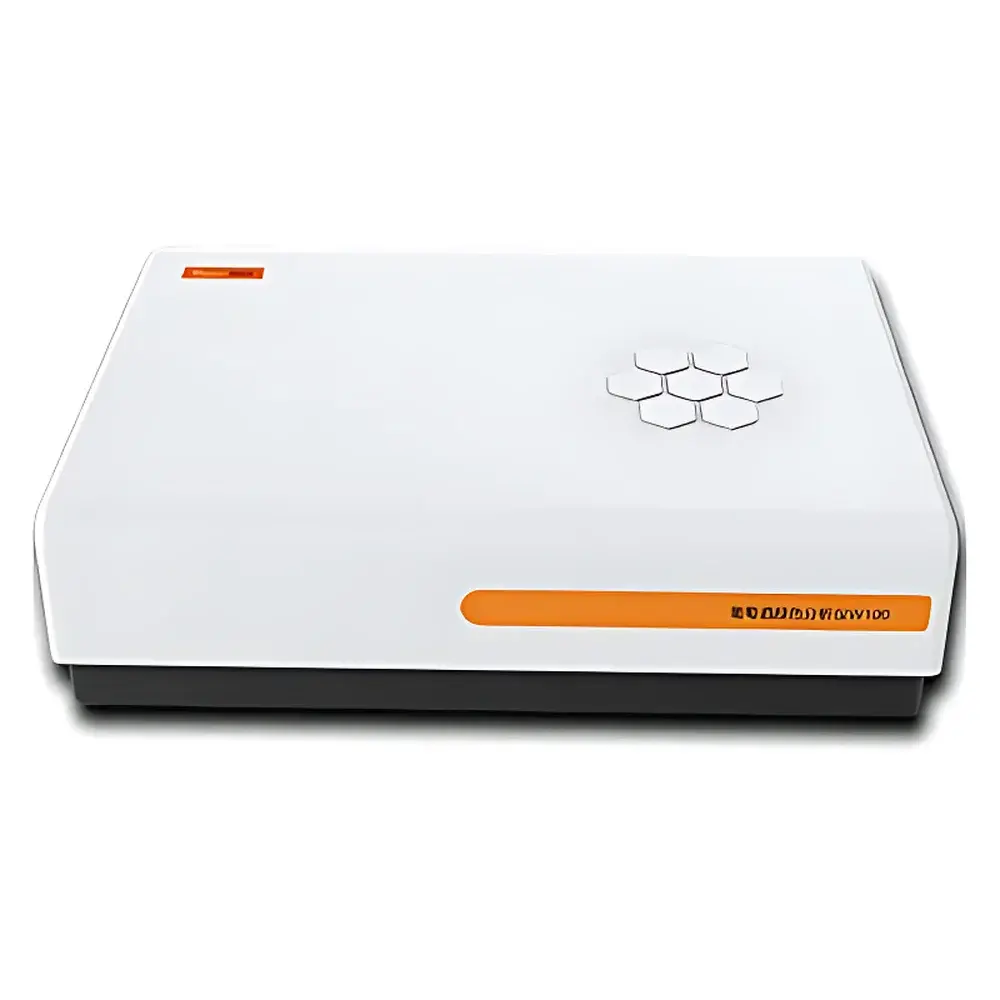
Hanon W100 Wine Color Analyzer
| Brand | Hanon |
|---|---|
| Origin | Shandong, China |
| Manufacturer Type | Authorized Distributor |
| Region | Domestic (China) |
| Model | W100 |
| Pricing | Available Upon Request |
Overview
The Hanon W100 Wine Color Analyzer is a dedicated spectrophotometric instrument engineered for objective, quantitative color assessment of wine and other clear liquid beverages. It operates on the principle of double-beam UV-Vis-NIR absorbance spectroscopy (190–1100 nm), enabling precise measurement of CIELAB color space parameters (L*, a*, b*, C*, h*, ΔEab) in accordance with ISO 11664-4 (CIE 1976 L*a*b* color space) and ASTM E308-22 (Standard Practice for Computing the Colors of Objects by Using the CIE System). Unlike subjective visual evaluation—prone to inter-observer variability, ambient lighting bias, and physiological fatigue—the W100 delivers traceable, reproducible color metrics essential for quality control in winemaking, regulatory compliance, product standardization, and sensory correlation studies.
Key Features
- Optical architecture with dual-source illumination: factory-calibrated deuterium lamp (UV) and tungsten-halogen lamp (Vis-NIR), ensuring spectral continuity across the full 190–1100 nm range
- Automated wavelength calibration and dark current correction routines executed at system startup and user-defined intervals
- Hermetically sealed optical chamber with SiO2-coated mirrors and lenses, minimizing oxidation, humidity-induced drift, and particulate contamination
- High-stability photometric system achieving photometric accuracy ≤ ±0.3 nm (verified at D656.1 reference line) and stray light < 0.03% T at 220 nm and 360 nm
- Modular lamp design: plug-in socket interface enables rapid source replacement without realignment or recalibration
- Real-time lamp life monitoring via integrated firmware, logging operational hours and triggering maintenance alerts
Sample Compatibility & Compliance
The W100 accommodates standard 10 mm pathlength quartz cuvettes (supplied) and supports optional 5 mm, 20 mm, or flow-cell configurations for high-throughput or inline adaptation. It complies with ISO 4833-1:2013 (microbiological methods) for sample handling hygiene and meets electromagnetic compatibility (EMC) requirements per IEC 61326-1. While not certified under FDA 21 CFR Part 11, its software architecture supports audit-trail-enabled operation when deployed in GLP/GMP environments—user-configurable data logging, timestamped measurements, and exportable .csv/.xlsx reports satisfy traceability requirements for internal QC documentation and third-party audits.
Software & Data Management
The proprietary Hanon WineColor Analysis Software (v3.2+) provides full instrument control, spectral acquisition, CIELAB conversion, batch processing, and comparative ΔE analysis. It implements standardized illuminant D65 and 10° observer settings by default, with configurable alternatives (e.g., illuminant A, 2° observer) for method flexibility. All raw spectra and derived color coordinates are stored with metadata (date/time, operator ID, sample ID, instrument serial number). Export functions support direct integration into LIMS platforms via ODBC-compliant database schema. Software validation documentation—including IQ/OQ protocols and electronic signature capability—is available upon request for regulated laboratory deployment.
Applications
- Objective quantification of wine aging trends (e.g., anthocyanin degradation, browning index calculation)
- Batch-to-batch color consistency verification across vintages and varietals
- Correlation of instrumental color metrics with sensory panel data for predictive modeling
- Raw material screening (grape must, juice) prior to fermentation
- Label claim substantiation (e.g., “ruby red”, “pale straw”) using metrologically traceable values
- Research applications in enology, including pigment stability studies under thermal/light stress
FAQ
Does the W100 comply with international wine color standards such as OIV or ISO?
Yes—it measures spectral transmittance in alignment with OIV Method OIV-MA-AS315-01A (2021) and computes CIELAB values per ISO 11664-4, enabling direct comparison with published reference datasets.
Can the instrument be used for non-wine samples such as fruit juices or spirits?
Yes—provided samples are optically clear and fall within the absorbance range (0.05–2.0 AU); method validation per sample matrix is recommended prior to routine use.
Is spectral data export supported in vendor-neutral formats?
Yes—absorbance spectra and color coordinates export to ASCII text, CSV, and Excel-compatible XLSX files without proprietary codec dependencies.
What maintenance is required beyond lamp replacement?
Annual verification of wavelength accuracy and photometric linearity using NIST-traceable calibration standards is recommended; no optical alignment is needed due to sealed optical path design.
How is measurement uncertainty estimated for L*, a*, b* outputs?
Based on repeated measurements of certified color standards (e.g., NIST SRM 2035), typical expanded uncertainty (k=2) is ±0.05 for L*, ±0.04 for a*, and ±0.06 for b* under controlled lab conditions (23°C ±1°C, RH 50% ±5%).





