


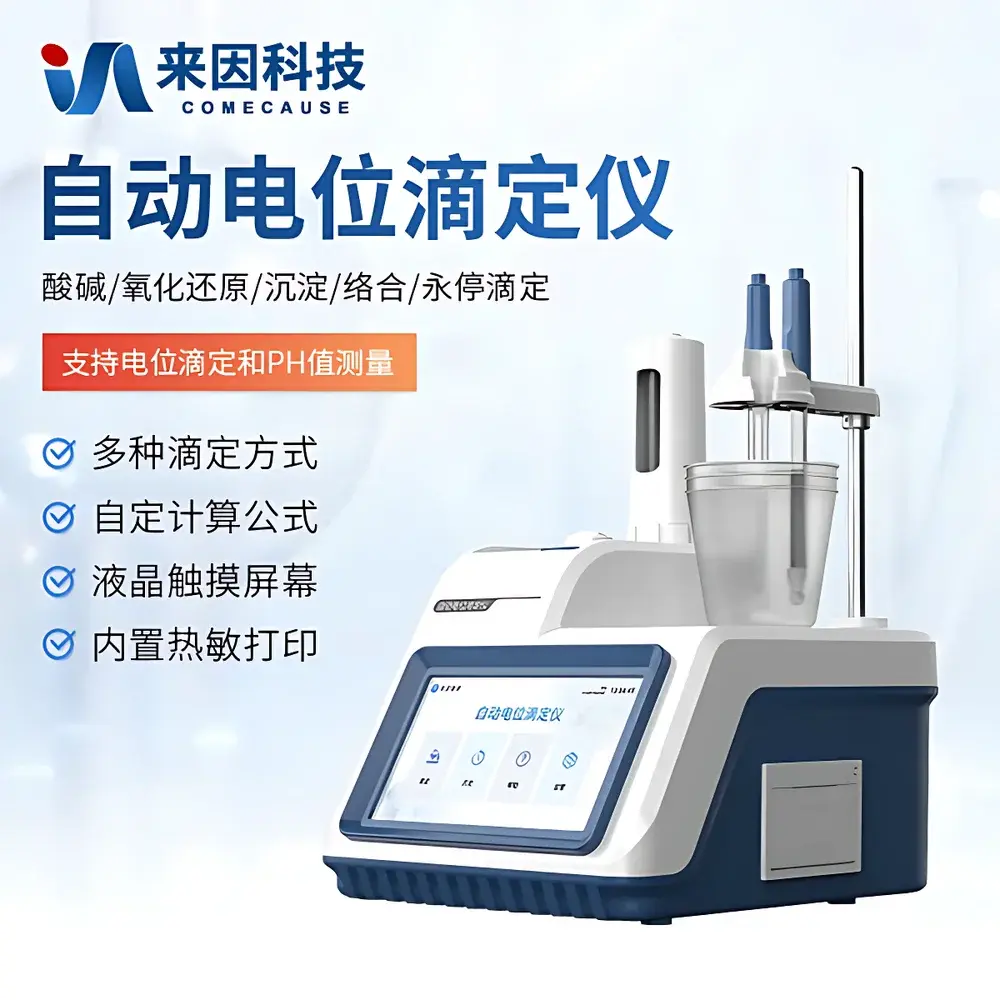
COMECAUSE IN-D3 Automatic Potentiometric Titrator
| Brand | COMECAUSE |
|---|---|
| Origin | Shandong, China |
| Manufacturer Type | Direct Manufacturer |
| Model | IN-D3 |
| Instrument Type | General-Purpose Automatic Potentiometric Titrator |
| Application Scope | Universal Laboratory Use |
| Potential Range | −2000 to +2000 mV |
| Potential Resolution | 0.1 mV |
| Titration Accuracy | ±5 µL (for 10 mL burette) |
| Potential Basic Error | ±0.25 ‰/FS |
| pH Range | 0–14 |
| pH Resolution | 0.01 |
| pH Accuracy | ±0.01 |
| Temperature Range | −5 to 105 °C |
| Temperature Resolution | 0.1 °C |
| Temperature Accuracy | ±0.2 °C |
| Data Storage Capacity | 100,000 records |
| Operating System | Android 10 |
| Display | 7-inch capacitive touchscreen |
| Connectivity | USB, Wi-Fi, Ethernet |
| Dimensions | 310 × 226 × 233 mm |
| Weight | 3.7 kg |
Overview
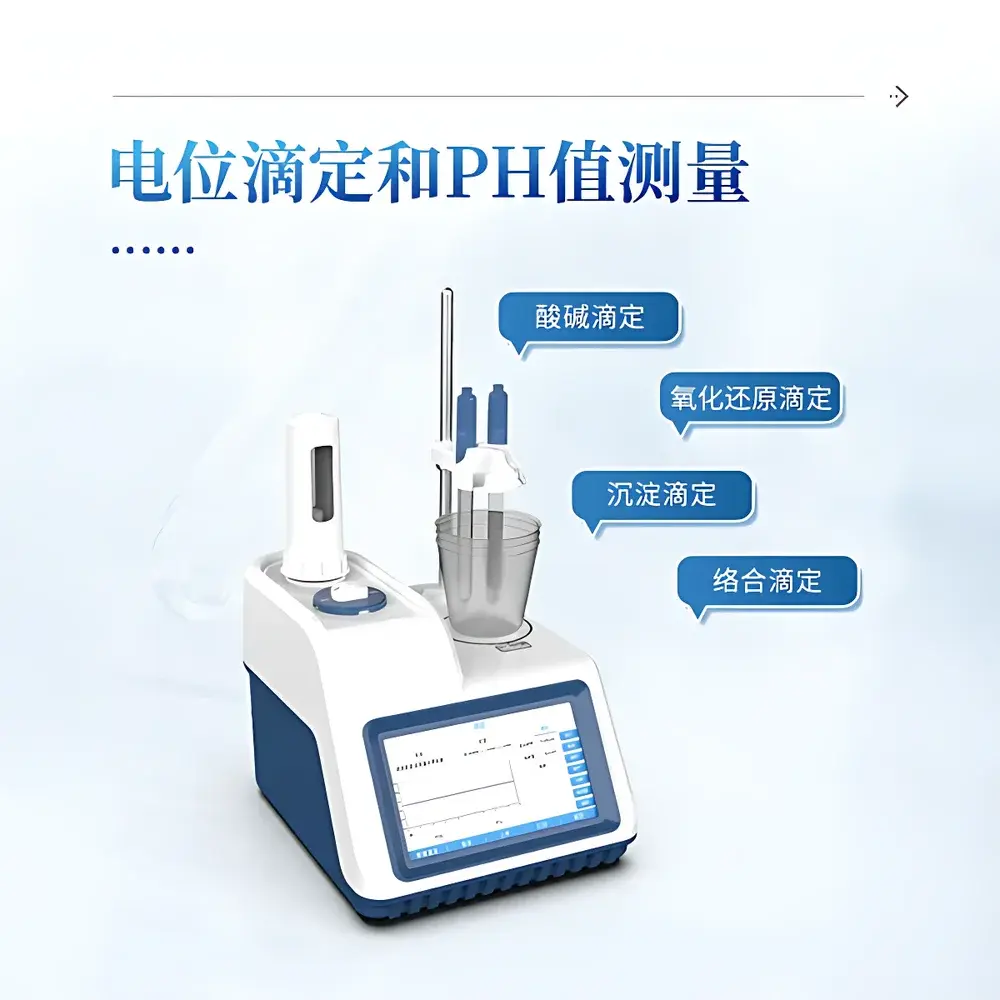
The COMECAUSE IN-D3 Automatic Potentiometric Titrator is a precision electrochemical analyzer engineered for high-reproducibility potentiometric titrations in regulated and research laboratory environments. It operates on the fundamental principle of monitoring the electromotive force (EMF) of an indicator electrode–reference electrode cell as titrant is incrementally delivered. The inflection point in the potential vs. volume curve—corresponding to stoichiometric equivalence—is identified algorithmically using first-derivative or fixed incremental endpoint detection. Designed and verified in accordance with JJG 814–2015 (Chinese National Verification Regulation for Automatic Potentiometric Titrators), the IN-D3 meets Class 0.05 performance criteria: maximum indication error ≤ ±1.5% and repeatability ≤ 0.2% RSD under standardized conditions. Its architecture integrates a microprocessor-controlled peristaltic dosing system, magnetic stirring platform, and multi-parameter sensing interface—enabling traceable, operator-independent quantification of analytes across acid-base, redox, precipitation, and complexometric reaction systems.
Key Features
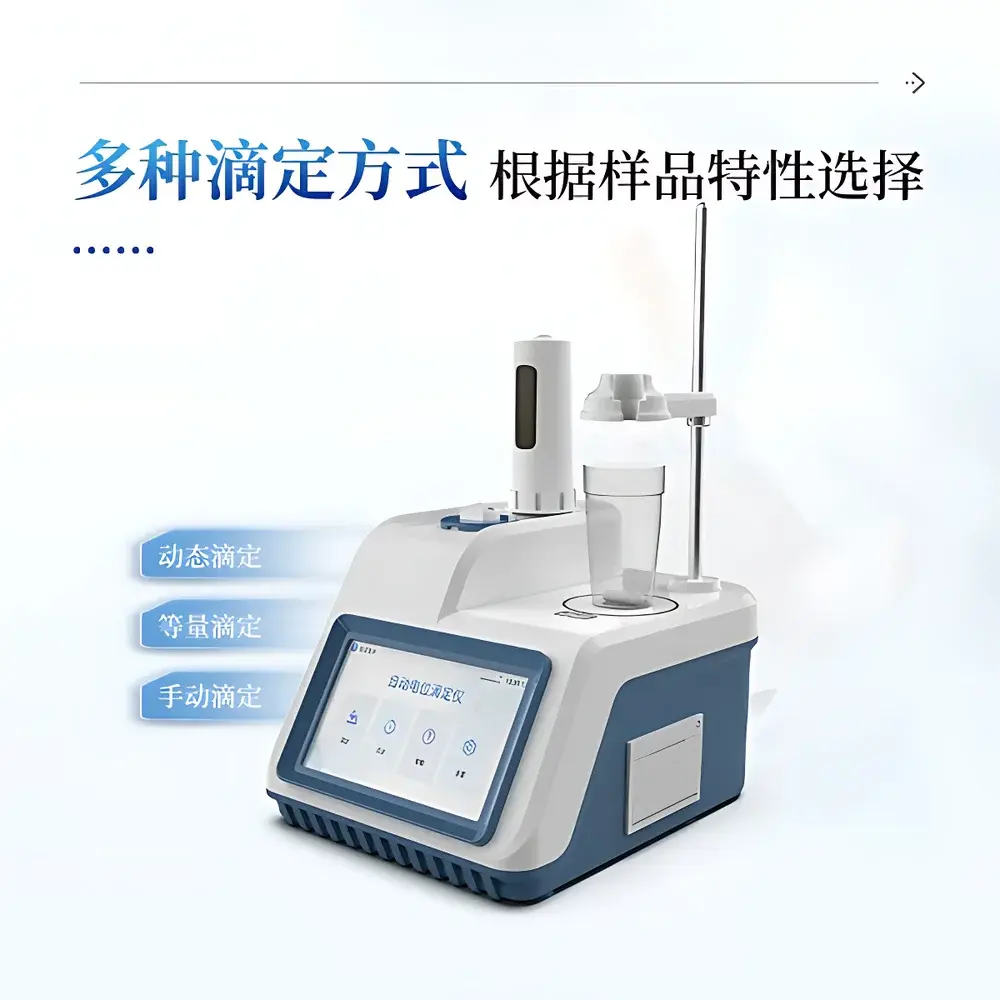
- Multi-mode titration control: dynamic titration (adaptive step size), fixed-volume addition, manual override, and pre-defined endpoint triggering
- Dual-function measurement capability: simultaneous potentiometric titration and direct pH measurement with automatic temperature compensation
- Expandable electrochemical modularity: optional conductometric and dead-stop (biamperometric) titration kits compliant with ISO 9297 and ASTM E2081
- Intuitive Android 10-based HMI: 7-inch capacitive touchscreen with graphical real-time titration curve visualization and on-device method editing
- Self-calibrating fluid handling: automated air purge, line priming (“flush”), and post-run line evacuation functions minimize carryover and bubble-induced volumetric error
- Method library management: supports creation, naming, parameterization, and storage of ≥100 user-defined titration protocols—including custom stoichiometric calculation formulas based on balanced chemical equations
- Regulatory-ready data integrity: timestamped raw data logging (potential, volume, pH, temperature), audit trail metadata, and export via USB/Wi-Fi/Ethernet in CSV or PDF formats
Sample Compatibility & Compliance
The IN-D3 accommodates aqueous and mixed-solvent samples within standard laboratory vial formats (e.g., 50–250 mL beakers or titration cups). Electrode compatibility follows IUPAC-standardized configurations: combination pH electrodes (Ag/AgCl reference), redox electrodes (Pt or Au working), ion-selective electrodes (e.g., Ag for halides, F⁻ for fluoride), and dual-platinum dead-stop cells. All hardware and firmware comply with electromagnetic compatibility (EMC) requirements per GB/T 18268.1–2010 (IEC 61326-1 equivalent) and electrical safety per GB 4793.1–2007 (IEC 61010-1). While not certified to FDA 21 CFR Part 11 out-of-the-box, its data export architecture and user-access controls support validation for GLP/GMP environments when deployed with documented SOPs and electronic signature workflows.
Software & Data Management
The embedded Android 10 OS hosts a purpose-built titration application supporting offline operation and local database persistence. Each titration run logs raw sensor values at ≥2 Hz resolution, including mV, pH, temperature, and cumulative delivered volume. Data files are stored in structured CSV format with header metadata (operator ID, method name, date/time stamp, electrode serial number, calibration history ID). Export options include direct thermal printing (built-in), USB mass storage dump, or network transfer via SMB or HTTP POST to LIMS-compatible endpoints. Firmware updates are delivered via signed OTA packages; configuration backups can be scheduled or triggered manually. Audit trail entries record all critical events: method modification, calibration execution, user login/logout, and instrument error states—with immutable timestamps.
Applications
The IN-D3 serves as a primary quantitative tool across quality control and analytical development workflows. In food and beverage labs, it quantifies titratable acidity (e.g., lactic, citric, acetic acids) per AOAC 947.05 and determines chloride by Mohr or Volhard methods. Pharmaceutical applications include assay of active ingredients (e.g., amine hydrochlorides via non-aqueous titration), residual catalyst analysis (e.g., Pd in API intermediates), and USP water content verification using Karl Fischer coulometric adaptation (with optional module). Environmental testing covers alkalinity (APHA 2320B), cyanide (ASTM D4377), and sulfate (ISO 9297). Educational institutions utilize its transparent interface to demonstrate Nernst equation behavior, equivalence point theory, and method validation principles (accuracy, precision, linearity per ICH Q2(R2)).
FAQ
What electrode types are supported for potentiometric titration?
The IN-D3 accepts standard BNC-terminated electrodes: combination pH electrodes (±0.01 pH accuracy), platinum redox electrodes, silver/silver chloride reference electrodes, and ion-selective electrodes compatible with aqueous or non-aqueous media.
Does the instrument support GLP-compliant data archiving?
Yes—raw data files include full metadata and are exportable in machine-readable CSV format. When integrated into validated laboratory networks with time-synced servers and controlled access policies, the system supports ALCOA+ data integrity principles.
Can titration methods be transferred between IN-D3 units?
Yes—method files (.titr) are portable via USB drive and retain all parameters, formulas, and endpoint logic. No proprietary cloud dependency is required.
Is temperature compensation applied automatically during pH measurement?
Yes—integrated Pt1000 sensor provides real-time temperature input; Nernst slope correction is applied dynamically per IUPAC-recommended equations.
What maintenance is required for long-term accuracy?
Routine verification includes daily electrode calibration (two-point pH, known mV buffer), monthly burette accuracy check using gravimetric dispensing, and annual verification against JJG 814–2015 test points using certified reference solutions.




