
Leica LAS X ID Industrial Software Platform for Microscopic Image Analysis
| Brand | Leica |
|---|---|
| Origin | Germany |
| Model | LAS X ID |
| Application Domain | Industrial Quality Control & Materials Science |
| Compliance | ISO 17025-aligned workflow support, GLP/GMP-ready audit trail capabilities, FDA 21 CFR Part 11–compatible user authentication and electronic signature options (via optional configuration) |
Overview
Leica LAS X ID is a purpose-built industrial software platform developed by Leica Microsystems (Wetzlar, Germany) for high-precision microscopic image acquisition, quantitative analysis, and standardized reporting in metallurgical, materials science, and manufacturing quality assurance environments. Built upon the robust architecture of Leica Application Suite X (LAS X), LAS X ID extends core imaging functionality with domain-specific modules engineered for reproducible, traceable, and standards-compliant microstructural evaluation. The platform operates on the principle of structured digital microscopy—integrating hardware control (Leica DM series upright microscopes, DFC cameras, motorized stages), real-time image processing, and metrology-grade measurement algorithms into a unified, workflow-driven interface. Unlike generic image analysis tools, LAS X ID embeds metrological traceability at the software layer: calibration management, pixel-to-micron mapping validation, and configurable uncertainty propagation for dimensional and morphological parameters are natively supported.
Key Features
- Workflow-Centric Interface: Full-screen image-centric design with context-sensitive toolbar expansion—functions appear only when relevant to the current task (e.g., grain boundary detection activates only after segmentation initiation).
- Role-Based User Profiles: Configurable operator permissions (e.g., “Technician”, “QA Auditor”, “Materials Engineer”) govern access to acquisition settings, analysis parameters, report generation, and archive export—enabling compliance with internal SOPs and external regulatory frameworks.
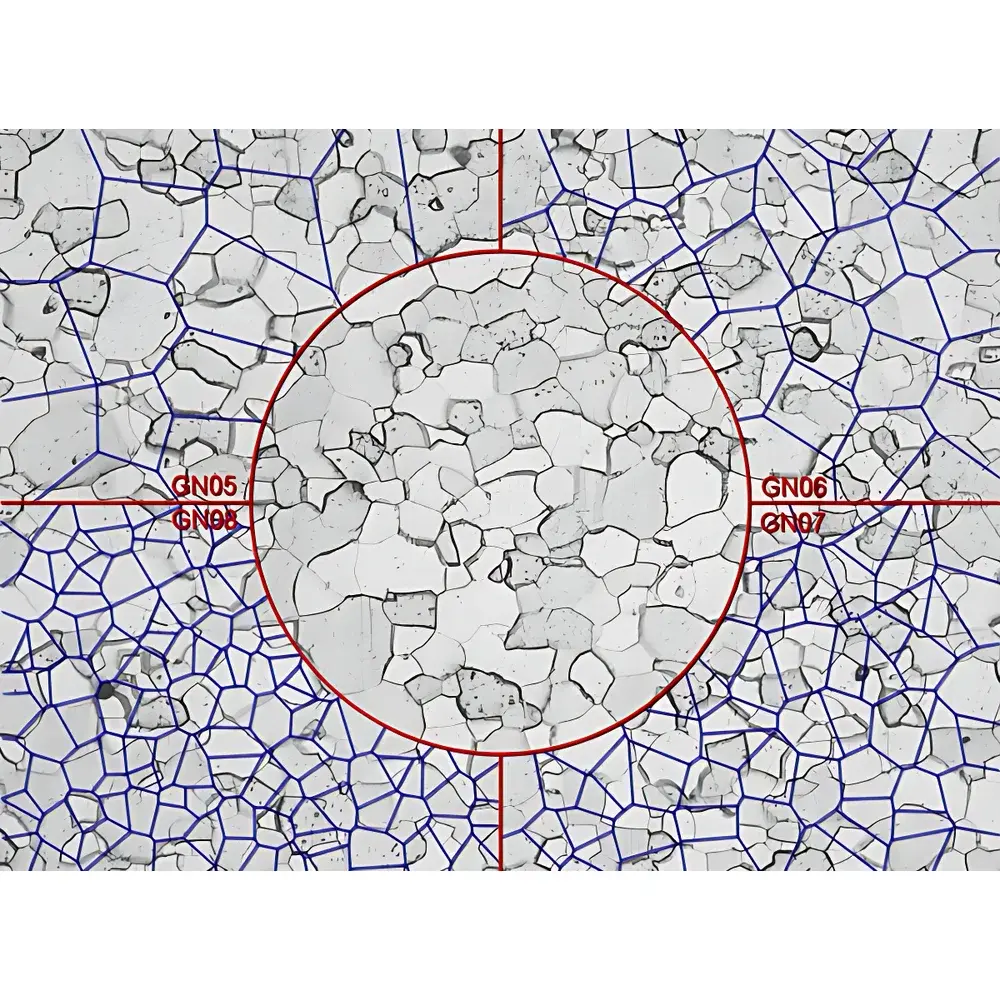
- Modular Architecture: Core LAS X ID platform integrates seamlessly with validated application modules including Grain Expert (ASTM E112–22 compliant grain size quantification), Phase Expert (enhanced contrast sensitivity for phase discrimination in multi-phase alloys), Cast Iron Expert (nodularity and vermicularity assessment per ISO 945–1), Decarburization Expert (surface carbon loss profiling in heat-treated steels per ISO 3887), and Stereology Toolbox (unbiased volume fraction, particle count, and mean intercept length calculations per ASTM E562 and ISO 23803).
- Automated Reporting Engine: Template-driven report generation with embedded metadata (microscope model, objective magnification, camera exposure time, calibration timestamp, operator ID), supporting PDF/A-1b archival compliance and CSV/Excel export for LIMS integration.
- Hardware Synchronization: Native bidirectional communication with Leica motorized objectives, filter turrets, illumination systems, and Z-drives—ensuring repeatable focus stacking, multi-channel fluorescence registration, and automated mosaic acquisition across large-area specimens.
Sample Compatibility & Compliance
Designed for polished metallographic sections, fracture surfaces, coated substrates, and ceramic cross-sections, LAS X ID supports standard specimen formats (25 mm, 30 mm, 50 mm diameter mounts) and accommodates both brightfield, darkfield, differential interference contrast (DIC), and polarized light imaging modalities. All modules adhere to metrological principles defined in ISO/IEC 17025:2017 for testing laboratories—particularly clauses 7.2 (selection of methods), 7.7 (assurance of result validity), and 7.8 (reporting of results). Optional configuration enables 21 CFR Part 11 compliance through electronic signatures, audit trail logging (with immutable timestamps and user attribution), and secure role-based data access controls—meeting requirements for regulated industries including aerospace component certification (AMS 2300), automotive casting QA (VDA 5), and medical device material verification (ISO 10993–12).
Software & Data Management
LAS X ID runs on Windows 10/11 (64-bit) with minimum 16 GB RAM and NVIDIA Quadro or AMD Radeon Pro GPU acceleration recommended for real-time segmentation. Data storage follows hierarchical project structures: raw TIFF/OME-TIFF images (with embedded EXIF and custom metadata tags), processed ROIs, measurement databases (.lasxdata), and finalized reports are version-controlled within user-defined network shares or Leica’s optional LAS X Server environment. All analytical operations generate an immutable audit trail—including parameter changes, manual corrections, and module activation events—exportable as encrypted XML logs for internal review or regulatory submission. Integration with laboratory information management systems (LIMS) is achieved via standardized RESTful API endpoints and ODBC-compliant database connectors.
Applications
- Quantitative metallography for ASTM E3, E112, E1245, and ISO 643 conformance
- Decarburization depth profiling in case-hardened gears and bearing steels
- Nodularity assessment in ductile iron castings per SAE J431 and EN-GJS-400
- Inclusion rating in stainless steels using ASTM E45 methodologies
- Coating thickness measurement on thermal-sprayed or PVD-deposited layers
- Fractography analysis of fatigue crack initiation zones and cleavage facets
- Grain boundary engineering studies for high-temperature alloy development
FAQ
Is LAS X ID compatible with non-Leica microscopes?
No—LAS X ID requires native hardware drivers and firmware-level synchronization available exclusively with Leica DM series upright and inverted industrial microscopes (e.g., DM6 M, DM2700 M) and Leica DFC camera models.
Can analysis modules be added post-purchase?
Yes—modules are licensed individually and activated via hardware-bound dongles or network license servers; no reinstallation is required.
Does LAS X ID support batch processing of multiple samples?
Yes—through the LAS X Batch Processor, users define standardized acquisition and analysis sequences for unattended operation across up to 100+ mounted specimens using motorized stage coordinates.
How is measurement uncertainty handled in LAS X ID?
Uncertainty budgets are calculated per ISO/IEC Guide 98–3 (GUM) principles: contributions from pixel calibration error, stage repeatability, segmentation threshold variability, and operator-defined ROI placement are propagated algorithmically and reported alongside each quantitative result.
Is cloud-based deployment supported?
No—LAS X ID is an on-premise desktop application; remote access may be implemented via IT-approved virtual desktop infrastructure (VDI), but cloud-hosted instances are not certified or supported by Leica Microsystems.






