
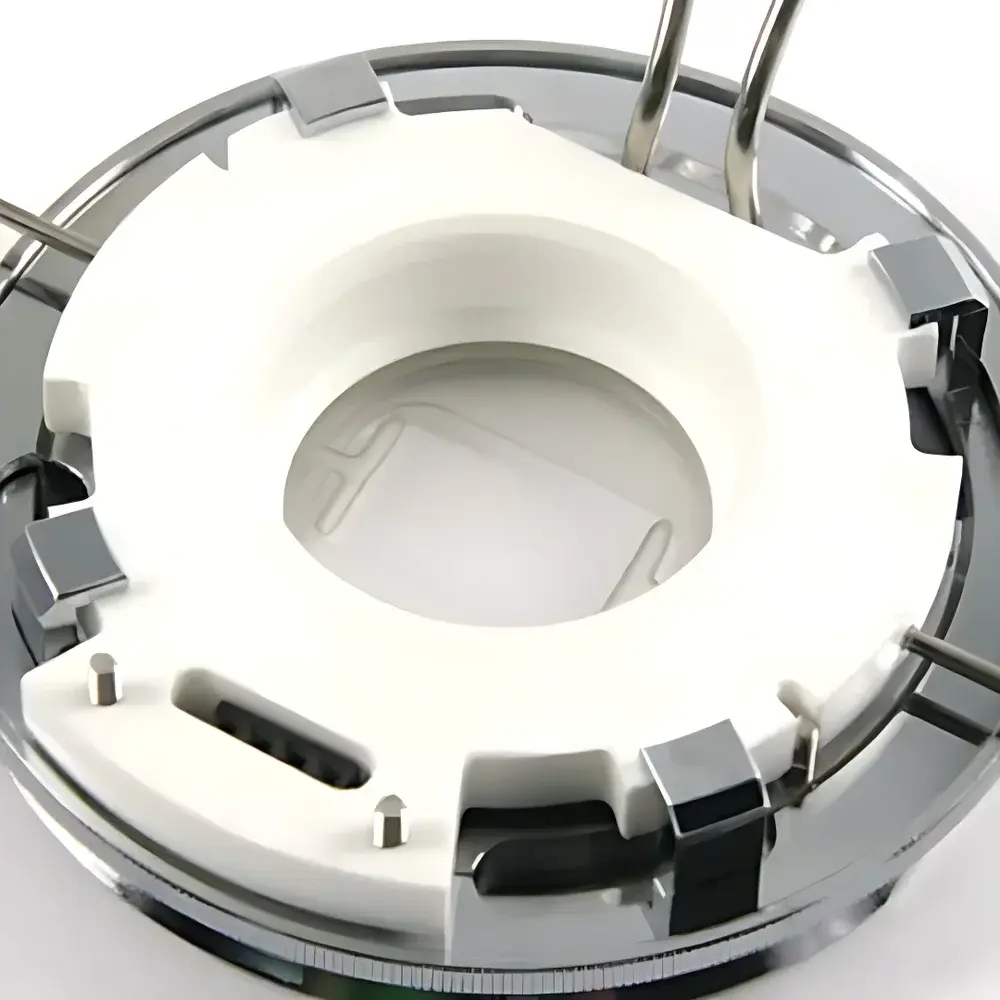
Bioptechs FCS2/FCS3 Microfluidic Perfusion Chamber for Live-Cell Microscopy
| Brand | Bioptechs |
|---|---|
| Origin | USA |
| Model | FCS2 (for inverted microscopes), FCS3 (for upright microscopes), CFCS2 (cooling-enabled variant) |
| Component Category | Optical Instrument Component |
| Optical Compatibility | Full compatibility with brightfield, phase contrast, DIC, fluorescence (including TIRF and confocal), and super-resolution modalities |
| Temperature Control Range | Ambient to 50 °C ±0.2 °C (air-gap-free design) |
| Flow Regime | Tunable from near-laminar (low-shear) to directed high-shear, user-defined geometry |
| Chamber Volume & Geometry | Fully user-adjustable chamber height (10–500 µm), optical path length, and flow channel profile |
| Thermal Uniformity | <0.1 °C spatial variation across imaging area |
| Fluidic Interface | 1/16″ OD tubing compatible (C-Flex®, Tygon®) |
| Environmental Sealing | Closed-system operation compatible with CO₂/bicarbonate or organic buffering systems |
| Assembly | Tool-free, modular configuration |
Overview
The Bioptechs FCS2 and FCS3 Microfluidic Perfusion Chambers are precision-engineered optical instrument components designed specifically for high-fidelity, long-term live-cell microscopy under physiologically relevant fluidic and thermal conditions. Unlike conventional perfusion chambers relying on air gaps or fixed geometries, the FCS platform employs a solid-state, air-gap-free thermal architecture that integrates direct conductive heating/cooling with optically optimized quartz or coverslip-based flow paths. Its operational principle is rooted in controlled laminar hydrodynamics governed by Poiseuille flow theory, enabling reproducible shear stress profiles (0.01–20 dyn/cm²) across the cell monolayer while maintaining Köhler illumination integrity and minimal optical aberration. The system supports both static incubation and dynamic perfusion protocols — including rapid buffer exchange (<5 s for full chamber turnover), gradient generation, and multi-channel sequential delivery — without compromising spatial resolution or thermal stability. Designed for integration into regulated laboratory environments, the FCS series meets foundational requirements for GLP-compliant imaging workflows, particularly where temperature traceability, media sterility, and shear-sensitive phenotype preservation are critical.
Key Features
- Tool-free, modular assembly with interchangeable gaskets and spacers for real-time adjustment of chamber height (10–500 µm), enabling precise control over hydrodynamic resistance and shear distribution
- Air-gap-free thermal management delivering ±0.2 °C accuracy and <0.1 °C spatial uniformity across the entire imaging field — verified via embedded thermistor arrays and NIST-traceable calibration
- Optically neutral construction using fused silica or #1.5H high-transmission coverslips, supporting UV-vis-IR transmission (200–2500 nm) and minimizing spherical/chromatic aberration in widefield and point-scanning modalities
- Full compatibility with all major microscope architectures: FCS2 optimized for inverted platforms (e.g., Nikon Ti2, Zeiss Axio Observer), FCS3 for upright systems (e.g., Olympus BX3, Leica DM6000), and CFCS2 incorporating Peltier-based active cooling
- Closed-system fluidics supporting CO₂/bicarbonate buffered media or HEPES-based organic buffers; integrated gas-permeable membranes available upon request for long-term pH stabilization
- Dual-stage temperature controller with hardware-level alarm circuitry, independent of host PC, providing fail-safe shutdown if thermal excursion exceeds preset thresholds
Sample Compatibility & Compliance
The FCS chamber accommodates adherent mammalian cells (e.g., endothelial, neuronal, epithelial), primary isolates, and 3D organoid fragments cultured directly on functionalized glass or polymer substrates. Its open-top design permits standard coating protocols (fibronectin, collagen I, poly-L-lysine) and post-seeding interventions (transfection, microinjection, laser ablation). From a regulatory standpoint, the device conforms to ISO 13485 manufacturing practices as applied to research-use-only (RUO) optical accessories. While not FDA-cleared, its material composition (USP Class VI-certified elastomers, borosilicate glass, medical-grade stainless steel fittings) and closed-fluidic architecture support audit readiness for GMP-aligned preclinical imaging studies. Documentation packages include material declarations, RoHS/REACH compliance statements, and sterilization validation data (ethylene oxide and gamma irradiation options available).
Software & Data Management
The FCS operates independently of proprietary software but interfaces seamlessly with third-party acquisition platforms (e.g., MetaMorph, NIS-Elements, Micro-Manager, μManager) via TTL-triggered solenoid valve control and analog temperature feedback loops. Optional digital I/O modules enable synchronization with camera exposure timing, stage position, and environmental logging systems. All temperature setpoints, ramp rates, and alarm thresholds are programmable through a local front-panel interface or RS-232/USB command protocol (SCPI-compliant). Audit trails — including timestamped thermal logs, power cycle history, and error event records — are stored onboard and exportable in CSV format, satisfying core elements of FDA 21 CFR Part 11 for electronic record integrity when paired with validated LIMS integration.
Applications
- Real-time observation of shear-dependent mechanotransduction in vascular endothelium under physiological flow profiles (e.g., pulsatile vs. steady laminar)
- High-resolution calcium imaging during neurotransmitter perfusion in primary hippocampal neurons
- Long-term time-lapse tracking of mitochondrial dynamics in cardiomyocytes exposed to hypoxia-reoxygenation cycles
- Single-molecule localization microscopy (SMLM) requiring ultra-stable thermal and mechanical conditions during dSTORM/PALM acquisitions
- Microfluidic drug screening assays combining gradient generation, timed compound delivery, and endpoint morphometric analysis
- Correlative light-electron microscopy (CLEM) workflows where chamber disassembly must preserve ultrastructural integrity post-fixation
FAQ
Is the FCS compatible with total internal reflection fluorescence (TIRF) microscopy?
Yes — the FCS2 and FCS3 use high-refractive-index quartz or matched coverslips (n = 1.525) and maintain sub-100 nm parallelism tolerance, ensuring stable evanescent field generation and minimal background scatter.
Can I perform simultaneous patch-clamp electrophysiology and imaging in the FCS chamber?
Absolutely — the chamber includes dedicated electrode ports positioned outside the optical path; custom electrode holder adapters are available for Axon Instruments and HEKA amplifiers.
What is the maximum recommended flow rate before turbulence onset?
For a standard 200 µm-height chamber with 1 mm width, Reynolds number remains <100 up to ~100 µL/min using aqueous media at 37 °C — well within laminar regime per theoretical prediction and experimental verification.
Does Bioptechs provide validation documentation for ISO/IEC 17025-accredited labs?
Yes — installation qualification (IQ), operational qualification (OQ), and performance qualification (PQ) templates are included, along with uncertainty budgets for temperature and flow calibration.
Are replacement gaskets and spacers supplied with dimensional traceability certificates?
All consumable spacers are manufactured to ±1 µm flatness and thickness tolerance, with individual CofC (Certificate of Conformance) provided per lot number.





