Chroma Fluorescence Filter Sets
| Brand | Chroma |
|---|---|
| Origin | USA |
| Manufacturer Type | Authorized Distributor |
| Product Category | Imported Optical Component |
| Model Series | Chroma |
| Price Range | USD 1,400 – 7,000 (based on configuration) |
| Component Type | Precision Interference Optical Filter |
Overview
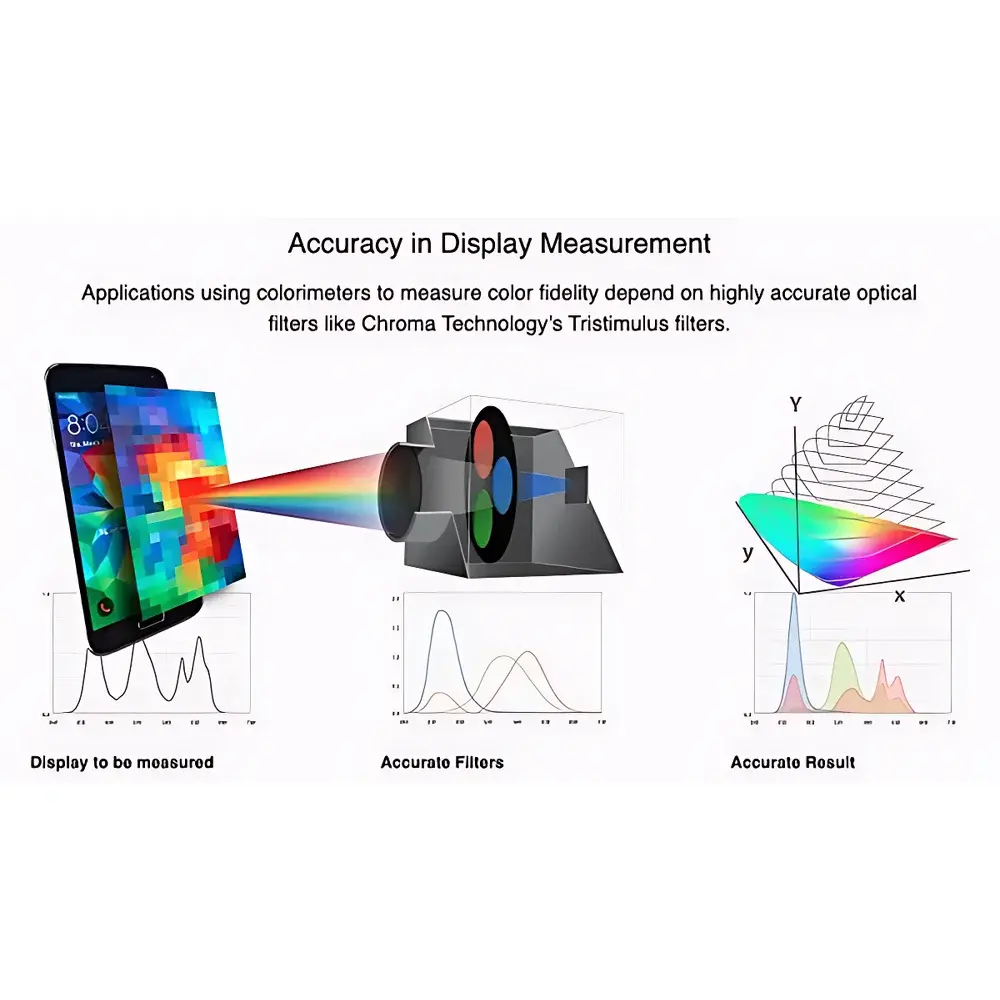
Chroma fluorescence filter sets are high-performance optical interference filters engineered for demanding fluorescence microscopy and spectroscopic applications. Built upon thin-film multilayer dielectric coating technology, these filters deliver exceptional spectral selectivity, steep edge transitions (typical transition slopes <1% per nanometer), and ultra-low autofluorescence—critical for maximizing signal-to-noise ratio in low-light biological imaging. Each filter set consists of precisely matched excitation filters, emission filters, and dichroic mirrors optimized for specific fluorophore combinations (e.g., FITC/TRITC/Cy5, DAPI/GFP/mCherry, or custom multiplex panels). Chroma’s proprietary hard-coated ion-beam-sputtered (IBS) process ensures long-term environmental stability, minimal wavelength shift under temperature variation (±0.1 nm/°C), and resistance to humidity and cleaning solvents—meeting ISO 9001-certified manufacturing standards.
Key Features
- Ultra-steep spectral edges: Typically <1% transmission change per nanometer at cut-on/cut-off points, enabling precise separation of closely spaced emission spectra.
- High optical density (OD ≥6) beyond passbands: Effectively blocks out-of-band laser light and ambient stray radiation, essential for confocal, TIRF, and super-resolution microscopy.
- Sub-nanometer center wavelength tolerance: ±0.5 nm for bandpass filters; ±1.0 nm for dichroics—guaranteed via spectral certification with NIST-traceable spectrophotometry.
- λ/20 surface flatness and λ/10 transmitted wavefront error: Minimizes wavefront distortion critical for diffraction-limited imaging and quantitative intensity measurements.
- Low-autofluorescence fused silica or BK7 substrates: Certified per ASTM E1317 for fluorescence background ≤0.05% relative to standard quartz reference.
- Customizable mounting options: Includes unmounted filters (25 mm, 32 mm, 50 mm round; 25 × 36 mm rectangular), pre-aligned cube assemblies (e.g., Nikon CFI, Olympus U-FLB, Zeiss Axio), and OEM-ready filter wheels compatible with Thorlabs, Prior, and Sutter systems.
Sample Compatibility & Compliance
Chroma fluorescence filter sets support a broad range of sample types—from live-cell monolayers and tissue sections to fixed whole-mount specimens and microfluidic assays. Their high transmission (>90% peak) and low photobleaching-induced drift ensure reproducible quantification across time-lapse experiments. All filters comply with ISO 10110-7 (optical component surface quality), ISO 9211-3 (interference coatings), and RoHS 2015/863/EU. For regulated environments—including clinical IVD workflows and GLP-compliant assay development—Chroma provides full traceability documentation: individual spectral scans, coating lot numbers, substrate certifications, and material declarations. Filters used in FDA-cleared imaging platforms (e.g., Leica DMi8, Nikon Ti2-E) are validated per IEC 61000-4-3 for electromagnetic compatibility in lab-grade instrumentation.
Software & Data Management
Chroma provides free, web-accessible spectral data libraries (CSV, SDF, and .txt formats) compatible with common microscope control software including Micro-Manager, MetaMorph, NIS-Elements, and ZEN Blue. Each filter’s full transmission/reflection curve is archived with timestamped calibration metadata, supporting audit-ready data provenance. For integration into automated workflows, Chroma’s spectral database supports API-driven queries via RESTful endpoints—enabling dynamic filter selection based on acquisition parameters in Python-, LabVIEW-, or MATLAB-controlled systems. All spectral files include embedded EXIF tags indicating measurement instrument (PerkinElmer Lambda 1050+), operator ID, and environmental conditions (22.0 ± 0.2°C, 45 ± 3% RH), satisfying 21 CFR Part 11 requirements for electronic records when deployed with compliant LIMS or ELN platforms.
Applications
- Widefield and spinning-disk confocal fluorescence microscopy
- Total internal reflection fluorescence (TIRF) and structured illumination microscopy (SIM)
- Fluorescence in situ hybridization (FISH) and comparative genomic hybridization (CGH)
- Raman spectroscopy background suppression using notch and edge filters
- Flow cytometry spectral unmixing with multi-band detection schemes
- Single-molecule localization microscopy (SMLM), including STORM and PALM
- Live-cell calcium and voltage imaging using ratiometric dyes (e.g., Fura-2, ArcLight)
FAQ
Are Chroma fluorescence filters suitable for UV-excited fluorophores such as DAPI?
Yes—Chroma offers deep-UV optimized filter sets (e.g., 350/50 nm excitation, 460/50 nm emission) with high transmission down to 250 nm and minimal solarization effects after >10⁴ J/cm² 365 nm exposure.
Do you provide spectral validation reports with each shipment?
Yes—every filter set includes a unique serial-numbered spectral certificate generated from in-house PerkinElmer Lambda 1050+ measurements, traceable to NIST SRM 2036.
Can Chroma filters be cleaned without degradation?
Yes—hard-coated IBS filters tolerate standard lens cleaning protocols using spectroscopic-grade methanol, isopropanol, or commercial optics cleaners (e.g., CytoClean™), provided lint-free cellulose wipes and <10 psi nitrogen blow-off are used.
What is the typical lead time for custom filter designs?
Standard catalog items ship within 3–5 business days; custom designs (e.g., multi-band dichroics or Raman edge filters) require 6–8 weeks for coating run scheduling and spectral verification.
Are Chroma filters compatible with laser scanning microscopes operating at 488 nm, 561 nm, and 640 nm?
Yes—Chroma’s LaserMUX series provides >99.5% reflection efficiency at specified laser lines and <0.1% transmission in adjacent bands, minimizing crosstalk in multicolor acquisition.