
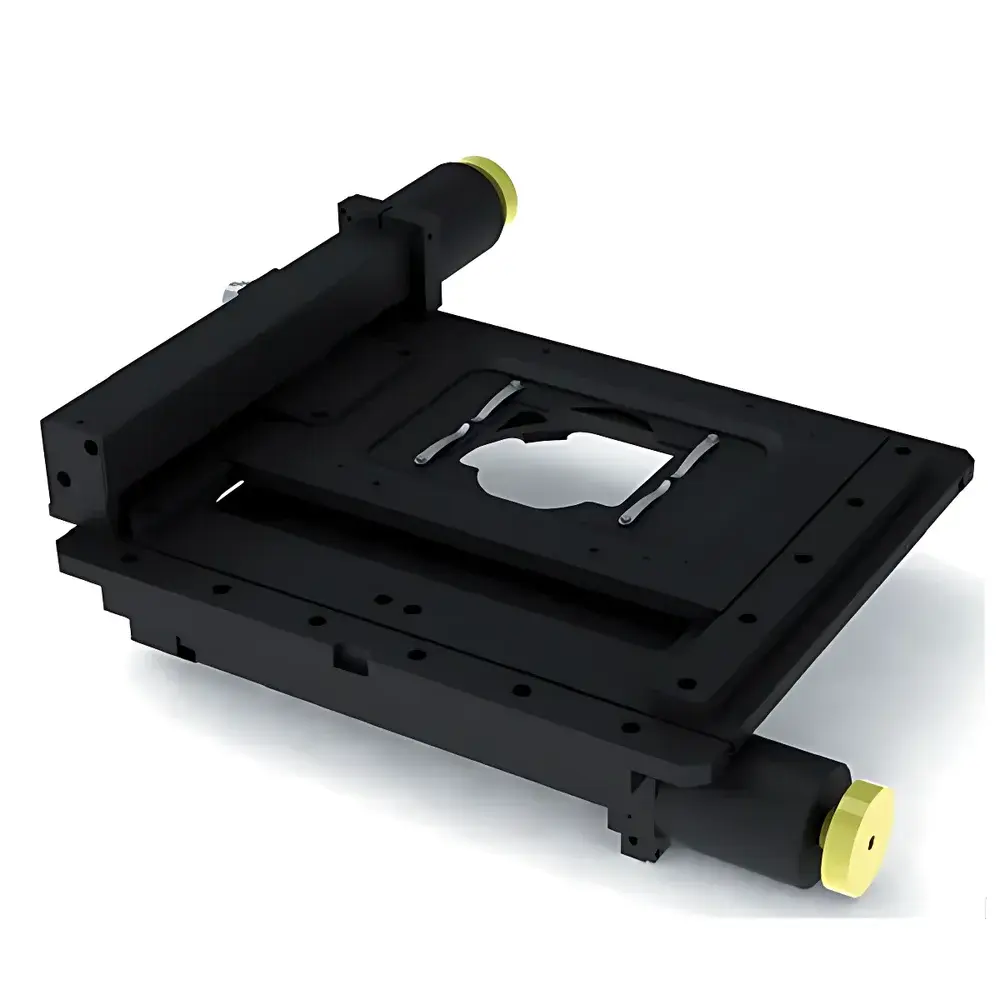
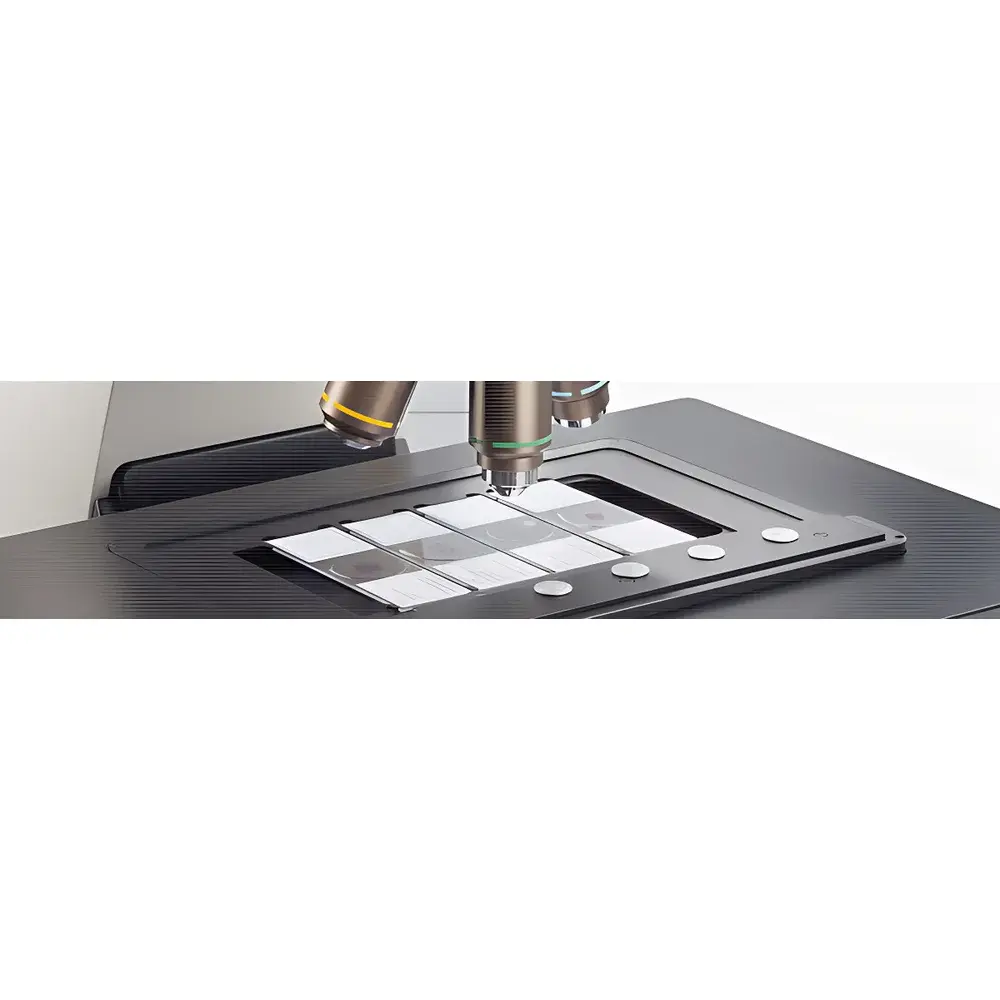
Marzhauser SCAN IM Motorized Microscope Stage
| Brand | Marzhauser |
|---|---|
| Origin | Germany |
| Model | SCAN IM |
| Travel Range | 30 mm to 300 mm (X/Y) |
| Compatibility | Upright, Inverted & Stereo Microscopes |
| Mounting Interface | Standard dovetail and screw-hole patterns per DIN/ISO microscope stage specifications |
| Drive Type | Stepper motor with closed-loop position verification |
| Positioning Resolution | ≤ 0.1 µm (dependent on controller and microstepping configuration) |
| Repeatability | ±0.5 µm |
| Load Capacity | Up to 1.5 kg (static, centered) |
| Environmental Rating | Designed for ISO Class 5–7 laboratory environments |
| Compliance | CE, RoHS, EN 61000-6-2/-6-4 |
Overview
The Marzhauser SCAN IM Motorized Microscope Stage is a high-precision, modular XY translation platform engineered for automated digital pathology workflows, whole-slide imaging (WSI), and quantitative microscopy applications. Built upon Marzhauser’s six-decade heritage in precision motion control for life science instrumentation, the SCAN IM operates on a robust stepper-motor-driven architecture with mechanical backlash compensation and optional closed-loop feedback for enhanced positional fidelity. Its core function is to deliver deterministic, repeatable sample positioning under optical magnification—enabling seamless tile-based image acquisition, multi-region-of-interest (ROI) scanning, time-lapse z-stack navigation, and synchronized hardware triggering with camera and illumination systems. The stage integrates natively with standard upright, inverted, and stereo microscope frames via DIN-compliant mounting interfaces, supporting both OEM integration and retrofitted automation of existing Leica, Zeiss, Olympus, Nikon, and Keyence platforms.
Key Features
- Modular travel options: X/Y ranges from 30 × 30 mm up to 300 × 300 mm, configurable as single-axis or dual-axis units with interchangeable base plates.
- Mechanically optimized kinematic design featuring recirculating ball-screw drives and preloaded linear guides for minimal wobble and thermal drift (< 0.8 µm/°C).
- Controller-agnostic interface: Compatible with Marzhauser’s M-Stack and M-Drive controllers, as well as third-party systems via RS-232, USB, or TTL-triggered step/direction signals.
- High-load stability: Rated for static loads up to 1.5 kg with center-of-gravity alignment—suitable for heavy glass slides, multi-well plates, and custom specimen holders.
- Low-vibration operation: Optimized acceleration profiles and microstepping resolution (down to 1/256-step mode) ensure silent, jitter-free movement during live imaging.
- IP52-rated housing with corrosion-resistant anodized aluminum construction for long-term reliability in humid or reagent-exposed lab environments.
Sample Compatibility & Compliance
The SCAN IM accommodates standard 1″ × 3″ (25 × 75 mm) glass histology slides, cytology slides, tissue microarrays (TMAs), and custom substrates up to 5 mm thickness. It supports both manual slide loading and integration with automated slide loaders (e.g., Leica CV5030, Sakura Tissue-Tek AutoSection). All mechanical and electrical components comply with EU directives including CE marking (2014/30/EU EMC Directive, 2014/35/EU LVD), RoHS 2011/65/EU, and EN 61000-6-2 (immunity) / EN 61000-6-4 (emission). For regulated digital pathology deployments, the stage meets prerequisite mechanical stability requirements outlined in FDA Guidance for Digital Pathology Systems (2021) and aligns with ISO 13485:2016 quality system expectations when deployed within validated WSI instrument architectures.
Software & Data Management
The SCAN IM does not include embedded firmware but functions as a deterministic peripheral within validated imaging ecosystems. It is fully supported by major digital pathology software suites—including 3DHISTECH CaseViewer, Hamamatsu NanoZoomer NDP.view, and Indica Labs HALO—via standardized ASCOM, MMCore, or vendor-specific SDKs. Positional metadata (X, Y, timestamp, objective ID) is logged in TIFF ImageDescription tags or OME-TIFF structured headers, ensuring traceability for GLP/GMP audit trails. When paired with Marzhauser’s M-Drive controller, optional audit-log export (CSV/JSON) captures all motion commands, error codes, and calibration timestamps—supporting 21 CFR Part 11 compliance when implemented with appropriate electronic signature and access-control layers.
Applications
- Digital pathology slide scanning for primary diagnosis, second-opinion review, and AI training dataset generation.
- Automated fluorescence colocalization studies requiring precise ROI navigation across multi-channel acquisitions.
- Time-lapse live-cell imaging with programmable XY trajectories and synchronized environmental chamber control.
- High-throughput screening of cell cultures, organoids, or 3D bioprinted constructs using tiled mosaic reconstruction.
- Quantitative morphometry in neurohistology, renal biopsy analysis, and tumor margin assessment workflows.
- OEM integration into custom-built confocal, light-sheet, or hyperspectral imaging platforms.
FAQ
What microscope brands and models are compatible with the SCAN IM?
The SCAN IM mounts to Leica DM series, Zeiss Axio line, Olympus BX/IX series, Nikon Eclipse Ci/Ei, and Keyence BZ-X platforms using standard DIN 31000-compliant dovetail rails or M4/M5 threaded holes.
Is the SCAN IM suitable for use in GMP-regulated digital pathology labs?
Yes—when integrated into a validated whole-slide imaging system and operated with appropriate procedural controls, its mechanical reproducibility and documentation-ready positional logging support compliance with ISO 15189, CAP checklist ANP.42710, and CLIA requirements.
Can the SCAN IM be upgraded to include Z-axis focus control?
No—the SCAN IM is strictly an XY translation stage; however, Marzhauser offers the FOCUS IM series for independent Z-axis motorization, and both can be synchronized via shared controller logic.
What is the typical lead time for custom travel-range configurations?
Standard SCAN IM variants ship within 4–6 weeks; bespoke travel lengths or mounting adaptations require 10–12 weeks from order confirmation and mechanical drawing sign-off.
Does Marzhauser provide IQ/OQ documentation packages?
Yes—upon request, Marzhauser supplies instrument-specific Installation Qualification (IQ) and Operational Qualification (OQ) templates aligned with ISO/IEC 17025 and ASTM E2500-13 guidelines, including test protocols for repeatability, linearity, and thermal stability verification.



