
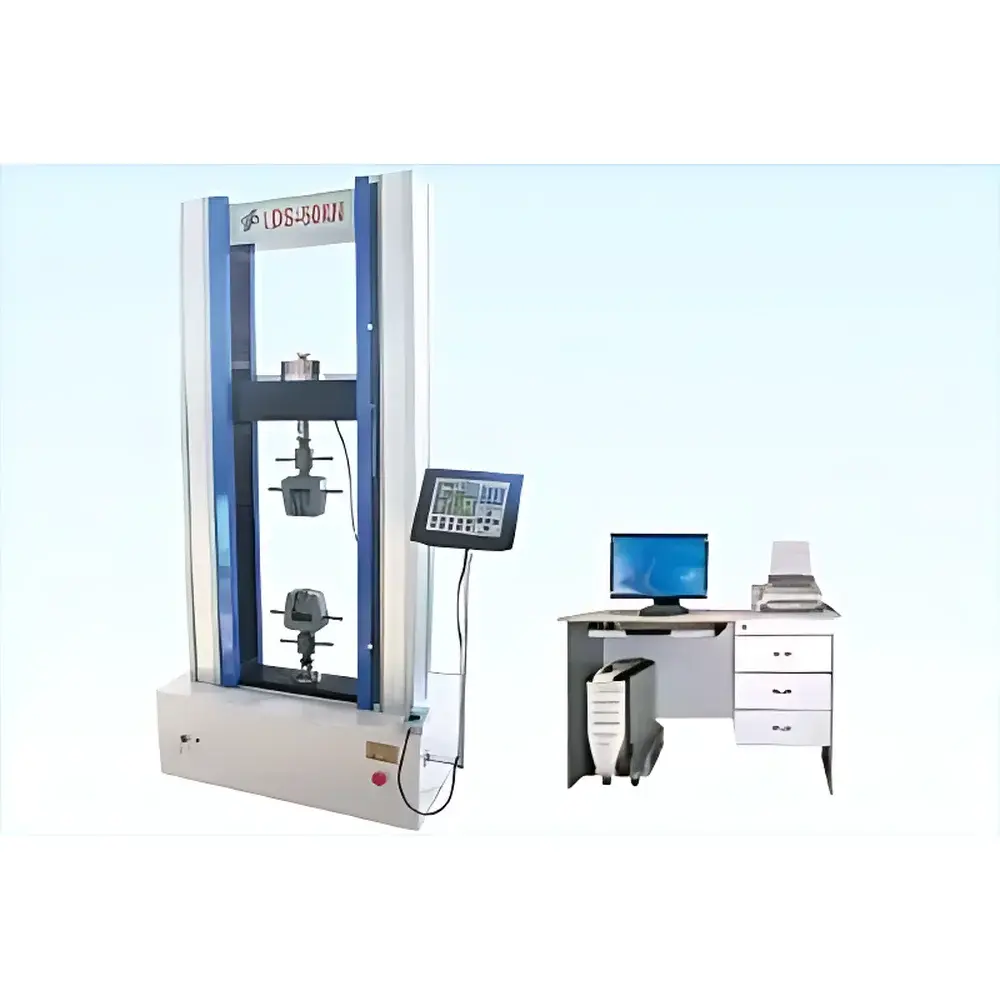
WSM-20KN Universal Testing Machine
| Origin | Jilin, China |
|---|---|
| Manufacturer Type | Authorized Distributor |
| Origin Category | Domestic (China) |
| Model | WSM-20KN |
| Quotation | Available upon Request |
| Max. Test Load | 20 kN |
| Load Cell Accuracy | ±0.5% FS |
| Speed Range | 0.05–500 mm/min |
| Speed Accuracy | ±0.5% |
| Large-Deformation Measurement Range | 0–1000 mm |
| Large-Deformation Accuracy | ±0.5% |
| Effective Travel (Crosshead) | 1160 mm |
| Effective Test Width | 420 mm |
| Power Supply | AC 220 V, 2 kW |
Overview
The WSM-20KN Universal Testing Machine is an electromechanical static testing system engineered for precision mechanical characterization of non-metallic materials, engineering plastics, and polymeric specimens under tension, compression, bending, and shear loading conditions. Based on the principle of controlled displacement or force actuation via a high-rigidity precision ball-screw drive train, the machine delivers repeatable load application across defined strain rates in accordance with standardized quasi-static test protocols. Its architecture integrates closed-loop digital control, real-time data acquisition, and compliance with fundamental mechanical testing theory—including Hooke’s law, Euler–Bernoulli beam theory for flexure, and ASTM/ISO definitions of stress, strain, modulus, and failure criteria. Designed for laboratory and quality control environments, the WSM-20KN supports full traceability and reproducibility in material property evaluation per ISO 527, ISO 178, ASTM D638, ASTM D790, and GB/T 1040.2–2006 (equivalent to ISO 527-2) and GB/T 9341–2008 (equivalent to ISO 178).
Key Features
- High-stiffness frame with precision-ground ball-screw actuation system ensures minimal deflection and optimal axial alignment during high-load testing.
- Integrated 20 kN load cell from Transducer Techniques (USA), calibrated to ±0.5% full-scale accuracy, compliant with ISO 7500-1 Class 0.5 requirements.
- Dual-mode control architecture supporting both constant-rate-of-traverse (CRT) and constant-rate-of-load (CRL) operation, programmable via embedded controller or PC-based software.
- Digital crosshead position feedback with dual-resolution encoding—micrometer-scale resolution for positioning, millimeter-scale for travel monitoring—plus LED digital readout and physical scale indicator.
- Modular fixture system including wedge-action tensile grips (0–10 mm parallel jaw) and three-point bending fixtures, all designed for quick tool-free changeover and specimen centering repeatability.
- Large-deformation extensometer (0–1000 mm range, ±0.5% accuracy) enables precise elongation measurement for ductile polymers and elastomers without contact interference.
- Comprehensive safety architecture: hardware-based overload cutoff, thermal protection for motor driver, voltage anomaly detection, dual mechanical limit switches, and automatic emergency stop on specimen rupture.
- Real-time multi-curve display capability—including stress–strain, force–displacement, force–time, and deflection–time—with user-definable axis scaling, overlay comparison (up to 12 curves), and localized zoom-in functionality.
Sample Compatibility & Compliance
The WSM-20KN accommodates flat, round, and rectangular specimens conforming to standard dimensions specified in ISO 527-2 (tensile bars), ISO 178 (flexural bars), and GB/T 1040.2. Typical compatible materials include thermoplastics (e.g., ABS, PC, PP), thermosets (e.g., epoxy, phenolic), composites (fiber-reinforced polymers), elastomers (TPE, silicone), and rigid foams. All test configurations support pre-test parameter validation, post-test data integrity verification, and audit-ready reporting aligned with GLP and GMP documentation standards. The system meets electromagnetic compatibility (EMC) requirements per IEC 61326-1 and electrical safety standards per IEC 61010-1.
Software & Data Management
Bundled Windows-native testing software provides intuitive test method configuration, real-time visualization, automated calculation of mechanical parameters (tensile strength, yield point, Young’s modulus, flexural modulus, elongation at break, Poisson’s ratio), and export to industry-standard formats. Raw data (force, displacement, time, extensometer output) is stored in ASCII-delimited files (.csv) and native binary archives with embedded metadata (operator ID, timestamp, environmental notes, calibration certificate ID). Report templates are fully customizable and support direct export to Microsoft Excel and Word. Software features FDA 21 CFR Part 11-compliant user access levels, electronic signature fields, and immutable audit trails for all test modifications, calibrations, and result exports—enabling regulatory submission readiness.
Applications
- Quality assurance of polymer extrusions, injection-molded components, and composite laminates in automotive and medical device manufacturing.
- R&D validation of new resin formulations, additive effects (e.g., plasticizers, fillers), and aging behavior (thermal/UV exposure).
- Failure analysis of brittle fracture, ductile necking, creep deformation, and interfacial delamination in multi-material assemblies.
- Standardized conformance testing for ISO/ASTM certification packages, technical data sheet generation, and supplier qualification audits.
- Educational use in materials science laboratories for hands-on instruction in mechanical behavior fundamentals and test methodology standardization.
FAQ
What standards does the WSM-20KN support out-of-the-box?
Preconfigured test methods cover ISO 527, ISO 178, ASTM D638, ASTM D790, GB/T 1040.2, and GB/T 9341. Custom method creation is supported via editable parameter sets.
Is the system compatible with third-party extensometers or environmental chambers?
Yes—the machine features analog and digital I/O ports (±10 V, RS-232, USB) for integration with external devices including video extensometers, humidity-controlled enclosures, and cryogenic stages.
How is calibration traceability maintained?
Load cell and displacement sensors are factory-calibrated against NIST-traceable reference standards. Calibration certificates include uncertainty budgets and are archived within the software database with version-controlled revision history.
Can test sequences be automated for batch processing?
Yes—script-based automation allows unattended execution of multi-step tests (e.g., preconditioning → tensile ramp → hold → recovery), with conditional logic for pass/fail decision points and auto-triggered report generation.
What maintenance intervals are recommended?
Ball-screw lubrication every 6 months; annual verification of load cell linearity and crosshead alignment; biannual firmware and software updates provided free of charge under standard support agreement.



