
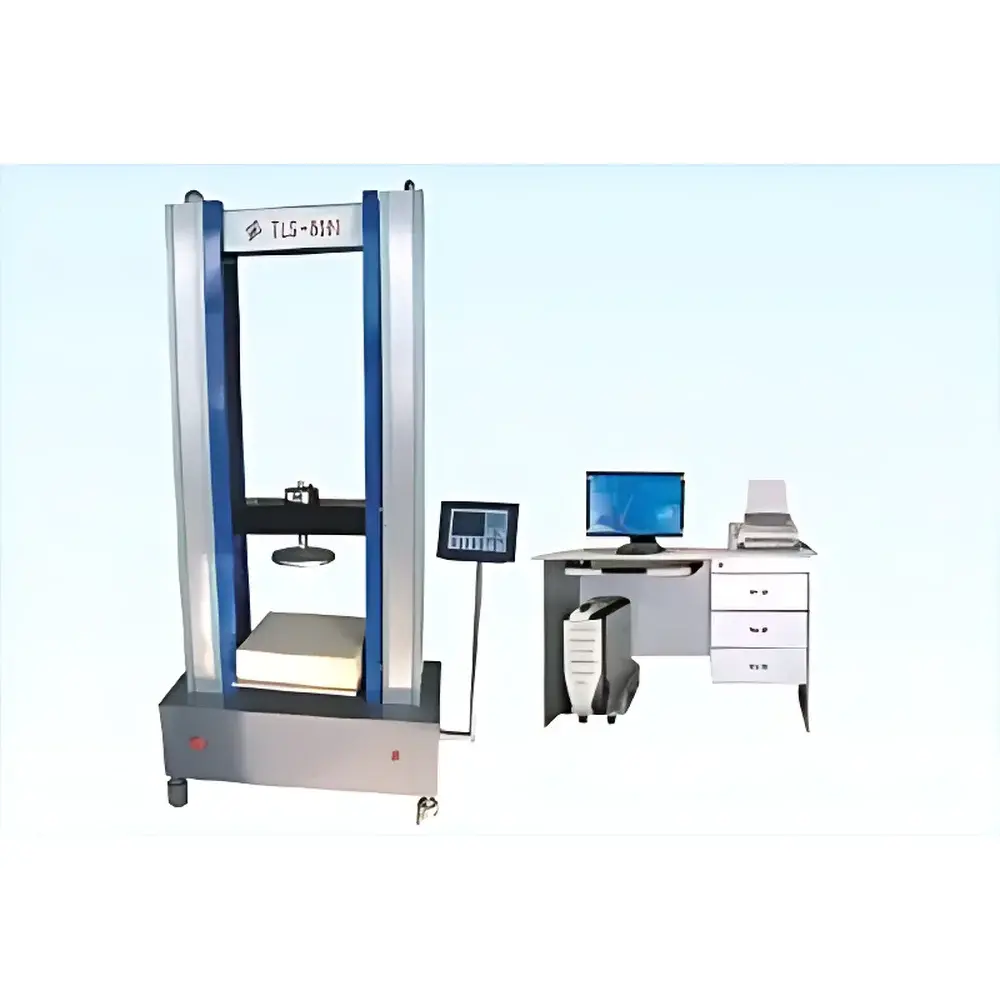
TLS-1KN Foam Compression and Tensile Testing Machine
| Origin | Jilin, China |
|---|---|
| Manufacturer Type | Authorized Distributor |
| Origin Category | Domestic (China) |
| Model | TLS-1KN |
| Pricing | Upon Request |
| Max Load Capacity | 1 kN |
| Force Accuracy | ±0.5% FS |
| Force Resolution | 0.1 N |
| Speed Range | 0.05–500 mm/min |
| Speed Accuracy | ±0.5% |
| Large-Deformation Measurement Range | 20–1000 mm |
| Large-Deformation Accuracy | ±0.5% |
| Crosshead Travel | 1000 mm |
| Displacement Accuracy | ±0.5% of reading |
| Effective Test Width | 550 mm |
| Indentor Diameter (for indentation hardness) | Φ200 mm |
| Support Plate Dimensions | 380 × 380 mm, with 6 mm diameter holes on 20 mm centers |
| Power Supply | AC 220 V, 1 kW |
Overview
The TLS-1KN Foam Compression and Tensile Testing Machine is an electromechanical universal testing system engineered for high-reproducibility mechanical characterization of flexible and rigid polymeric foam materials. It operates on the principle of controlled uniaxial force application—either in tension or compression—while precisely measuring load, displacement, and large-strain deformation. Designed to comply with core international standards for foam physical property evaluation—including ISO 2439 (indentation hardness), ASTM D3574 (flexible cellular materials), and GB/T 6669, GB/T 6344, and GB/T 10807—the instrument delivers traceable, auditable data suitable for R&D validation, QC release testing, and regulatory documentation under GLP/GMP frameworks.
Key Features
- Modular dual-mode testing capability: fully configurable for tensile, compressive, and indentation hardness protocols on a single platform.
- High-fidelity force measurement: integrated imported load cell with ±0.5% full-scale accuracy and 0.1 N resolution ensures reliable detection across low-force soft-foam regimes and higher-load rigid-foam transitions.
- Precision motion control: servo-driven dual-screw crosshead system enables programmable speed ranging from 0.05 to 500 mm/min, with ±0.5% speed fidelity and real-time digital position feedback.
- Large-deformation tracking: dedicated extensometer system (20–1000 mm range, ±0.5% accuracy) supports accurate elongation and permanent set calculation per GB/T 6669 and ISO 1856.
- Multi-parameter real-time acquisition: simultaneous capture of force, displacement, strain, stress, time, and derived metrics—including tensile strength, compressive modulus, indentation load deflection (ILD), and residual deformation.
- Intelligent safety architecture: hardware-enforced over-load, over-current, over-voltage, under-voltage, thermal, and mechanical limit protection; automatic stop upon specimen rupture.
- Dual-control interface: intuitive LCD control panel for manual operation plus PC-based software for automated test sequencing, parameter scripting, and method recall.
- Calibration traceability: electric auto-calibration routines for force and displacement channels using certified reference values; manual zeroing at any point during setup or execution.
Sample Compatibility & Compliance
The TLS-1KN accommodates standard foam geometries per ISO 2439 and ASTM D3574: rectangular slabs (e.g., 380 × 380 mm support plate with perforated grid), cylindrical specimens for tensile testing, and custom-cut samples up to 550 mm wide and 1000 mm tall. Its Φ200 mm spherical indenter and 380 × 380 mm vented base plate meet dimensional requirements for ILD, compression set, and hardness profiling. All test methods are pre-configured to align with ISO, ASTM, and Chinese national standards (GB/T), enabling direct compliance reporting. Data audit trails—including operator ID, timestamp, environmental notes, and calibration logs—support FDA 21 CFR Part 11 readiness when paired with validated software configurations.
Software & Data Management
The embedded Windows-based testing software provides full method definition, real-time curve visualization (force–displacement, stress–strain, load–time, etc.), and multi-curve overlay with color-coded differentiation. Users may select arbitrary regions for localized magnification, extract point-specific values, and perform post-test calculations (e.g., secant modulus, yield offset, recovery ratio). Reports export natively to editable .xlsx and .docx formats, preserving raw data integrity and metadata. All test parameters, results, curves, and system logs are automatically archived with time-stamped filenames and searchable indexing. Software supports user-level access control, electronic signatures, and change history logging—critical for regulated environments requiring ALCOA+ data governance principles.
Applications
- Indentation Load Deflection (ILD) testing of mattress and seating foams per ISO 2439 and ASTM D3574 Method A.
- Compression set evaluation (22 h/70 °C or 168 h/70 °C) per GB/T 6669 and ISO 1856 for automotive and packaging applications.
- Tensile property determination—including ultimate strength, elongation at break, and Young’s modulus—on flexible polyurethane and ethylene-propylene-diene monomer (EPDM) foams.
- Hardness profiling across density gradients in molded or slabstock foam batches.
- Quality conformance verification against internal specifications or customer technical agreements (e.g., OEM material release criteria).
- Accelerated aging studies where mechanical property retention is monitored before/after thermal or humidity exposure cycles.
FAQ
What foam standards does the TLS-1KN directly support?
It includes built-in test templates for ISO 2439, ASTM D3574 (Methods A–I), GB/T 6344, GB/T 6669, and GB/T 10807—with customizable pass/fail thresholds and reporting fields.
Can the system perform cyclic compression fatigue tests?
Yes—via programmable step sequences defining preload, dwell, compression stroke, hold time, and recovery phases; up to 999 cycles per run with cycle-count logging.
Is third-party calibration certification available?
Certified calibration services—including NIST-traceable force and displacement verification—are offered through authorized service partners with documented uncertainty budgets.
Does the software support LIMS integration?
Raw data exports (.csv, .xlsx) and metadata-rich XML reports enable seamless ingestion into common LIMS platforms via API or scheduled file transfer.
What maintenance is required for long-term accuracy?
Annual verification of load cell linearity, encoder resolution, and crosshead alignment is recommended; routine cleaning of guide rods and lubrication of screw assemblies every 6 months ensures mechanical stability.



