
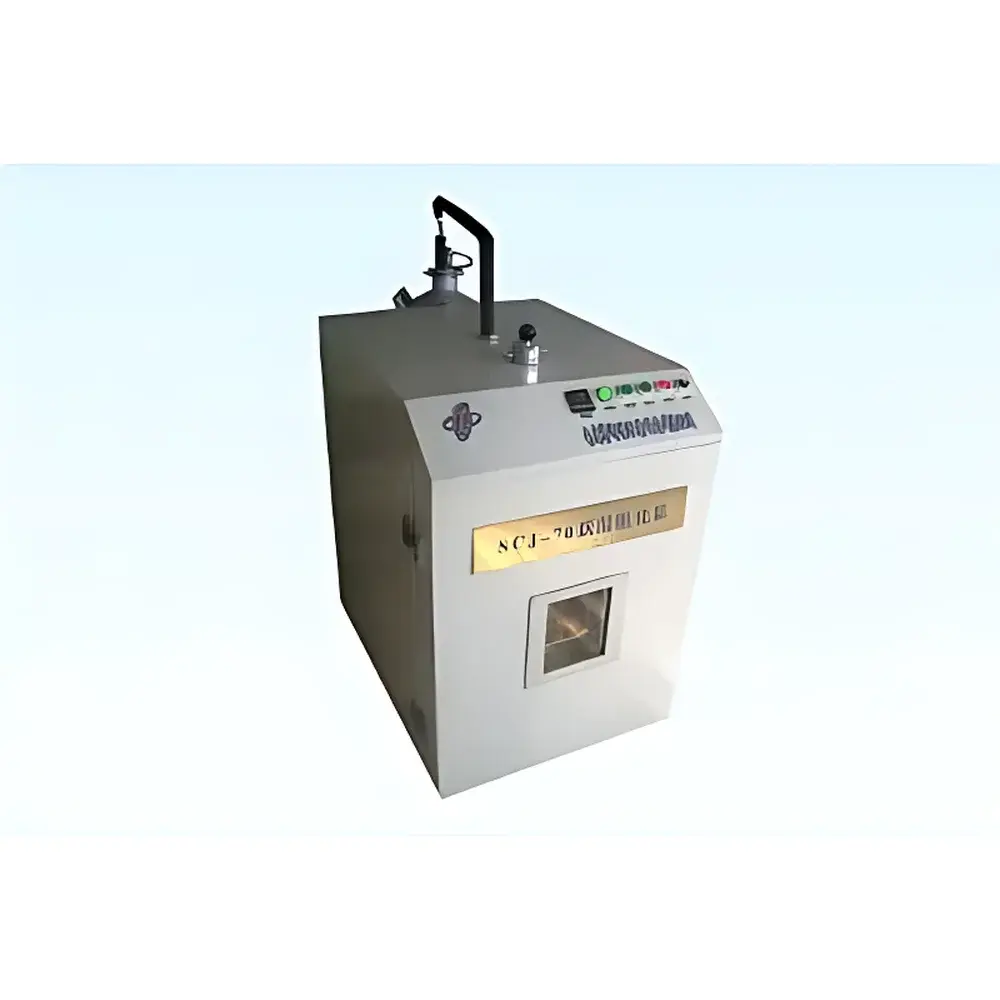
SCJ-70 Low-Temperature Embrittlement Tester
| Origin | Sichuan, China |
|---|---|
| Manufacturer Type | Authorized Distributor |
| Origin Category | Domestic (China) |
| Model | SCJ-70 |
| Pricing | Available Upon Request |
| Temperature Range | −70 °C to 0 °C |
| Temperature Control Accuracy | ±0.5 °C |
| Display Resolution | 0.1 °C |
| Hammer Blade Radius | 1.6 ± 0.1 mm |
| Impact Velocity | 200 ± 20 cm/s |
| Specimen Dimensions | 20 × 2.5 × 2.5 mm |
| Lower Jaw Arc Radius | 4.0 ± 0.1 mm |
| Clearance Between Blade Outer Edge and Clamp | 2.0 ± 0.1 mm |
| Distance from Impact Point to Clamp Centerline | 3.6 ± 0.1 mm |
Overview
The SCJ-70 Low-Temperature Embrittlement Tester is a precision mechanical impact apparatus engineered for the standardized determination of the brittle transition temperature (BTT) of soft polymeric materials—particularly automotive interior plastics—under controlled cryogenic conditions. It operates on the principle of Charpy-type impact testing adapted for low-temperature embrittlement evaluation: specimens are conditioned at progressively decreasing temperatures and subjected to a calibrated pendulum-driven hammer impact; the embrittlement temperature is statistically defined as the temperature at which 50% of tested specimens fracture under prescribed impact parameters. This methodology aligns with the fundamental thermomechanical concept that polymer chain mobility diminishes with cooling, leading to a reversible loss of ductility and an increase in fracture susceptibility. The instrument is explicitly designed to fulfill the procedural and metrological requirements of GB/T 5470–1985 (“Plastics—Determination of Brittle Temperature by Impact Method”), serving as a critical tool for quality assurance in Tier-1 automotive component supply chains and polymer formulation laboratories.
Key Features
- Stable cryogenic temperature control spanning −70 °C to 0 °C, achieved via dual-stage cascade refrigeration with PID-regulated immersion bath circulation;
- High-reproducibility impact mechanism featuring a gravity-accelerated pendulum system with precisely machined hardened steel hammer blade (radius 1.6 ± 0.1 mm) and kinematically defined release geometry;
- Real-time digital temperature monitoring with 0.1 °C resolution and verified uniformity (±0.5 °C) across specimen zone per ASTM E747 calibration practice;
- Dedicated specimen holder with precision-ground lower jaw (arc radius 4.0 ± 0.1 mm) ensuring consistent three-point bending support and minimizing stress concentration artifacts;
- Geometrically constrained impact alignment: fixed 2.0 ± 0.1 mm clearance between blade outer edge and clamp body, and exact 3.6 ± 0.1 mm offset between impact point and clamp centerline—both traceable to gauge-block verification;
- Compliance-ready mechanical design with non-volatile parameter logging capability for audit trail generation under GLP and internal QA protocols.
Sample Compatibility & Compliance
The SCJ-70 accommodates standard rectangular specimens measuring 20 mm × 2.5 mm × 2.5 mm (L × W × H), cut from molded or extruded thermoplastic elastomers (TPEs), PVC compounds, polyolefin blends, and other flexible automotive-grade polymers. Specimen conditioning follows strict thermal equilibration time requirements per GB/T 5470–1985 (minimum 5 min at target temperature). While GB/T 5470 remains the primary reference, the test principle is functionally equivalent to ISO 974 (“Plastics—Determination of Temperature of Embrittlement Under Impact Conditions”) and correlates with ASTM D746 (“Standard Test Method for脆性温度 of Plastics and Elastomers Under Impact”). Instrument configuration supports full traceability to national metrological standards via optional NIST-traceable thermometer calibration certificates and documented uncertainty budgets.
Software & Data Management
The SCJ-70 operates as a standalone electromechanical system with integrated digital temperature controller and impact event counter. No proprietary software is embedded; however, all operational parameters—including setpoint temperature, dwell time, impact count, and pass/fail outcome per specimen—are displayed on a high-contrast LCD interface and logged to internal memory (retention ≥ 1000 test records). Data export is supported via RS-232 serial interface to external PCs running validated laboratory data management systems (LDMS). When integrated into regulated environments (e.g., IATF 16949-certified facilities), the unit supports manual entry of operator ID, batch number, and environmental conditions—enabling linkage to electronic batch records compliant with FDA 21 CFR Part 11 when paired with appropriate audit-trail-enabled LDMS platforms.
Applications
- Validation of low-temperature performance limits for door trims, dashboard substrates, airbag covers, and seat foam laminates;
- Comparative evaluation of plasticizer efficacy and thermal stabilizer packages in PVC and TPO formulations;
- Supplier qualification testing per OEM specifications (e.g., GMW14124, Ford WSS-M99P1111-A, VW TL 52350);
- Root cause analysis of field failures occurring during winter operation or cold storage transport;
- Supporting material selection decisions during early-phase vehicle development (Phase 0–2) where BTT serves as a key gate criterion;
- Internal QC release testing for injection-molded components prior to shipment to assembly plants.
FAQ
What international standards does the SCJ-70 directly support?
The instrument is configured and validated to meet GB/T 5470–1985. Its test methodology is technically aligned with ISO 974 and ASTM D746, though formal compliance with those standards requires verification of ancillary procedures (e.g., specimen preparation, conditioning time) per respective clauses.
Is calibration certification included with delivery?
A factory calibration report covering temperature uniformity, impact velocity verification, and dimensional inspection of critical tooling (blade, jaws, spacers) is supplied. NIST-traceable calibration certificates are available as an optional add-on.
Can the SCJ-70 be used for non-automotive polymers?
Yes—any flexible polymeric material exhibiting a measurable ductile-to-brittle transition within −70 °C to 0 °C may be evaluated, including medical tubing compounds, wire insulation grades, and packaging films—provided specimen geometry and clamping constraints are respected.
What maintenance intervals are recommended?
Refrigeration oil and filter replacement every 12 months; annual verification of pendulum moment of inertia and blade geometry using certified gauges; biannual recalibration of temperature sensors against reference PRTs.



