
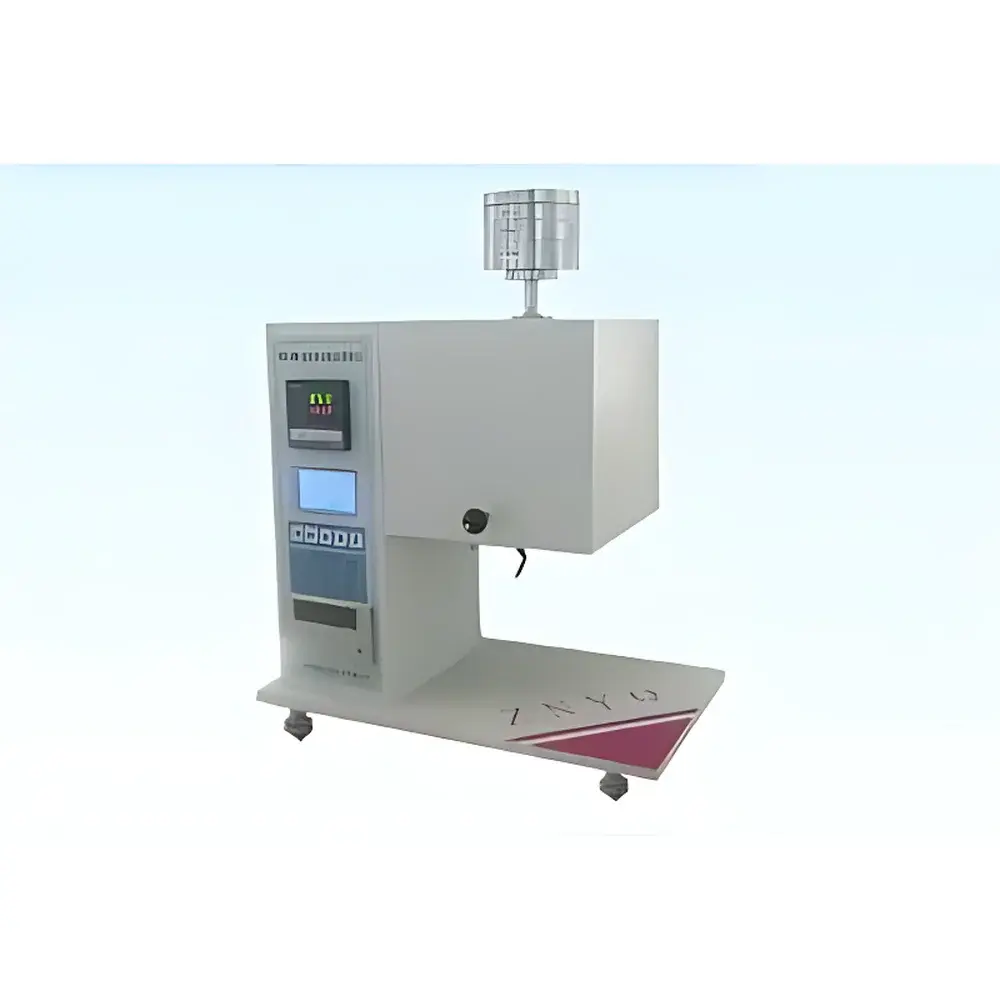
Shenzhen Ruiyao SRZ-400C Melt Flow Rate Tester (MFR Tester) for Thermoplastic Polymers
| Origin | Jilin, China |
|---|---|
| Manufacturer Type | Authorized Distributor |
| Origin Category | Domestic (China-Made) |
| Model | SRZ-400C |
| Pricing | Available Upon Request |
| Cylinder Bore Diameter | 9.550 ± 0.025 mm |
| Piston Head Diameter | 9.475 ± 0.015 mm |
| Piston Head Length | 6.35 ± 0.1 mm |
| Die Capillary Diameter | 2.095 ± 0.005 mm |
| Temperature Range | 80–400 °C |
| Temperature Accuracy | ±0.2 °C |
| Temperature Resolution | 0.1 °C |
| Maximum Power Consumption | <500 W |
| Temperature Recovery Time | ≤4 min |
| Stroke Detection Interval | 30 mm |
| Position Control Accuracy | ±0.1 mm |
| Net Weight | 50 kg |
Overview
The Shenzhen Ruiyao SRZ-400C Melt Flow Rate Tester is a precision-controlled, microprocessor-driven instrument engineered for the standardized determination of melt mass-flow rate (MFR) and melt volume-flow rate (MVR) of thermoplastic polymers under defined load and temperature conditions. It operates in strict accordance with ISO 1133-1:2011 (Plastics — Determination of the melt mass-flow rate (MFR) and melt volume-flow rate (MVR) of thermoplastics) and ASTM D1238 (Standard Test Method for Melt Flow Rates of Thermoplastics by Extrusion Plastometer), as well as GB/T 3682.1–2018 (equivalent to ISO 1133-1). The device employs the gravimetric extrusion principle: polymer granules or pellets are loaded into a heated barrel, melted under controlled temperature and applied piston load, and extruded through a standardized capillary die; the mass of extrudate collected over a fixed time interval is used to calculate MFR (g/10 min), while optional volumetric measurement enables MVR (cm³/10 min) derivation via calibrated piston displacement tracking.
Key Features
- High-stability temperature control system with dual-zone heating and PID algorithm, maintaining ±0.2 °C accuracy across the full 80–400 °C operating range — critical for reproducible rheological behavior assessment of high-melting-point resins such as polyetheretherketone (PEEK) and polyphenylene sulfide (PPS).
- Precision-machined test components compliant with ISO 1133 geometric tolerances: cylinder bore (9.550 ± 0.025 mm), piston head (9.475 ± 0.015 mm), and capillary die (2.095 ± 0.005 mm), ensuring minimal wall-slip error and laminar flow consistency.
- Automated cut-off mechanism synchronized with real-time position sensing (±0.1 mm resolution over 30 mm stroke), enabling precise timing of extrudate collection intervals without manual intervention.
- Integrated thermal recovery optimization: achieves <4-minute return to setpoint after load change or sample insertion — essential for high-throughput QC laboratories performing sequential multi-condition tests.
- Embedded microprocessor with built-in data logging, automatic calculation of MFR/MVR, and direct thermal printing of test reports including date/time stamp, test parameters (load, temperature, duration), and raw mass values.
- Voice-guided operation interface and bundled instructional software (Windows-compatible) support rapid operator onboarding and reduce procedural variability in GLP-compliant environments.
Sample Compatibility & Compliance
The SRZ-400C is validated for use with a broad spectrum of commodity and engineering thermoplastics, including but not limited to polyethylene (PE), polypropylene (PP), polystyrene (PS), acrylonitrile-butadiene-styrene (ABS), polyamide (PA6, PA66), polyacetal (POM), polytetrafluoroethylene (PTFE), poly(methyl methacrylate) (PMMA), and polycarbonate (PC). All mechanical dimensions and thermal performance metrics conform to the dimensional and metrological requirements specified in ISO 1133-1 Annex A and ASTM D1238 Annex A. The instrument supports standard test loads ranging from 2.16 kg to 21.6 kg (via optional weight kits) and accommodates both single- and multi-step temperature ramping protocols required for comparative thermal stability analysis.
Software & Data Management
Data output is structured in ASCII text format compatible with LIMS integration and statistical process control (SPC) platforms. Each printed report includes unique test ID, operator ID (manually entered), environmental ambient temperature/humidity (if externally logged), and digital signature fields for QA review. While the base unit does not include FDA 21 CFR Part 11-compliant electronic signatures, its audit trail functionality — including timestamped parameter changes, calibration history, and error logs — satisfies core GLP documentation requirements for regulated polymer manufacturing facilities. Optional USB export enables traceable archival in accordance with ISO/IEC 17025 clause 7.5.2 (Control of records).
Applications
This instrument serves as a primary quality control tool in polymer production plants, compounders, and third-party testing labs for batch release verification, raw material screening, degradation monitoring (e.g., post-extrusion MFR shift), and formulation development. Its repeatability (RSD <1.5% per ISO 1133 repeatability criteria) supports specification conformance testing per customer technical data sheets (TDS) and industry standards such as UL 94, IEC 60695, and automotive OEM material specifications (e.g., GMW16219, Ford WSS-M99P1111-A). In R&D settings, it facilitates correlation studies between MFR and mechanical properties (tensile strength, impact resistance) and aids in processing window definition for injection molding and extrusion processes.
FAQ
Does the SRZ-400C comply with ISO 1133-1:2011 and ASTM D1238?
Yes — all critical hardware dimensions (barrel, piston, die), temperature uniformity, and timing mechanisms meet the mandatory requirements of both standards.
Can the instrument measure both MFR and MVR simultaneously?
MFR is measured gravimetrically by default; MVR requires optional piston displacement encoder integration and is calculated using cross-sectional area and displacement rate.
What is the recommended calibration frequency for routine QC use?
Per ISO/IEC 17025, temperature sensors and mass measurement subsystems should be verified at least daily prior to first test, with full calibration traceable to NIST or CNAS-accredited labs performed every six months.
Is the die capillary supplied with certified dimensional validation data?
Each SRZ-400C shipment includes a manufacturer’s certificate of conformance listing actual measured die diameter (2.095 ± 0.005 mm) and surface roughness (Ra ≤ 0.4 µm), verified via coordinate measuring machine (CMM).
Can the device operate unattended for extended periods?
Yes — automated cut-off, thermal stabilization monitoring, and fault detection (e.g., jamming, overheating) enable safe overnight operation when configured with appropriate safety enclosures and ventilation.



