
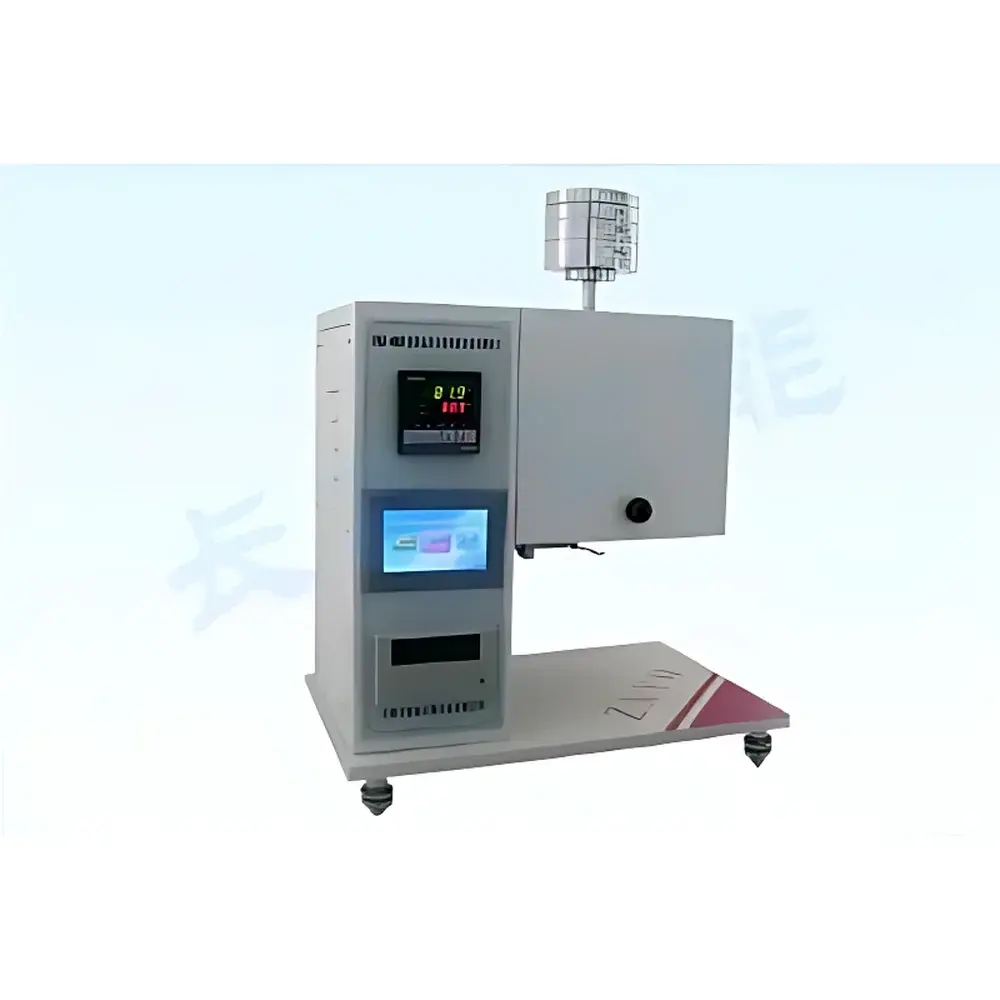
SRZ-400D Melt Flow Rate Tester
| Origin | Jilin, China |
|---|---|
| Manufacturer Type | Authorized Distributor |
| Origin Category | Domestic (China) |
| Model | SRZ-400C |
| Pricing | Available Upon Request |
| Compliance | GB/T 3682–2000 Method A, ISO 1133:1997 |
| Temperature Range | 80–400 °C |
| Temperature Accuracy | ±0.2 °C |
| Temperature Resolution | 0.1 °C |
| Barrel Bore Diameter | 9.550 ± 0.025 mm |
| Piston Head Diameter | 9.475 ± 0.015 mm |
| Piston Head Length | 6.35 ± 0.1 mm |
| Die Capillary Diameter | 2.095 ± 0.005 mm |
| Position Sensing Interval | 30 mm |
| Position Control Accuracy | ±0.1 mm |
| Max Power Consumption | < 500 W |
| Temperature Recovery Time | ≤ 4 min |
Overview
The SRZ-400D Melt Flow Rate Tester is a precision-controlled, microprocessor-driven instrument engineered for the standardized determination of melt mass-flow rate (MFR) and melt volume-flow rate (MVR) of thermoplastic polymers in accordance with GB/T 3682–2000 (Method A) and ISO 1133:1997. It operates on the fundamental principle of extrusion plastometry: a precisely dimensioned polymer sample is loaded into a heated barrel, melted under controlled temperature and load conditions, and extruded through a standardized capillary die. The mass or volume of extrudate collected over a defined time interval is used to calculate flow rate—expressed in g/10 min (MFR) or cm³/10 min (MVR). This gravimetric/volumetric measurement serves as a critical quality control parameter for raw material consistency, process stability, and batch-to-batch comparability across polyolefin, engineering plastic, and high-performance resin production.
Key Features
- Integrated microprocessor-based control system with real-time PID temperature regulation and closed-loop feedback for thermal stability
- High-precision machined components: barrel bore (Ø9.550 ± 0.025 mm), piston head (Ø9.475 ± 0.015 mm, length 6.35 ± 0.1 mm), and capillary die (Ø2.095 ± 0.005 mm) fully compliant with ISO 1133 geometric tolerances
- Wide operational temperature range from 80 °C to 400 °C with ±0.2 °C accuracy and 0.1 °C digital resolution—suitable for low-melt PE and high-thermal-stability fluoropolymers alike
- Automated timing and cut-off mechanism synchronized with position sensing (30 mm travel interval, ±0.1 mm repeatability) to ensure consistent specimen extrusion duration
- Backlit LCD interface with native Chinese-language menu navigation, eliminating language barriers during routine lab operation
- Integrated thermal recovery optimization: full stabilization within ≤4 minutes after load change or temperature step, minimizing downtime between tests
- Low-power architecture (<500 W max) designed for continuous operation in QC laboratories without requiring dedicated circuitry
Sample Compatibility & Compliance
The SRZ-400D supports standardized testing of a broad spectrum of thermoplastic resins including polyethylene (PE), polypropylene (PP), polystyrene (PS), acrylonitrile-butadiene-styrene (ABS), polyamide (PA), acrylic resins, polyoxymethylene (POM), fluoroplastics (e.g., PTFE, FEP), and polycarbonate (PC). All mechanical dimensions and thermal performance parameters are traceably aligned with ISO 1133:1997 Annex A (capillary rheometry) and GB/T 3682–2000 Method A (gravimetric MFR). While not inherently 21 CFR Part 11-compliant due to its embedded controller architecture, the instrument’s deterministic test sequence, fixed calibration intervals, and auditable manual data recording support GLP-aligned documentation practices in regulated manufacturing environments.
Software & Data Management
The SRZ-400D operates via an embedded firmware platform with no external PC dependency. Test parameters—including temperature setpoint, preheat duration, load selection (e.g., 2.16 kg, 5.00 kg), and cut-off interval—are configured directly on the front-panel interface. Results are displayed in real time and automatically printed via integrated thermal printer (optional configuration). Raw mass values, timestamps, and operator inputs are retained in non-volatile memory for up to 100 test records. For enterprise-level integration, ASCII-formatted printout logs may be manually transcribed into LIMS or Excel-based QA databases. Future firmware updates (via USB port) may introduce CSV export capability and enhanced audit trail metadata—subject to regional regulatory validation requirements.
Applications
- Raw material acceptance testing per supplier specifications and internal technical agreements
- In-process monitoring of polymer degradation during compounding, extrusion, or injection molding
- Correlation of MFR with molecular weight distribution (MWD) trends in R&D labs using reference standards
- Batch release verification in ISO 9001-certified plastics manufacturing facilities
- Technical service support for troubleshooting flow-related processing defects (e.g., melt fracture, die swell inconsistency)
- Educational use in polymer science curricula for hands-on demonstration of rheological behavior under shear
FAQ
Does the SRZ-400D support both MFR and MVR measurements?
Yes—by combining timed extrudate mass collection with piston displacement tracking, the instrument enables calculation of both melt mass-flow rate (g/10 min) and melt volume-flow rate (cm³/10 min) per ISO 1133 Clause 6.
Is calibration traceable to national metrology institutes?
The unit ships with factory calibration certificates for temperature sensors (PT100) and mechanical dimensions; end-user recalibration must follow ISO 1133 Annex B procedures using NIST-traceable weights and certified reference materials.
Can the device accommodate alternative loads beyond standard 2.16 kg and 5.00 kg?
Mechanically compatible with optional load masses (e.g., 1.20 kg, 10.00 kg) provided they conform to ISO 1133 dimensional and tolerance requirements and are validated for thermal expansion effects at elevated temperatures.
What maintenance intervals are recommended for long-term accuracy?
Barrel and die cleaning after every 5–10 tests using brass brushes and high-purity xylene; annual verification of piston concentricity and barrel roundness by qualified metrology service provider.
Is the thermal printer included as standard equipment?
Thermal printing is available as a factory-configured option; units shipped without printer require manual data entry into external QA systems.
Related Products







