
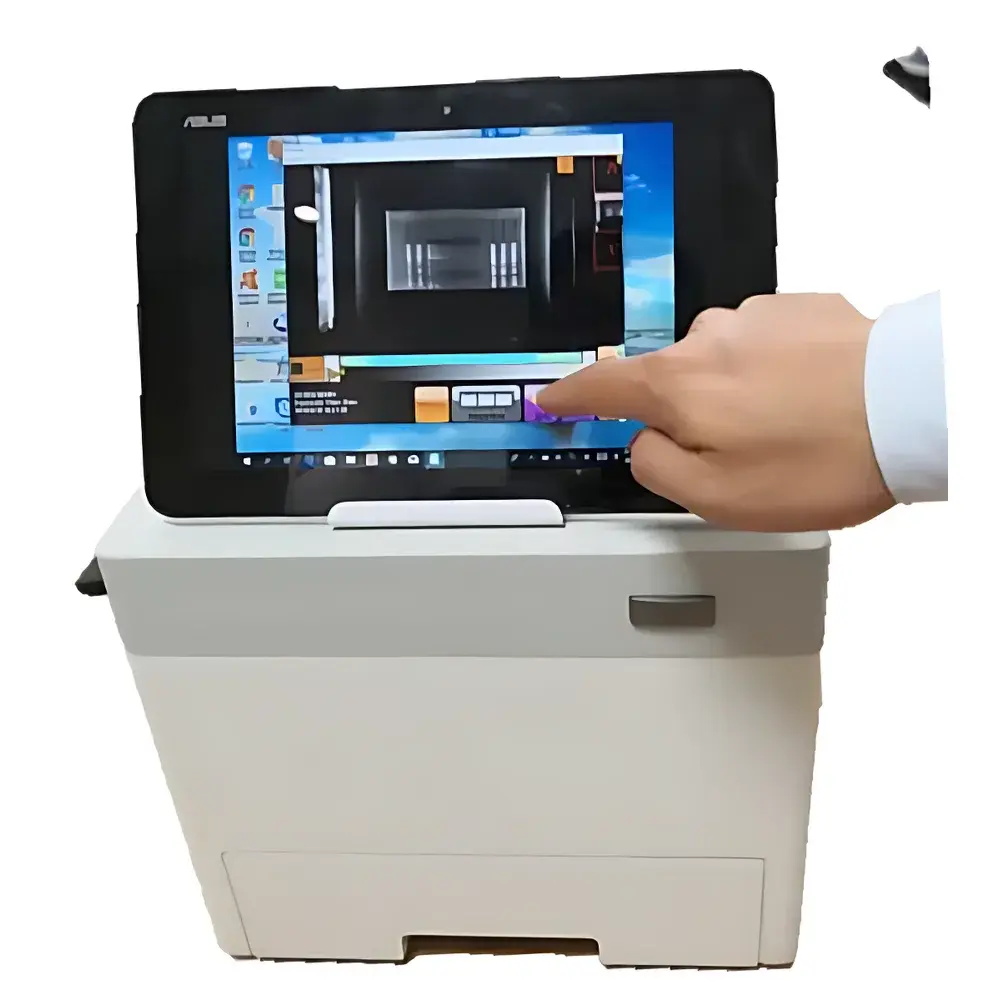
PacificImage Glite 600UV/BW Gel Documentation System
| Brand | PacificImage |
|---|---|
| Origin | Taiwan |
| Model | Glite 600UV/BW |
| Instrument Type | Semi-Automatic Western Blotting & Gel Imaging System |
| Camera | Starlight-grade CMOS, 6 MP (3096 × 2080) |
| Bit Depth | 8/16-bit output |
| Exposure Time | 5 ms – 10 s |
| Excitation Sources | UV (302 nm), Blue LED (470 nm), White LED (optional) |
| Imaging Area | 13 × 18 cm |
| Filter Holder | Manual dual-slot |
| Emission Filter | 620 nm bandpass amber filter |
| Operating System | Windows 7/8/10 |
| Image Formats | TIFF, JPEG, BMP |
| Interface | USB 3.0 |
| Dimensions (W×H×D) | 300 × 260 × 257 mm |
| Weight | 10 kg |
Overview
The PacificImage Glite 600UV/BW Gel Documentation System is a compact, benchtop-grade imaging platform engineered for high-fidelity visualization and documentation of nucleic acid gels and protein blots under multiple excitation wavelengths. It operates on the principle of fluorescence emission detection: nucleic acid dyes (e.g., ethidium bromide, GelRed, SYPRO Safe) or chromogenic substrates (e.g., DAB, HRP-conjugated antibodies, Coomassie Blue) absorb specific wavelengths—UV (302 nm), blue light (470 nm), or visible white light—and re-emit photons at longer wavelengths, which are captured by a starlight-grade 6-megapixel CMOS sensor with 16-bit dynamic range. The system’s fixed-focus optical architecture eliminates manual focusing drift, ensuring consistent spatial resolution across repeated acquisitions. Its 13 × 18 cm imaging chamber accommodates standard mini-gels (e.g., 10 × 10 cm) and blot membranes without cropping, while the integrated 620 nm bandpass amber filter selectively transmits emitted fluorescence while blocking excitation bleed-through—critical for signal-to-noise optimization in low-abundance band detection.
Key Features
- Multi-modal excitation capability: Interchangeable UV (302 nm), blue LED (470 nm), and optional white LED sources enable universal compatibility with legacy and next-generation stains—including EtBr, GelGreen, GelRed, SYPRO Ruby, and Coomassie-based protocols.
- Magnetic filter insertion mechanism: Allows rapid, tool-free swapping of emission filters; dual-slot manual holder supports sequential acquisition with different filters for comparative analysis.
- Auto-shutoff safety logic: UV and blue light sources deactivate automatically upon lid opening, meeting IEC 61010-1 Class II laser product safety requirements for enclosed imaging cabinets.
- Drawer-style sample tray: Enables one-handed gel placement and precise excision of bands under illumination—minimizing UV exposure time and improving workflow ergonomics.
- USB 3.0–enabled image acquisition: Direct connection to Windows 7/8/10 laptops or desktops; no external frame grabber or driver installation required.
- Fixed-focus optics with calibrated field uniformity: Eliminates focus calibration drift between sessions, supporting longitudinal studies where inter-run reproducibility is essential.
Sample Compatibility & Compliance
The Glite 600UV/BW supports routine applications across molecular biology and protein biochemistry workflows, including agarose and polyacrylamide gel electrophoresis (PAGE), Southern/Northern blotting, and chemiluminescent or chromogenic Western blot detection. It complies with ISO/IEC 17025–recommended practices for imaging system validation in accredited laboratories and meets general electrical safety standards per IEC 61010-1. While not FDA 21 CFR Part 11–certified out-of-the-box, its TIFF/JPEG/BMP export formats and timestamped metadata support GLP-compliant recordkeeping when integrated into validated lab information management systems (LIMS). The system is routinely deployed in academic core facilities, biotech QC labs, and contract research organizations performing method development for nucleic acid quantification and protein expression profiling.
Software & Data Management
Acquisition and basic analysis are performed via PacificImage’s native Windows application, which provides real-time histogram preview, auto-exposure adjustment, background subtraction, and region-of-interest (ROI) intensity quantification. All images are saved with embedded EXIF metadata—including exposure duration, bit depth, excitation source, and filter ID—ensuring traceability. Export options include lossless TIFF (for publication-grade figures), compressed JPEG (for rapid sharing), and BMP (for legacy software compatibility). The software does not include advanced statistical modeling or AI-based band detection; however, exported 16-bit TIFF files are fully compatible with third-party analysis platforms such as ImageJ/Fiji, TotalLab Quant, or AlphaView SA—enabling integration into established data processing pipelines compliant with ISO 13485 or CLIA guidelines where applicable.
Applications
- Quantitative assessment of PCR products, restriction digests, and RNA integrity on agarose gels using EtBr or safer alternatives (e.g., GelRed).
- Detection of low-abundance proteins in SDS-PAGE gels stained with Coomassie Brilliant Blue R-250 or silver nitrate.
- Documentation of chemiluminescent Western blots developed with HRP–DAB or enhanced chemiluminescence (ECL) substrates under white-light illumination.
- Validation of CRISPR editing efficiency via T7E1 or Surveyor nuclease assays visualized with blue-light–compatible dyes.
- Teaching laboratory use: Compact footprint (300 × 260 × 257 mm) and intuitive interface reduce training overhead for undergraduate and graduate students.
FAQ
Is the Glite 600UV/BW suitable for chemiluminescent Western blot imaging?
Yes—when equipped with the optional white LED module, it captures high-contrast images of HRP–DAB–stained membranes and supports semi-quantitative densitometry of bands.
Can I use this system for SYBR Gold-stained gels?
Yes—SYBR Gold exhibits strong excitation at 302 nm; the Glite 600UV configuration delivers optimal sensitivity for this dye.
Does the camera support live preview during exposure setup?
Yes—the software provides real-time histogram and luminance preview at adjustable gain levels prior to final acquisition.
Is remote operation possible via network connection?
No—the system connects exclusively via USB 3.0 and requires direct host PC attachment; network streaming or cloud upload is not supported.
What maintenance is required for long-term optical performance?
Annual verification of UV lamp intensity (using NIST-traceable radiometer) and periodic cleaning of the emission filter surface with lens-grade isopropyl alcohol are recommended per manufacturer guidelines.




