
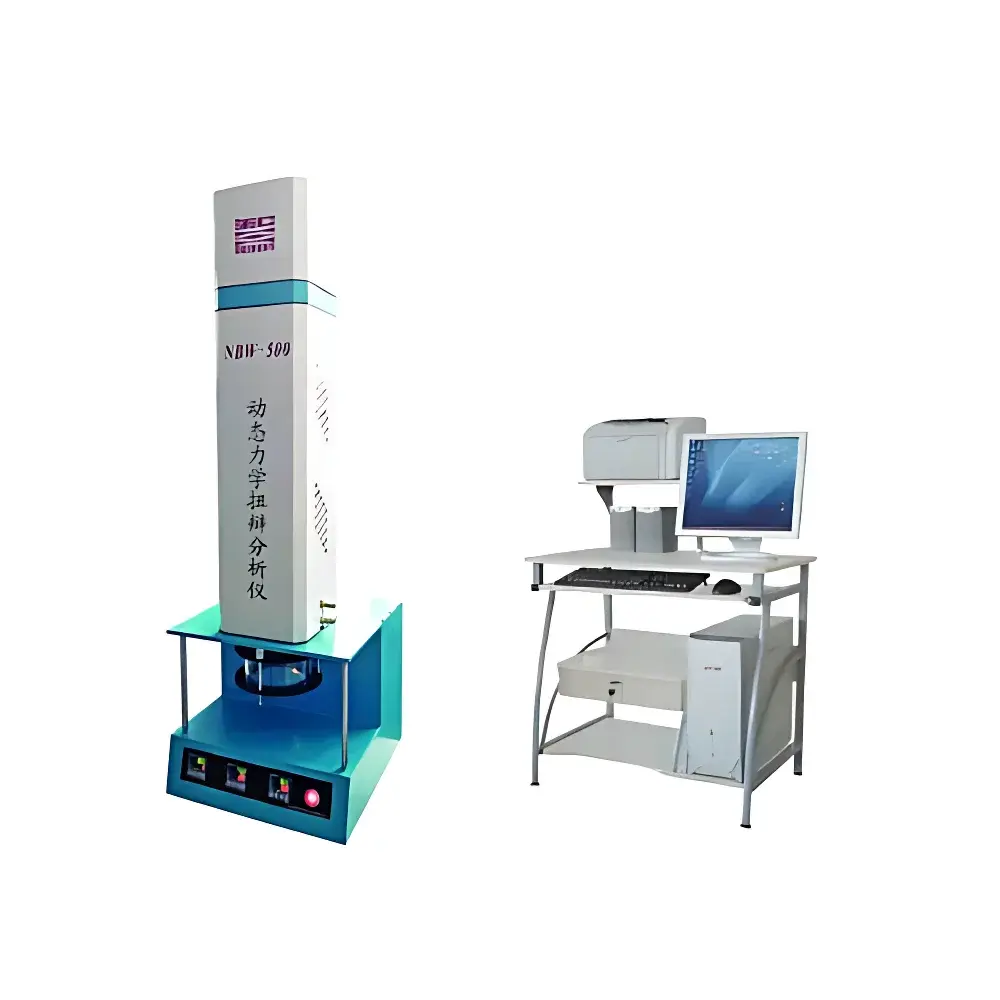
Changchun Intelligent NBW-500 Dynamic Mechanical Torsional Braid Analyzer
| Brand | Changchun Intelligent |
|---|---|
| Origin | Jilin, China |
| Manufacturer Type | Authorized Distributor |
| Country of Origin | China |
| Model | NBW-500 |
| Motor Power | 0.5 kW |
| Temperature Range | −120 °C to 500 °C |
| Heating Rate | 2 ± 1 °C/min |
| Time Measurement Range | 0.01–9999.99 s |
| Torsional Amplitude Range | 30°–60° |
| Angular Displacement Detection | Optical Encoder-Based |
| Accuracy Class | Grade 1 |
Overview
The Changchun Intelligent NBW-500 Dynamic Mechanical Torsional Braid Analyzer (TBA) is a precision instrument engineered for the characterization of viscoelastic behavior in polymeric and composite materials under controlled thermal conditions. It operates on the torsional braid analysis principle—a well-established dynamic mechanical technique standardized in ASTM D4092 and referenced in ISO 6721-4 for measuring storage modulus (G′), loss modulus (G″), and mechanical loss tangent (tan δ) as functions of temperature and time. Unlike conventional oscillatory rheometers or dynamic mechanical analyzers (DMA), the TBA method employs a minimal sample mass (typically < 0.1 g) mounted as a twisted glass-fiber braid—enabling high sensitivity to subtle transitions such as glass transition (Tg), secondary relaxations (β, γ), crystalline phase changes, melting events, and viscoelastic flow onset. The NBW-500 integrates digital servo control, optical angular displacement sensing, and multi-channel thermal management to deliver reproducible, traceable data across an extended temperature range from −120 °C to 500 °C.
Key Features
- Wide operational temperature range: −120 °C to 500 °C, achieved via integrated resistive heating and cryogenic refrigeration circuits with active thermal shielding
- Precision temperature ramping at 2 ± 1 °C/min, compliant with ASTM D4092 protocol requirements for standardized TBA testing
- Optical encoder-based angular displacement detection system with resolution down to 0.01°, enabling accurate measurement of free-decay torsional amplitude (θ), period (P), damping decrement (Δ), and derived modulus G′ ∝ 1/P²
- Dedicated torsional braid fixture: stainless-steel test tube with coaxial thermal jacketing, motor-driven starter rod, and magnetically coupled inertial disc assembly ensuring low-friction, repeatable initiation of free vibration
- Embedded three-channel thermocouple monitoring (sample zone, furnace wall, ambient reference) with real-time PID feedback control
- Integrated 0.5 kW stepping motor drive system with programmable torque initiation and synchronized optical triggering
- Grade 1 accuracy per JJG 501–2018 (Chinese national metrological verification regulation for dynamic mechanical analyzers)
Sample Compatibility & Compliance
The NBW-500 is optimized for fibrous or filamentous samples prepared as 200 mm twisted braids—typically composed of E-glass fibers impregnated with polymer resin, cured films, or thermoplastic filaments. Its minimal sample requirement makes it suitable for R&D labs working with limited material batches or high-value specialty polymers. The system supports compliance workflows aligned with GLP (Good Laboratory Practice) and pre-qualification for GMP environments: all thermal and angular measurements are timestamped, digitally logged, and stored with audit-trail metadata. While not inherently 21 CFR Part 11 compliant out-of-the-box, the software architecture supports configuration for electronic signature, user access levels, and data integrity controls when deployed with validated IT infrastructure.
Software & Data Management
The proprietary TBA Control & Analysis Suite runs on Windows-based industrial PCs (supplied with清华同方 hardware) and provides full sequence automation—from thermal equilibration and braid excitation to decay capture and modulus derivation. Raw sensor data (angular position vs. time, temperature vs. time) are acquired at ≥1 kHz sampling rate and stored in binary format with embedded calibration coefficients. Post-processing modules compute G′, G″, tan δ, activation energy (via Arrhenius or WLF fitting), and transition onset/peak temperatures using standard algorithms consistent with ISO 6721-4 Annex A. Export options include CSV, XML, and PDF reports with customizable templates for internal documentation or regulatory submission. All data files include embedded instrument ID, operator tag, and environmental context—facilitating traceability in multi-user academic or industrial QA/QC settings.
Applications
- Characterization of glass transition temperature (Tg) and breadth in thermosets, epoxies, and crosslinked elastomers
- Monitoring cure kinetics and degree of crosslinking in resin systems during thermal treatment
- Detection of secondary relaxations associated with side-chain mobility or local segmental motion
- Evaluation of thermal stability and degradation onset in high-performance polymers (e.g., polyimides, PEEK)
- Comparative analysis of filler dispersion effects in fiber-reinforced composites
- Supporting material selection for aerospace, packaging, and currency substrate applications—validated by users including Northeast Forestry University, South China Normal University, and Chengdu Banknote Printing Co., Ltd.
FAQ
What sample preparation is required for TBA testing?
Standard specimens consist of a 200 mm braid formed from 10–15 strands of 10–13 µm diameter E-glass fiber, uniformly impregnated with the test polymer. Detailed preparation guidelines—including twist density, resin loading, and curing protocols—are provided in the ASTM D4092 annex.
Is liquid nitrogen required for sub-ambient operation?
Yes. The −120 °C lower limit requires external LN2 supply connected via vacuum-jacketed transfer line. The system includes automated LN2 level monitoring and safety interlocks.
Can the NBW-500 perform forced oscillation tests?
No. It is designed exclusively for free-decay torsional braid analysis per ASTM D4092. Forced oscillation DMA capabilities require separate instrumentation.
How is calibration verified?
Factory calibration includes reference measurements using NIST-traceable temperature standards and certified inertial discs. Users perform routine verification using supplied calibration braids and documented amplitude/period check points.
What maintenance is recommended?
Biannual inspection of optical encoder alignment, thermocouple drift validation, and lubrication of magnetic coupling surfaces. No consumables beyond replacement braids and LN2 are required under normal operation.



