
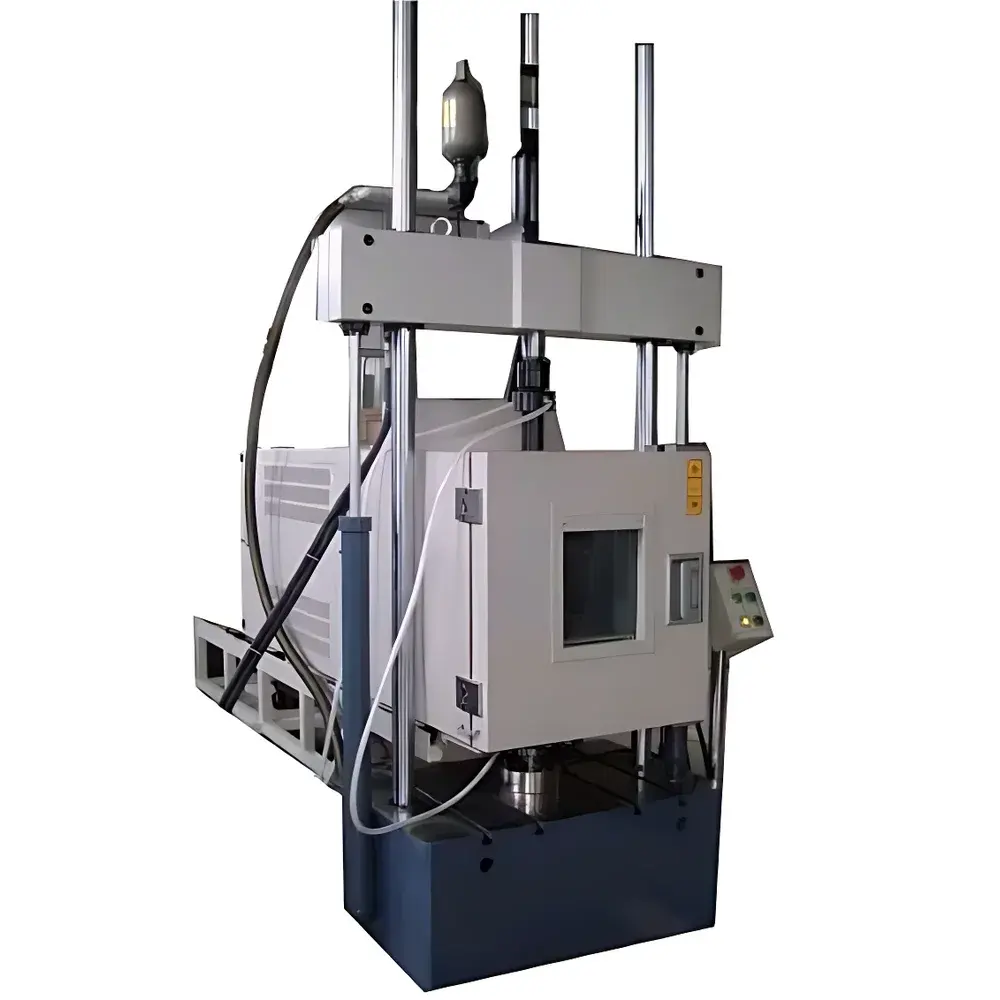
DJW-50KN Electro-Mechanical Dynamic and Static Stiffness & Fatigue Testing Machine
| Origin | Jilin, China |
|---|---|
| Manufacturer Type | Authorized Distributor |
| Origin Category | Domestic (China) |
| Model | DJW-50KN |
| Quotation | Available Upon Request |
| Static Tensile Load Range | 0–50 kN |
| Static Compressive Load Range | 0–50 kN |
| Load Accuracy | ≤ ±1% FS |
| Displacement Measurement Range (Tension) | 0.05–1000 mm |
| Displacement Measurement Range (Compression) | 0.05–500 mm |
| Deformation Measurement Range (Compression) | 0–100 mm |
| Crosshead Speed Range | 0.2–500 mm/min |
| Specimen Diameter Compatibility | 20–400 mm |
| Optional Extensometer | High-Accuracy Large-Deformation Extensometer |
Overview
The DJW-50KN Electro-Mechanical Dynamic and Static Stiffness & Fatigue Testing Machine is a dual-mode mechanical testing system engineered for precise quantification of static stiffness, dynamic stiffness, and cyclic fatigue behavior in elastomeric and viscoelastic materials—particularly vulcanized rubber compounds, polyurethane bushings, automotive mounts, and vibration-damping components. Operating on a servo-controlled electromechanical actuation principle, the system applies controlled uniaxial tensile or compressive loads while synchronously measuring force, displacement, and (optionally) strain via high-resolution transducers and encoder-based motion feedback. Unlike hydraulic systems, its electro-mechanical architecture delivers superior low-speed stability, repeatable waveform fidelity in sinusoidal or block-loading profiles, and inherent compatibility with ISO 527, ASTM D412, ASTM D3574, and ISO 4664-1 test protocols for rubber elasticity and fatigue resistance.
Key Features
- Integrated dual-mode control architecture supporting both static quasi-static testing (tension/compression) and dynamic fatigue testing (sinusoidal, triangular, or user-defined waveforms) within a single platform.
- High-fidelity load cell with 50 kN capacity and ≤ ±1% full-scale accuracy, calibrated per ISO 7500-1 Class 1 requirements.
- Precision ball-screw-driven crosshead with closed-loop position control, enabling smooth speed regulation from 0.2 to 500 mm/min and sub-micron displacement resolution.
- Dual-range displacement sensing: extended travel (0.05–1000 mm) for tensile elongation studies; high-resolution compression range (0.05–500 mm) with dedicated 0–100 mm deformation measurement channel optimized for small-strain hysteresis analysis.
- Modular fixture interface accommodating cylindrical specimens from 20 mm to 400 mm in diameter—suitable for standard rubber pads, isolators, and custom-engineered elastomer assemblies.
- Optional large-deformation extensometer compliant with ASTM E83 Class B-1 specifications, enabling direct strain measurement independent of machine compliance—critical for accurate modulus derivation at large strains (>50%).
Sample Compatibility & Compliance
The DJW-50KN is validated for use with vulcanized natural rubber (NR), styrene-butadiene rubber (SBR), nitrile rubber (NBR), ethylene propylene diene monomer (EPDM), and thermoplastic elastomers (TPEs). Its mechanical design satisfies structural rigidity requirements outlined in ISO 2041 (vibration and shock—vocabulary) and supports test execution under ambient laboratory conditions (15–30 °C, RH ≤ 80%). All force and displacement data acquisition meets traceability standards aligned with ISO/IEC 17025:2017 for testing laboratories. The system’s control firmware enables audit-ready test logging—including operator ID, timestamp, environmental metadata, and raw sensor timestamps—at configurable intervals (10 Hz to 1 kHz), facilitating GLP-compliant reporting and FDA 21 CFR Part 11–compatible electronic records when deployed with validated software modules.
Software & Data Management
The system operates under a Windows-based test controller application with real-time graphical monitoring, multi-channel oscilloscope-style waveform display, and automated test sequence scripting. Raw data streams (force, displacement, time, optional strain) are saved in ASCII CSV and binary TDMS formats for post-processing in MATLAB, Python (NumPy/Pandas), or commercial CAE tools. Software features include automatic yield point detection, hysteresis loop integration (energy loss per cycle), storage/loss modulus calculation (via dynamic stiffness ratio), and fatigue life curve generation (S–N plots). Exported reports conform to ASTM E122–22 statistical sampling guidelines and support customizable templates compliant with internal QA documentation workflows.
Applications
- Static stiffness characterization of engine mounts, suspension bushings, and rail fasteners per SAE J211 and ISO 10844.
- Cyclic compression fatigue testing of rubber isolators under constant amplitude or spectrum loading (e.g., road-simulation profiles).
- Creep and stress-relaxation analysis of bonded elastomeric interfaces in structural adhesive joints.
- Dynamic modulus and damping coefficient (tan δ) determination across frequency sweeps (0.1–10 Hz) at controlled strain amplitudes.
- Quality assurance screening of production lots against upper/lower specification limits derived from historical Weibull fatigue distributions.
FAQ
What types of rubber compounds are validated for use with the DJW-50KN?
Natural rubber (NR), SBR, NBR, EPDM, silicone, and thermoplastic elastomers (TPEs) have been verified across standard specimen geometries; material-specific calibration curves may be required for highly filled or nanocomposite formulations.
Does the system support closed-loop strain control during dynamic testing?
Yes—when equipped with the optional large-deformation extensometer and enabled via firmware version 3.2+, the system executes displacement- or strain-controlled sinusoidal fatigue with phase-locked PID regulation.
Is the test software compliant with 21 CFR Part 11 for regulated environments?
The base software provides electronic signature capability, audit trail logging, and user role-based access control; full Part 11 compliance requires deployment on a validated Windows OS configuration and documented IQ/OQ protocols.
Can the machine perform tension-compression asymmetry tests?
Yes—custom waveform scripting allows independent definition of tension and compression half-cycles, enabling simulation of real-world service loads such as those experienced by anti-vibration mounts in reciprocating machinery.
What maintenance intervals are recommended for long-term metrological stability?
Annual recalibration of the load cell and displacement encoders is advised per ISO 9001 Clause 7.1.5; routine verification using certified reference standards (e.g., NIST-traceable deadweight sets) should occur before each test campaign.



